
 In a song by Sting, one of the world’s more intelligent singer-songwriters, he admits that he’s lost his lost faith in politicians because “they all seem like game show hosts to me.” It aptly expressed a sentiment held by many people twenty years ago, when “If Ever I Lose My Faith in You” was first popular. Here in the States today, presidential game-show politics has devolved into reality TV, with all of its scripted drama and adversity. Responsible citizens can only cry or laugh. Having cried, I suppose that’s why I posted Daffy Duck’s run for the presidency recently. The short cartoon made me laugh when I discovered it, quite by accident, on youtube.
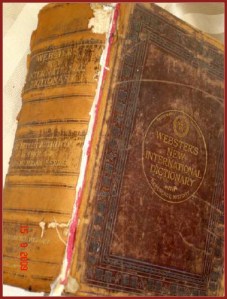
Still, crying is what’s needed today. By a stroke of good fortune, I own of a massive tome, the 1919 edition of Webster’s New International Dictionary (with Reference History), which I rely on to tell me what people were thinking 100 years ago, or longer. I haul the heavy volume from the shelf and open it on the floor of my office more often that you might think. Inspired the other day by a comment by Mark Roques on the Daffy Duck post, I wondered what Webster had to say back in the day about politics.
I found this definition: “politics”: (1) “The science and art of government; the science dealing with the organization and regulation of a state, in both its internal and external affairs…. (2) The theory or practice of managing or directing the affairs of public policy or of political parties; Hence political affairs, principles, convictions, opinions, sympathies….”
Sounds like a pretty important area of life, politics, when put that way. As a Christian who believes that government is ordained by God and that we have obediences to fulfill to God in the realm of government, I thought that Webster’s definitions were pretty noble words to describe how political stewardship of government ought to be understood by citizens and conducted by our elected officials.
To get an opposing view, I turned to a near-contemporary of Webster’s, the influential satirist Ambrose Bierce, who was born in 1842, the year before Wesbster died. I wasn’t surprised to find in his witty Devil’s Dictionary, 1906, a (sadly) more accurate definition of today’s politics: “A strife of interests masquerading as a contest of principles. The conduct of public affairs for private advantage.”
It’s tragic that Bierce’s definition prevails over Webster’s today in America, although high marks to Webster who, in more polite terms, concluded his second definition (above) with these words: “… artful or dishonest management to secure the success of political candidates or parties.”
Ponder Webster’s two definitions. Then think about where we are today and have a good cry. It’s a place to start.
©2016 by Charles Strohmer
A note from Charles: If you want more of the perspectives that Waging Wisdom seeks to present, I want to invite you to follow this blog. Just click here and find the “Follow” button in the right margin, enter your email address, and then click “Follow.” You will then receive a very short email notice when I publish a new post. Thank you.
 “The foreign policy of the personality.” The late
  his. No relationship need stay adversarial or broken or unjust if the redeeming and renewing grace of God is at work in it. So with all these associations and analogies rattling ‘round my brain, I challenged myself: What kind of shape is the foreign policy of my personality in these days? Am I increasingly walking in the redeeming, renewing grace of God with every passing year? I’ve been thinking about this. And there are so many contexts in which to think about it, and to do something about, or not. Husband – wife; parent – child; sibling – sibling; employer – employee; pastor – congregant; congregant – congregant; board member – CEO; neighbor – neighbor – the contexts seem endless.
 The title of this post refers to a sermon I preached last December to the hospitable Evangelical congregation, but I was nervous in the pulpit because I knew it would not be the kind of Evangelical preaching that most Evangelicals would be accustomed to hearing on a Sunday morning. I would not be talking theology. Instead, I had felt compelled to share some biblical insights and personal experiences to indicate ways in which good citizens of all faiths, or no faith at all, have a responsibility to work toward ending “the logic of violence” in this country and replacing it with the peaceable wisdom of God.
 The politically correct (PC) world is organized around the principle that anything and everything is acceptable and everyone must accept that. In short, the PC world seeks to create a world in which there are no offenses (what the Bible calls sins). A huge bureaucratic hierarchy promotes and supports this goal across the spectrum of law-making – socially, economically, educationally, and politically. It is not possible, however, to create a world of no offenses through law.
 Two years ago a national poll conducted jointly by NBC News, the Wall Street Journal, and Annenberg showed that 71 percent of Americans believed that the Iraq war was “not worth it.” That was up from 58 percent a year earlier, in an ABC News and Washington Post poll. Today, if the Republican presidential candidates are any indication, even the GOP, including establishment figure Jeb Bush, believe that invading Iraq was a mistake.
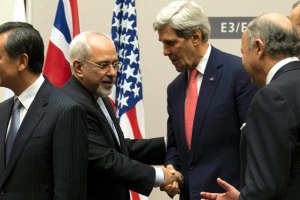 w. It was American diplomatic leadership that mobilized the world to fight ebola, that brought 66 countries together to fight ISIS, that led negotiations to the nuclear agreement with Iran, that brought Cuba in from the cold, and that led to the first peaceful democratic transition of power in Afghanistan. Of course none of this, Blinken added, “has happened as well as it should [or] as effectively as it should.” But, “You take the United States out of any of these pictures [and] it doesn’t happen. We are the single country that has the ability to mobilize and move others more than any other country.”
 In January on this blog,
  As I understand it, the wisdom norm of mutuality does not require people to give up their core beliefs before they can start to build more cooperative and sustainable arrangements with each other (again, provided those beliefs are not organized around violence). The wisdom norm of mutuality does not require a religious or a secular party to ditch its core beliefs before cooperation between them becomes doable. What Lady wisdom does require of them is to turn their eyes to their shared human interests and concerns as human beings made in the image of God.
 Waging Wisdom