“Christmas Carols & Songs”

d-clifton-christmas-albumI’ve never done this before on this blog and may never do it again, but I want to call your attention to some truly superb Christmas music and say, “Buy this album!” My wife and I were recently given it as a gift, and after we heard it we immediately moved it to #1 on our list of Christmas albums.

“Christmas Carols and Songs,” produced and arranged by David Clifton and Mark Russell, with the acclaimed choirs of Peterborough Cathedral, a full band, and the London Telefilmonic Orchestra. The full details of this special album, its history, and how to get hold of the album are available at Little Room Recordings.

You will find your own favorite carol or song on the album. Just to say that mine is the slightly jazzed up arrangement of “O Come, O Come, Emmanuel.” I also got a lot out of the well-researched booklet that accompanies the CD to give a brief history of the origin of each carol.

Link to iTunes download, name your price download, and CD mail order purchase: http://www.littleroom.com/artists/ikos/

Enjoy it for years to come. And Merry Christmas.

©2016 by Charles Strohmer

Predicting the U.S. Presidential Debates

It has been said that only novelists know the future. Even so, I don’t think it’s much of a risk for us to to predict what the debates between Donald J. Trump and Hillary Clinton devolve into. The first of the three scheduled debates begins in a few days, on Monday evening, September 26. For one thing, they will be anything but presidential. Instead, they will be…, well, why wait for Monday? Here’s a sneak peek from the never predictable John Cleese and Michael Palin. This short video from a 1972 Month Python skit tells us what the debates will be like.

A segment from Monty Python’s “Argument Clinic.” Standard YouTube license.

For other posts about Donald Trump and Hillary Clinton, see these, beginning with this one: To Boldly Go: anti-Trump Republicans Speak Up [Jun 11]; Donald Trump Is Wrong about the Founding of ISIS [Aug 12]; A Christian View of Not Voting for Donald Trump or Hillary Clinton [Aug 25]; Is Donald Trump Merely Lending His Name to “America”? [Sept. 16]; Who Lost the First Presidential Debate? [Sept 26].

A note from Charles: If you want more of the perspectives that Waging Wisdom seeks to present, I want to invite you to follow this blog for a while to see if you like it. Just click here and find the “Follow” button in the right margin, enter your email address, and then click “Follow.” You will receive a very short email notice when I publish a new post. Thank you.

Special Announcement – The John Peck Website

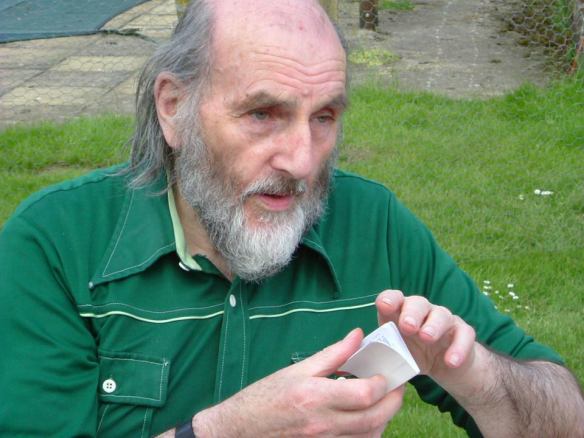
John Peck holding a tiny BibleI am very pleased to announce that a website has been launched to carry the sermons and other talks of late Revd John Peck, British theologian, philosopher, and so much more. Revd Peck was an extraordinary person, family man, preacher, teacher, and mentor to many. To see why people say this, check out this memorial to him.

John and I were close for 30 years. He was my mentor for many of those years, and we collaborated on a number of projects, including co-authoring a book. His sermons and other talks are real gems. You won’t get a rehash of what you already know. So I highly recommend this new site. Have a look-see for yourself, and a listen. I would love to hear your impression of it, and of John.

If you have never heard of Revd Peck, you can get a quick taste by reading his compelling his vision for a vibrant church. Or a bigger drink from this exclusive interview from 1998.

To visit the new site for his sermons and talks.

Thank you.

Photo of John holding a tiny Bible courtesy of Peck estate.

A note from Charles: If you want more of the perspectives that Waging Wisdom seeks to present, I want to invite you to follow this blog. Just click here and find the “Follow” button in the right margin, enter your email address, and then click “Follow.” You will then receive a very short email notice when I publish a new post. Thank you.


©2016 by Charles Strohmer

The Revd John Peck (1924-2016)

John Peck smilingThis is just a short personal note from me to readers of this blog to express my appreciation for everyone’s notes, good wishes, and prayers after hearing news of the death of John Peck, a dear friend and mentor. On July 5, in memory of John, I posted his “I Have a Vision” statement for the church, written nearly 40 years ago, but timeless in essence. We have been astounded at the large number who have read it, liked it, and shared it. Just today, when I thought the sharing had ended, I saw another blogger who had picked it up. Cool.

For those who would like a glimpse behind the scenes at what made John Peck a remarkably admired and sought-after Christian leader and thinker in the UK, and in parts of the US and Europe, the official obituary has captured that. If you would like a taste of his wisdom on a wide range of issues, within and outside church walls, check out this interview with John.

I am also very glad to be able to say that the project to put John’s sermons and other talks on the Web for a new generation should soon be completed. Stay tuned.

That website is now up and running. Here it is.

“If you belong to Christ, then his history has changed what you are.” John Peck, British theologian

©2016 by Charles Strohmer

Photo courtesy of Ann Horn (check out her photographs).

A note from Charles: If you want more of the perspectives that Waging Wisdom seeks to present, I want to invite you to follow this blog. Just click here and find the “Follow” button in the right margin, enter your email address, and then click “Follow.” You will then receive a very short email notice when I publish a new post. Thank you.

“I Have a Vision,” John Peck

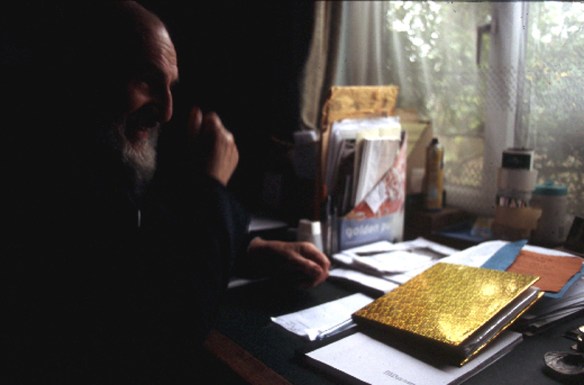
John Peck at his deskSomeone has said that a sunset on earth is a sunrise in heaven. Last week the Rev. John Peck passed away peacefully in his sleep, three days into his 93rd year. A godly, noble man who overflowed with wisdom. A true mensch. A dear friend. I knew John closely for thirty-three years and we collaborated on a number of projects. Since receiving news of his death I have been thinking: how strange it will be not to have this unique outlier in the world with us.

John, who has been called “The Least Known Best Theologian in the World,”* had an exceptional passion for the church. It would be hard to top his lovely and concise picture of a healthy church. It has been printed and framed and hangs on the wall of pastors’ offices. Part of John’s enduring legacy is being experienced today in churches who have taken his vision to heart and found ways to live it. Here is it is in his own words.

I Have a Vision

Of a church whose worship seeks out all the resources of its members and utilizes all their skills.

Where the hymns are sung with zest, perception, and expression, and accompanied by every instrument anyone can play, including hands, and feet, and smiles. And where the unfamiliar music of another generation is learned until it is loved.

A church with liturgies that are never mechanical, and spontaneity that is never trivial.

Where the least of its meetings are conducted like royal appointments, and its greatest days are marked with solemn hilarity.

Where organisational efficiency is always at the service of caring love.

Where even poor efforts are done with painstaking diligence, and commended with tolerant hope.

Where brilliance of mind or skill only serves to light up Jesus Christ and His Gospel; where no one can hog the limelight, no one gets too much attention, and no one gets left out.

Of a church were outsiders get as much welcome as old friends; were no one stands alone unless they need to; where the awkward ones are accepted, and the pleasant ones are disturbed by hard realities.

Where the first to hear a complaint is the offender, and the last to air it is the sufferer.

Where people’s interests are worldwide, without being worldly, and personal without being petty.

I have a vision of a church which shares an invincible passion for learning and giving, whose life is energised by a glad acceptance of the Cross as a way of life.

Whose self-critical humor puts people at ease, and whose self-denials disturb and brace them.

Whose sympathy is so warm and imaginative that no one has the nerve to indulge in self-pity; and whose ideals are so high that slightly soiled notions are shamed into silence.

Whose convictions are firm without being rigid; whose tolerance extends even to the intolerant; whose life is an admonition, whose love learns even from its opponents, and whose faith is infectious.

I have a vision of a church that is like that because from time to time it hears its Redeemer’s voice speak with such authority that nothing will do but obedience, nothing matters but God’s love, and others coming in can only wonder, and wish, and ask. . .

John R. Peck, B.S., A.L.B.C.
March, 1979
Earl Soham, Suffolk, England

*The art historian Karen L. Mulder’s apt description of John Peck.

Image of John Peck laughing courtesy of Karen L. Mulder.

A website has been created to continue the legacy of John Peck’s exceptional teaching ministry to a new generation. Here’s that site.

For more about John Peck, see:

A major interview with John in 1998

Martin Wroe’s tribute

Baptist Times (UK) tribute

Baptist Times extensive obituary

©2016 by Charles Strohmer

A note from Charles: If you want more of the perspectives that Waging Wisdom seeks to present, I want to invite you to follow this blog. Just click here and find the “Follow” button in the right margin, enter your email address, and then click “Follow.” You will then receive a very short email notice when I publish a new post. Thank you.

Faith Seeking Wisdom: A Prophetic Approach to Our Time

child reading a BibleThe title of this post refers to a sermon I preached last December to the hospitable Evangelical congregation, but I was nervous in the pulpit because I knew it would not be the kind of Evangelical preaching that most Evangelicals would be accustomed to hearing on a Sunday morning. I would not be talking theology. Instead, I had felt compelled to share some biblical insights and personal experiences to indicate ways in which good citizens of all faiths, or no faith at all, have a responsibility to work toward ending “the logic of violence” in this country and replacing it with the peaceable wisdom of God.

As I say, I was nervous and misspoke a few times as a result, such as when I used the word “church” but meant “mosque,” though the congregation understood what was meant. I was also nervous because I was, in part, going to contrast the effect that two different kinds of preached messages can have on a crowd toward stirring up or defusing adversarial relations. The one message was from a Christian, the other from a Muslim. I wasn’t sure how this congregation would take to an illustration in which it was the Muslim who got the gold star. So it was a great relief when, right after my talk the pastor of the church took the mic and affirmed the message to his congregation.

This is the first time we’ve put a talk (by anyone) on this blog. It may be the only time! So this is something of an experiment. We don’t know if it will fly. We’ll leave that up to you.

I should also say that because I’m no great shakes as a preacher, I hemmed and hawed about whether to put this talk on the blog. The tipping point came in recent weeks, as I and countless others have with great sadness watched the already heated social and political climate of this country being kindled with inflammatory rhetoric that has now burst forth into physical violence at Trump rallies. My talk is not on that subject, but I think its message is directly related. If it helps even a few listeners just in that regard, it will have been a successful experiment.

To listen to the talk “Faith Seeking Wisdom: A Prophetic Approach to Our Time,” just click the little arrow and you’re away.

©2016 by Charles Strohmer

Image by Samantha Sophia, courtesy Unsplash

The Unforgivable World

Cross on vestThe politically correct (PC) world is organized around the principle that anything and everything is acceptable and everyone must accept that. In short, the PC world seeks to create a world in which there are no offenses (what the Bible calls sins). A huge bureaucratic hierarchy promotes and supports this goal across the spectrum of law-making – socially, economically, educationally, and politically. It is not possible, however, to create a world of no offenses through law.

The effort to try to purge human hearts from offending others through law cannot eliminate their alienating tendencies. The effort will in fact exacerbate those destructive tendencies, which are already implicated in the rising sectarian, adversarial, and conflicted relationships that exist between groups in our time. That a peaceful world could be created by that means is a project doomed to failure.

Offenses, when they arise, must be forgiven: “If you forgive men when they sin against you, your heavenly Father will also forgive you. If you do not forgive men their sins, your Father will not forgive your sins” (Matthew 6:14-15). “Lord, how many times shall I forgive my brother when he sins against me? Up to seven times? Jesus answered, “I tell you not seven times, but seventy-seven times” (Matthew 18:21-22).

Forgiveness is redemptive. When that grace is at work in human hearts, as it is in the gospel, real remedies can be sought across the spectrum of life. I don’t doubt that any number of movers and shakers in the PC world hope that their contributions are accomplishing that. But since “it is through the law that we become conscious of sin” (Romans 3:20), the PC world’s law-making machine in effect makes human beings greater sinners than they already are: “I would not have known what sin is except through the law” (Romans 7:7).

To say it another way, PC philosophy is organized around the delusion of individual and collective self-salvation. It is seeking to create a world that has no need of the gospel, a world, in other words, that is unforgivable, for it would be a world of the unforgiving.

©2016 by Charles Strohmer

Image by Natashi Jay, permission via flicker Creative Commons.

A note from Charles: If you want more of the perspectives that Waging Wisdom seeks to present, I want to invite you to follow this blog. Just click here and find the “Follow” button in the right margin, enter your email address, and then click “Follow.” You will then receive a very short email notice when I publish a new post. And, hey, tell some friends! Thank you.

America’s Quest for Happiness

little girl with balloon 2

“Happiness is desired by all; and moments of it are probably attained by most. Only moments of it can be attained because happiness is the inner concomitant of neat harmonies of body, spirit and society; and these neat harmonies are bound to be infrequent. There is no simple harmony between our ambitions and achievements because our ambitions tend to outrun achievements….

“There are no simple congruities in life or history. The cult of happiness erroneously assumes them. It is possible to soften the incongruities of life endlessly by the scientific conquest of nature’s caprices, and the social and political triumph over historic injustice. But all such strategies cannot finally overcome the fragmentary character of human existence. The final wisdom of life requires, not the annulment of incongruity but the achievement of serenity within and above it.

“The irony of America’s quest for happiness lies in the fact that she succeeded more obviously than any other nation in making life ‘comfortable,’ only finally to run into larger incongruities of human destiny by the same achievements by which it escaped the smaller ones. Thus we tried too simply to make sense out of life, striving for harmonies between man and nature and man and society and man and his ultimate destiny, which have provisional but no ultimate validity. Our very success in this enterprise has hastened the exposure of its final limits. Over these exertions we discern by faith the ironical laughter of the divine source and end of all things. ‘He that sitteth in the heavens shall laugh’ (Psalm 2, 4).

He laughs because ‘the people imagine a vain thing.’ The Scripture assures us that God’s laughter is derisive, having the sting of judgment upon our vanities in it. But if the laughter is truly ironic it must symbolize mercy as well as judgment. For whenever judgment defines the limits of human striving it creates the possibility of an humble acceptance of those limits. Within that humility mercy and peace can find a lodging place.”

Source: Reinhold Niebuhr, The Irony of American History, chapter 3, “Prosperity and Virtue”

©2016 by Charles Strohmer

Image by Samuele Deiana, via flickr.

A note from Charles: If you want more of the perspectives that Waging Wisdom seeks to present, I want to invite you to follow this blog. Just click here and find the “Follow” button in the right margin, enter your email address, and then click “Follow.” You will then receive a very short email notice when I publish a new post. And, hey, tell some friends! Thank you.