
THE RELIGIOUS ROOTS OF AL QAEDA AND ISIS part 3 of 4

arch in blue skyMark Twain is noted for having said that history may not repeat itself but it sure does rhyme. If you were in your early teens or younger between September 11, 2001, when the United States launched its “war on terrorism,” and May of 2003, when the U.S.-led war about Iraq “ended,” you probably had other things to do than to notice the glut of news stories that were on the Web and in the media about ending the threat of terrorism that was coming out of the Middle East.

Such stories, and every conceivable kind of spin-off that can be imagined, from every point of view, dominated the news during that twenty-month period. If you went on the Web to find a sports score or even just tomorrow’s weather, to find what you were looking for you had to plow through any number of stories about defeating al Qaeda, or the war in Iraq, or U.S. airstrikes, and so on. So if you were in your early teens then, just know that today’s profuse news stories about the threat of terrorism, airstrikes on ISIS, and every conceivably related matter is not something new in the world. History is just rhyming. And pray that the following ten years does not rhyme with the ten years that followed the “end” of the war about Iraq.

But today we have a leg up. A huge amount of scholarship that was not available on 9/11 is now available about the religious dimension of what is going on. In this series of posts, I am drawing on that research to help us understand the religious dimension of the threat.

In the Middle East, Sunni Muslim extremists such as al Qaeda and ISIS find a large degree of religious justification for their political and social militancy in the writings of the Egyptian intellectual Sayyid Qutb (1906-1966). An intellectual, schoolteacher, and critic, Qutb, a Sunni Arab, did not turn to radical Islamist ideology until he was in his forties, and in 1951 he joined the Egypt’s Muslim Brotherhood was soon one of its leading figures. We covered this ground in the two previous two posts.

We pick up the story with Qutb’s arrest in Cairo for sedition in 1954. He was sentenced to hard labor in what some have likened to a concentration camp. Except for two short periods, he spent nearly twelve years in prison, where the persuasive communicator studied extensively and wrote many books, including most of his thirty-volume commentary on the Qur’an, In the Shade of the Qur’an. He was executed by hanging in 1966.

sticking pointsWith the Brotherhood’s loss of the al-Banna, murdered by the Egyptian secret police in 1949, Qutb, after joining the organization, became editor of the Brotherhood’s radical newspaper. This gave him a national platform for advancing his growing body of writings, which promoted Islamic ideology, or political Islam (government that follow Islamic principles).

After his death, Qutb’s books (many still available only in Arabic) began having a huge effect on Muslim youth who were coming of age in the 1960s and 1970s. This was not what the Egyptian government expected now that they had Qutb out of the way. This postmortem is another of the curious twists of Qutb’s story. At his trial, passages from his militant-sounding book Milestones were cited as proof of its author’s treasonous intent. Having closely read the book, I can see why, and we will look at that book in a future post. On the other hand, a sustained public outcry arose during the trial from leading Muslims around the world who supported Qutb, and the government’s showcasing of Milestones at the trial backfired. It triggered the book’s publication throughout the Muslim world after Qutb’s death.

Organizations such as al Qaeda and ISIS (or simply IS, the Islamic state) do not come out of thin air, and for the next several posts I want to look carefully at core religious beliefs of Qutb’s political Islam. There we will find a well-thought-out religious ideology that Sunni Islamic militant groups such as al Qaeda and ISIS use to justify their existence. It shows us what the world is up against. And although even President Obama wants to “destroy” ISIS, as he said in his September 10 address to the nation, it cannot be destroyed by military power. For the problem is not merely organizational. It is individual. It is the problem of a gross spiritual disorder of the heart. Here’s why.

Beginning decades ago, for any number of reasons, scores of individuals began adopting a dangerous religious-political ideology that can lead to choosing the violent paths that groups such as al Qaeda and ISIS have chosen to go. These individuals call this the way of jihad. (Many Muslim scholars, for good reason, object to the militants using the word “jihad,” but I am using it because the militants use it of themselves.) Having committed to jihad, they then go to fight for jihad in any way possible in any country, such as individuals did in Afghanistan against Soviet Russia in the 1980s (Osama bin Laden was there and helped to finance that jihad). Osama bin Laden and his al Qaeda group were eventually given safe haven in Afghanistan by the Taliban government in the late 1990s. Other individuals traveled to Chechnya in the 2000s to fight the jihad against the Russians. Others went to fight for jihad in Iraq after the U.S. invasion of that country in 2003, and individuals who have joined ISIS are fighting for jihad in Iraq and Syria.

In short, the heart of the problem is the hearts of the individuals who comprise al Qaeda and ISIS, and although all kinds of different kinds commit to fight for jihad, they find their basic theological and religious unity in the writings of Sayyid Qutb. Of course not everyone fighting for jihad has read Qutb. His writings, however, provide the most comprehensive and well-articulated fundamental rationale for political Islam, or Islamist ideology. And in that rationale the individuals can find their inner unity and, in my view, a way to justify their violence, which they call fighting for jihad.

Qutb’s rationale has been widely disseminated in the Middle East and taken up by individuals who have either read Qutb firsthand or accepted his views through secondary sources, perhaps imams or other preachers. Some understanding of Qutb’s Islamist ideology will help us  understand of what unites the jihadists religiously and theologically as individuals. This heart problem is what ultimately must be addressed if Islamist jihadism in the world is to end. Getting some understanding of it is the first step down that road.

Continued in the next post.

©2014 by Charles Strohmer

Top image by Chris Hagood (permission via Creative Commons)

THE RELIGIOUS ROOTS OF AL QAEDA AND ISIS part 2 of 4

Egyptian dancing girl (unknown)Yesterday in Time online, Pulitzer prize-wining reporter Mark Thompson wrote: “If you’re having a tough time figuring out how much of a threat … ISIS poses to the United States, you’re hardly alone.” A large reason for that widespread lack is because our leaders and the media use the word “ideology” to label the threat but do not explain what that ideology is. It is an Islamist, that is a religious-political, ideology, and we here on this blog we are currently looking at key aspects of it in the influential writings of the Egyptian intellectual Sayyid Qutb (1906-1966), who became a political radical.

After returning to Egypt from two years “exile” in America, Qutb joined the Muslim Brotherhood in early 1950, which immediately gave this persuasive communicator a ready-made national platform to promote his emerging brand of Islamist ideology, or political Islam. Much in the news because of its role in Egyptian politics in 2012, the Islamist organization has had a long and controversial history in Egypt.

Founded in 1928 by Egyptian-born Hasan al-Banna (1906-49), a schoolteacher, the Muslim Brotherhood by the 1940s had grown into Egypt’s leading political alternative. It opposed Western liberalism, international Communism, and the separation of religion and politics. It was socially, religiously, and politically highly activist and promoted Islamic unity, strict modesty, and gender separation. Their slogan, still popular with today’s Islamist movements, was: “The Qu’ran is our constitution.”

In Jihad: The Trail of Political Islam, Gilles Kepel, a Rhodes scholar with a Ph.D. in Islamic thought, writes:

“Islam, for the Brothers, was a complete and total system, and there was no need for looking for European values as a basis for social order. Everything was made clear in the Koran, whose moral principles, the Brothers believed, were universal. This doctrine was shared by the entire Islamist movement, whatever their other views. All agreed that the solution to the political problems facing Muslims lay in setting up an Islamic state that would implement the law of the sacred texts of Islam – the sharia – as the caliph had done in the past.”

Hasan al-Banna had a decisive shaping influence on Qutb’s emerging Islamist worldview. The late-nineteenth and early twentieth century saw the birth of the movement known as political Islam, which preaches a return to the totality of Islam for all of life, including nonseparation of religion and government. Al-Banna had become its most influential proponent after studying the life of Muhammad and his companions and making conclusions about what he thought was the original vision of Islam in its first decades, which al-Banna complained Muslims had lost. Islamic scholar Noah Feldman, in his book After Jihad, writes that for al-Banna and his Muslim Brotherhood

“Islam was not merely a faith but a comprehensive worldview that covered the whole field of human existence…. It provided a blueprint for a just society, organized along Islamic principles.”

Al-Banna laid the guilt for what he called the pre-twentieth century decline of Islam at the feet of Islamic scholars (the ulema), whom he felt had reduced Islam from a comprehensive way of life to religious life only. Feldman continues:

“The mature Banna’s Islam was therefore both political and fundamentalist: political in refusing to be relegated to the sphere of the private or the personal, and fundamentalist in the technical sense that it went back to the most basic, fundamental elements of Islam: the divine message of the Qur’an and the sayings and actions of the Prophet and his followers.”

Al-Banna popularized the term “Islamic” as an adjective to distinguish his worldview from Western and other worldviews, including nationalist Muslim ones. The terms “Islamism” and “Islamist” also arose from al-Banna’s system of thought and, according to Feldman, the two terms were meant to describe “not just Muslims but people who see Islam as a comprehensive political, spiritual, and personal worldview defined in opposition to all that is non-Islamic.”

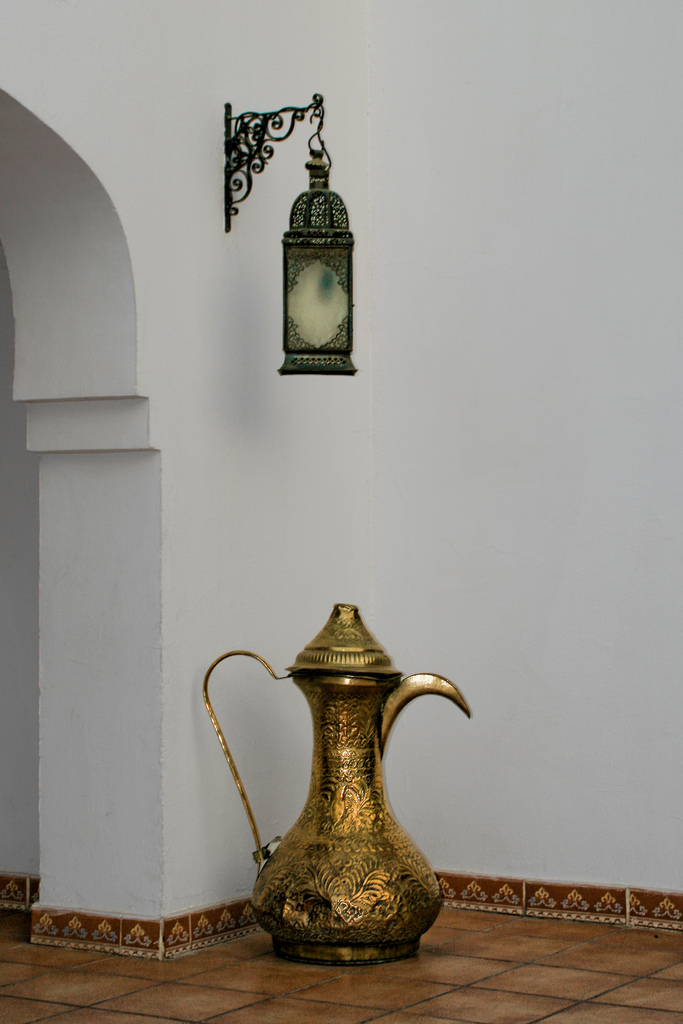
Egyptian lamp and jug (Matt Create)Following Banna’s logic, the Brotherhood became increasingly political and strongly opposed to the British-backed monarchy of Egypt, which, it said, failed to promote Islamic law and government. Al-Banna publicly denounced Egypt’s King Farouk and wrote letters to him demanding the Islamization of Egyptian life. In 1949, when Qutb was in America, al-Banna was murdered by the Egyptian secret police. His sudden death further radicalized Qutb, who, after joining the Brotherhood, quickly gained status as its leading intellectual and the editor of its radical newspaper.

By the time of Gamal Abdel Nasser’s rule (1954-58), the Brotherhood had reorganized as a major political player in Egypt, with chapters springing up outside Egypt, a process that Feldman believes “was the single most important institutional element in the diffusion of political Islam.” Although the Brothers generally sought gradual transformation of Egyptian society through peaceful means, such as through the publication of articles, newspapers, and periodicals, and by supporting social welfare initiatives, such as hospitals, schools, and charities, its reformist tone was edgy if not militant and its potential for violence was occasionally actualized.

During the 1950s, Brotherhood members were arrested for sedition and several of its leaders were executed by hanging after being accused of the failed 1954 assassination attempt on Egyptian prime minister Nasser. The government’s suppression of the Islamist organization then became so severe that many of its key leaders fled to Saudi Arabia, where they were welcomed by the princes, who put them to good use. In Terror and Liberalism, the essayist and critic Paul Berman writes:

“The Saudi princes were determined to keep their own country on a path of pure adherence to Saudi Arabia’s antique and rigid version of Islam [Wahhabism]; and Egypt’s intellectuals, with their stores of Koranic knowledge, had much to offer. The Egyptian exiles [from the Brotherhood] took over professional chairs in Saudi universities. And their impact was large. Qutb’s younger brother, Muhammad Qutb, a distinguished scholar in his own right, fled to Saudi Arabia and became and became a professor of Islamic studies. One of his students was Osama bin Laden.”

Story continues next post.

©2014 by Charles Strohmer

First image (unknown credit), second image by Matt Create (both via Creative Commons)

THE RELIGIOUS ROOTS OF AL QAEDA AND ISIS part 1 of 4

red sunsetThe militancy practiced by extremists such as al Qaeda and ISIS is not irrational, at least not to them. To them, it has a large degree of its religious and intellectual justification in the prolific writings of the Egyptian intellectual Sayyid Qutb, a Sunni Arab who for much of his adult life was more a man of letters than a political radical.

Early adult life. Born in 1906 and educated in Cairo, Qutb received degrees in teacher training and education in 1929 and 1933.  From 1933 to 1949, Qutb served the Egyptian ministry of education as a teacher and school inspector. He eventually resigned over philosophical differences with the ministry and to devote himself full time to writing. During this period, he acquired some Western leanings and had serious interests in poetry and journalism, and he published poems, short stories, essays on social and literary criticism, and books.

But Qutb was not apolitical. He ran with prominent elite intellectuals who had interests in domestic and international politics. During the 1930s, for instance, he increasingly objected to British influence in Egypt’s political life and deplored Jewish immigration to Palestine. Gilles Kepel, a foremost Western scholar on Qutb, writes in Muslim Extremism in Egypt that by 1945, “the principal subject matter of [Qutb’s] articles [had] shifted from literature to nationalism, political events, and social problems.” And Qutb had a growing disillusionment with the West, as we know from a book he wrote in the 1940s, Social Justice in Islam, which I will discuss in a future post. And in 1948, Qutb condemned the founding of the Jewish state.

“Exile” in America. As Qutb’s political writings became more critical of the Egyptian government in the 1940s, his polemics against the Egyptian monarchy infuriated King Farouk, who wanted him imprisoned. Influential friends, however, negotiated a deal in which Qutb, in 1948, went into a kind of voluntary exile in the United States, ostensibly to study the American education system on behalf on Egypt’s Ministry of Public Instruction. Farouk was friendly with Western governments, and according to Kepel “it was hoped that [Qutb] would return a supporter of ‘the American way of life.’” But the complete opposite occurred. Qutb’s time in America was a turning point for him on the road to political radicalism. Two experiences in particular stand out.

The first was what seems to have been a deeper conversion to Islam on the ship that was taking him to America. What specifically took place I have not been able to discover. Essayist and critic Paul Berman wrote in The New York Times Magazine that Qutb showed “that even before his voyage to America, he was pretty well set in his Islamic fundamentalism.” But apparently he was not a regularly practicing Muslim, for Kepel wrote that during the voyage Qutb began praying five times a day and preaching to his coreligionists. At any rate, his heightened sense of religious meaning, and its moral implications, walked off the ship with him on to America soil, where another life-changing experience awaited him.

old churchQutb brought his penetrating mind to bear on American life while he studied and traveled in the States for two years. Although impressed by American technology, he was appalled by much else that he saw, especially American materialism, its sexual immorality, and the freedom it allowed to women. He detested America’s separation of church and state and what he considered the prejudiced way the American press reported on Muslim events in the Middle East. Kepel writes that Qutb was shocked at a country so “devoid of any values that made sense to him.”

Qutb lay the blame at the feet of American Christianity. For instance, while studying at Colorado State College of Education, in Greeley, he attended a church service and the social event that followed, a church dance. Bruce Lincoln, of the University of Chicago Divinity School, writes in Holy Terrors that “Qutb was not disturbed simply by the eroticism he took to be indecorous and improper” – the room, Qutb would later write, “became a confusion of feet and legs; arms twisting around hips; lips met; chest pressed together.” More troubling for Qutb, Lincoln wrote, “and analytically most revealing, was the enabling condition of this offensive spectacle: the disconnection between the preceding ‘religious’ service and the ‘social’ event that followed.”

By the end of his America trip, Qutb had concluded that Christianity had failed in America because it had split religious life off from politics and the rest of life. It was therefore antithetical to the kind of whole-life Islam that Qutb was now practicing. Disgust with American Christianity and American values fueled Qutb’s growing religious and political radicalization. In the next post we will pick up the story of how it crystalized and began having a huge influence on a new generation of radicals in the Middle East, especially Osama bin Laden and al Qaeda, and now ISIS.

Story continues next post.

©2014 by Charles Strohmer

Image by mikelehen & davidecasteel respectively (permission via Creative Commons)

RELIGION AND THE POST-9/11 BIG PICTURE part 2 of 2

storm night skyAs we saw in the previous post, the religious dimension of violence in the Middle East among Muslims is becoming analogous to the Thirty Years’ War between Catholics and Protestants in first half of seventeenth-century Europe. That religious war included shifting alliances, blood-soaked fields, incredible suffering especially of the German peasantry, slow and halting diplomatic initiatives at peace, and the breakup of the Holy Roman Empire. It left much of Europe socially, economically, and politically devastated, as well as an aversion to religion that eventually entailed its removal as an official role in political power. “There are obvious differences,” Richard Haass wrote, “between the events of 1618-1648 in Europe and those of 2011-2014 in the Middle East. But the similarities are many and sobering. [And] as bad as things are, they could get worse.”

Yes, it could get worse. During the past decade in the Middle East, however, there were times when things seemed to be getting better. I am thinking here of the Taliban’s loss of political rule in Afghanistan, a shattered al Qaeda network, the promise of the Arab Spring, and the death of Osama bin Laden. But then the Arab Spring in Egypt was quashed by the Muslim Brotherhood and the military now runs the country. The Arab Spring in Syria was crushed by President Assad and the country plunged into a vicious civil war fueled also by militant Sunni groups from Iraq, including ISIS (an al Qaeda offshoot), entering Syria to fight against the Syrian government, which is supported by Iran.

When U.S. troops left Iraq in 2011, al Qaeda emerged in the country and bloodshed between Iraq’s Sunni and Shia populations escalated and has not ebbed. (Only a small percentage of Sunni – Shia violence in Iraq is reported on our evening news stations.) In 2013 Hezbollah militants (Shiites supported by Iran) entered Syria to fight the Sunnis. And in 2014, the religious militancy of ISIS, which now calls itself simply the Islamic State (IS), has made that of al Qaeda, which has disavowed IS, seem tame by comparison. (ISIS and al Qaeda are Sunni.)

So, yes, it may get worse. Beginning with the next post, and running for several more, I am going to offer a reader’s digest version of my research on the modern history of this religious militancy, and also share my conclusions, some of which may be surprising to many Americans.

One of the things that really puzzled me in the days following September 11, 2001 was the religious belief behind that day’s terrorist attack on the United States. I was born and raised just down the road from Dearborn, Michigan, the world headquarters of the Ford Motor Company. But Dearborn, one of Michigan’s largest cities, is also home to one of the largest Muslim populations in the U.S., and even though I grew up nearby, I never had much contact with Muslims. And because Dearborn was a quiet, middle class community, including its large Muslim population, I did not “get” the notion of Islamic militancy and 9/11. So in the aftermath, I began researching why people were saying that Islam was implicated in 9/11. Honestly, I was shocked at what I eventually discovered about what Osama bin Laden and his al Qaeda operatives believed. But having learned that, the social and political goals of ISIS, and its brutal violence, do not surprise me.

But let me add this caveat, which is so rarely reported by the American media that many Americans are ignorant of it. There is an ideological war occurring in Islam between scholars and imams of the Muslim reform movement (broadly so-called) and extremists such as al Qaeda and ISIS, who promote militant interpretations of Islam, and this is an internal struggle within Islam for the hearts and minds of Muslims in the Middle East.

There are many kinds of reformers, and I am only generalizing, but as I have written elsewhere (here and here), the reformers see Islam as a flexible, nondogmatic religion adaptable to the contemporary world while remaining faithful to Islam – not unlike many Western Christians feel about their faith. Some reformers even call for the separation of mosque and state. This growing Muslim reform movement must be kept continually in mind, and I may talk about it at times, as we work our way through the following posts on the nature and goals of radical militants such as ISIS, who see the reformers as apostates and enemies who must be killed.

The next post begins discussion on core beliefs of al Qaeda and ISIS.

©2014 by Charles Strohmer

Image by blainecourts (permission via Creative Commons)

RELIGION AND THE POST-9/11 BIG PICTURE part 1 of 2

sunsetOkay. I promised a post about the post-9/11 big picture. This is not an exact science. If you ask several artists to paint the same landscape, you will get several perspectives of it. Ask several analysts to describe the post-9/11 world and they will paint different pictures of it for you. And, as everyone knows, the picture has been changing dramatically many times, sometimes shockingly, over the past thirteen years, since the Taliban and al Qaeda were booted out of Afghanistan at the end of 2001. So approaching this topic with some humility of mind is, I think, required. The past is history and only novelists know the future. Today’s picture may not be tomorrow’s reality.

In broad brush strokes, then, the current picture includes at least the following: the Middle East policies of the United States, European states, Russia, and Israel; diplomatic initiatives; military interventions; widespread internecine Sunni/Shia violence in Iraq; the “civil” war in Syria; the unresolved Israel/Hamas dilemma; heightening tensions between Arab states and Persian Iran; fears about Iran’s nuclear intentions; the rise and geographic spread of ISIS (Islamic State of Iraq and Syria); the plight of millions of refugees who have fled Iraq and Syria; and the forming of unbelievable political alliances to deal with threats such as ISIS.

The picture has become so bleak and is now running with so much blood that respected senior statesmen and military advisers have publicly alluded that social and political chaos in the Middle East is the new normal. There has, of course, been chaos in the world in previous eras, but this time, they say, it’s chaos with a difference. For instance, Zbigniew Brzezinski, a former U.S. National Security Advisor, said in Foreign Policy magazine that the chaos that has broken out is the kind that governments are less capable of handling than they were, say, during the aftermaths of the two world wars of the twentieth century.

Statements like Brzezinsi’s have been alarmingly heightened in meaning by statements from Chuck Hagel, U.S. Secretary of Defense, and General Martin Dempsey, chairman of the Joint Chiefs of Staff. With the rampaging hellhounds of ISIS having carved out for themselves large swaths of Iraq and Syria, holding key cites in both countries and continuing their savagery, a consensus has emerged in Western and Middle Eastern capitals that ISIS has become everyone’s archenemy.

sunset 2 (mikelehen)Referring to ISIS (it now calls itself simply the Islamic State, or IS), Hagel recently said that “this is beyond anything we have seen.” ISIS is “beyond just a terrorist group.” They are an “imminent threat to every interest we have, whether it’s in Iraq or anywhere else.” (Joshua White, formerly a senior adviser in the Secretary of Defense’s office, and now at the Stimson Center, pointed out that the word “imminent,” as used here by Hagel, probably “signals justification of military force.”) Major General Paul Eaton, a senior adviser at the National Security Network, has said that the “ISIS foreign policy problem trumps other American interests in the world,” and so the Obama administration needs “to assign as its main foreign policy effort, the defeat of ISIS.”

ISIS may not be the main foreign policy effort of the United States but the defeat of ISIS is now a top priority. President Obama, John Kerry, the U.S. Secretary of State, and Hagel just spent time in Wales drumming up EU support to deal with ISIS. This includes, significantly, an anti-ISIS coalition of ten NATO states. In Wales, President Obama stated that the object is to “degrade and ultimately destroy” ISIS. Apparently, a plan will be forthcoming by the time the U.N. General Assembly convenes on September 14 in New York City.

Policy aside, General Dempsey’s recent language is quite revealing. ISIS, Dempsey said, has “an apocalyptic, end-of-days strategic vision [that] will eventually have to be defeated.” The word “apocalyptic,” of course, has a strong, ominous religious connotation. Coming closer to the religious mark, in my view, is no less a foreign policy heavyweight than Richard Haass, the President of the Council on Foreign Relations, who titled a recent article “The New Thirty Years’ War,” in which he explains that the conflict between extremist Sunni and Shia in the Middle East has now reached such a pitch of violence that it has become analogous to the devastating religious war between Catholics and Protestants in first half of seventeenth century Europe. Haass is the first high-level foreign policy expert I know of to publicly argue this, although in the article he does not ponder the implications very much.

The big picture in the region, then, is also a modern-day religious war between extremist Sunni and Shia in the region. It is a huge factor in what a secularized media and many politicians typically portray – employing a less volatile image – as a “sectarian conflict.” The implications are huge, and I want us to spend some time with this beginning in the next post.

©2014 by Charles Strohmer

Images by Fr Antunes & mikelehen respectively (permission via Creative Commons)

A Meditation on the Legacy of Wisdom

flower blooming in water

                                       A Meditation on the Legacy of Wisdom

                                “Teach us to number our days, that we may apply
                                        our hearts to wisdom.”  Psalm 90:12

Like all legacies, the legacy of wisdom is bequeathed by narrative. According to the Bible, there are ultimately two narratives of wisdom. One, and it came first, is traced to the wisdom of God that conceived of and gave birth to a world originally a place of peaceable, flourishing creational and human diversity (Ps. 104:24; Prov. 8:22-31).

The other, the Bible calls the wisdom of the world (1 Cor. 1-2). It is traced to the narrative of self-centered human wisdom (Gen. 3:6; James 3:14-18). Handed down to us from our original forebearers, it subjected creation to futility and decay (Rom. 8:20-21) and then spilled its own blood. Then, incredibly, it went as far as it is humanly possible to go. It spilled the blood of Jesus Christ, the agent of God’s wisdom.

Today we despair at the sight of our sophisticated, Olympian practice of worldly wisdom. Increasingly the brokenness and violence of its grossly distorted heroism bedims signs of the persistent narrative of God’s peaceable wisdom astir in our midst.

Yet look! There it is. Here it is. Over there, too. Christ active in the world with his gospel-shaped wisdom repairing human brokenness. The Savior alive among us with his redeeming, renewing, and restoring grace. And those participating in it – if only in some poor way and often against great odds – look closely at them. In them you will see narratives true to the legacy of God’s peaceable wisdom.

Prayer: O Lord, help us in our weakness. Strengthen me with grace to choose your peaceable wisdom for the decisions I will make today, that I may transmit a legacy to others that pleases you in the end.

©2014 by Charles Strohmer

Image by -Reji (permission via Creative Commons)

A ROOMFUL OF VERY DAMAGED PEOPLE

I forgive youWhile I am finishing preparing the menu items for the post-9/11 “big picture” posts (nearly there), I thought I would share this utterly amazing story out of the Middle East with you, on forgiveness and redemption. It takes place in a small roomful of very damaged people.

The context in which they say they are sorry shamed me for hugely lesser offenses that I find difficult to forgive. And kudos must go to the interviewer – she kept probing and got this story out, perhaps despite how she hoped the interview would go.

This is no ordinary extraordinary story for forgiveness, so I think I should say that you need 40 minutes of quiet time – alone or with others – if you want to experience it as a redemptive moment, which starts building momentum about 14-15 minutes into the story. The next 20 minutes are stunning. A holy moment, really. So if you are just going to have the story playing in the background while you’re busy doing other stuff, well, you’re certainly free to do that, and I don’t want to sound tetchy, but why insult to the people in the room?

Maybe more of us should say we are sorry. Here’s the story.

Image by quantumlars (permission via Creative Commons)
The Governance of “Sar Shalom”

lioin and lambIn February 2012, former Senator Rick Santorum made headlines in a controversial statement criticizing President Obama’s worldview. Santorum was running for the Republican nomination for President of the United States. Although his comment puzzled many news analysts, it was clear to many Christians that Santorum had implied that the president’s worldview was not sufficiently biblical to ensure wise political direction for the country. It’s far too easy, however, for us Christians to kick back and assume that we have a thoroughly biblical worldview about politics.

But let’s reflect on that assumption. Our country is poised for long, tedious, and potentially heated political campaigns to begin for the Republican and Democrat nominations for President of the United States. So this seemed like a good moment to press pause and reflect.

As followers of Jesus Christ, we need to ask ourselves how consistently do we see political life through the eyes of Jesus? How much of our political wisdom, to put it in words of Colossians 2:8, depends on the basic principles of this world rather than on a philosophy based on Christ?

More pointedly, through what filter do we interpret domestic and international issues and events, prescribe policies, engage with our political opponents – and elect presidents? Blue? Red? Liberal? Conservative? Libertarian? The mainstream media? Talk radio? The blogosphere? “Wisdom” is a good biblical word I often use as a replacement for “worldview,” and far too much of our wisdom, I believe, relies on American attitudes and allegiances rather than on Christ. Here’s why.

Jesus had a strange view of politics, at least according to American lights today. Think with me for a moment about the Palestine of his day and how he handled it. Ancient Palestine was not a land filled only with Jews. It was a land of great diversity. For one thing, Palestine was part of the Roman Empire, which was the superpower of the time, and, like all superpowers, you could not escape the presence of the Roman military, its legions, and soldiers.

Besides military personnel, Jesus’ audiences could at any time have included any cluster of ethnic, social, religious, political, and occupational vested interests and conflicting agendas that were daily in close contact with one another – Jews, of course, but also Romans, Greeks, religious leaders of various stripes, government officials, political zealots, a magistrate’s political spies, apostates, pagans, philosophers, fishermen, soldiers, tax collectors, lawyers – you name it. That land was not unlike the pluralism of our major cities today.

What can we learn from our Lord in the midst of all this human diversity, with its competing and conflicting interests and agendas? For one thing, we know what Jesus did not say in the Gospels. When people came to him seeking wisdom, Jesus did not regurgitate the vested interests, sectarian agendas, or partisan politics of the region’s economic and political powers, or those of the pundits in the media or on talk radio. He never told them, “Just get better at it; you’re being inconsistent.” Jesus did not say such things because he knew that their adherence to such views was what had landed them in the broken relationships and troubled situations they had come to Jesus to repair.

Neither did Jesus affirm the views that people might have been accustomed to hear from their religious leaders. Nor did Jesus – as many were doing – promote Greek philosophy or faithfulness to Roman ideology, any more than, today, he would align himself with American Exceptionalism or any other form of nationalism, be it Russian, Chinese, or Middle Eastern.

And when Jesus taught the crowds, he did not tell people that it would take becoming a Sadducee, or a Pharisee, of a Democrat, or a Republican, or even a Jew or a Christian, before they could have their broken relationships and troubled situations changed.

Instead, to his mixed audiences, whoever you were, Jesus taught such things as:

Don’t repay anyone violence for violence
Settle matters quickly with your adversary
Go the extra mile
Turn the other cheek
Stop throwing stones
Drop the hypocrisy
Repent of your to violence
Forgive, forgive, forgive
Love you enemies even

And I can image Jesus at times saying: If you hold a career in politics you are not precluded from this way of seeing and doing. No wonder Jesus’ teaching seemed strange!

white doveWhat’s going on? In short, Jesus was teaching people to apply God’s peaceable wisdom of shalom across the whole of life in their pluralist situations, with those who were different from them. Jesus called civic officials, religious leaders, and government authorities, not to mention ordinary folk, to commit themselves to shalom – to social, economic, and political well being. This meant not just shaking off dehumanizing habits of the heart as individuals but as communities, thereby creating opportunities and possibilities for living cooperatively and peaceably with one another amid the diversity of their land. This vision for life, as we have considered elsewhere, is a normative understanding of the biblical wisdom tradition.

Now the opposite of shalom is not war but brokenness, whether economic, social, or political. And as Rabbi Arnold Resnicoff once explained to me, “There is no shalom, even if bullets are not flying, if hearts, minds, and souls, or even dreams, are still broken. We, as God’s partners (according to Jewish theology), must help mend and repair the brokenness of the world.”

His use of the word “repair” was a deliberate reference to the Hebrew phrase tikkun olam, which means “repairing the world.” The phrase appears in many contexts in rabbinic literature for influencing both Jewish communities and the world at large toward societies of love, peace, justice, kindness, generosity, and suchlike – seen by some as a kind of rehearsal in this life for the anticipated Messianic age of shalom (creational and human well-being, wholeness, or flourishing).

Making possible shalom between God and human beings, and therefore between human beings themselves, is what Jesus died for. He was offering the peoples of Palestine samples of shalom with God throughout his itinerant ministry on the hillsides of Galilee and in the towns of Judea. So here’s how you do it, said Jesus the wisdom teacher to his mixed audiences. Follow my lead and you will create samples of the anticipated future of shalom in the here and now. It’s doable, he said, if you see it through the filter of God’s peaceable wisdom and act accordingly.

Peace with God and with others, across the spectrum of life, is what the governance of Sar Shalom is all about. Sar Shalom (Prince of Peace) is one of the stunning titles for the Messiah given in Isaiah 9:6:

“For unto us a child is born, to us a son is given, and the government will be on his shoulders. And he will be called Wonderful Counselor, Mighty God, Everlasting Father, and Prince of Peace.”

“Prince of Peace” is Sar Shalom in the Hebrew Bible. And notice that the context is “government,” of which the next verse adds:

“Of the increase of his government and peace [shalom] there will be no end.”

A “sar” was a ruling or governing official, such as a prince or a king. The plural of sar is sarim, as used in the Hebrew Bible to refer a king’s high-level officials and advisers,
who are to rule wisely (Proverbs 8:16) and with righteousness (Isaiah 32:1). But here in Isaiah 9:6, the word is singular, “Sar,” a Prince (or King) who is given the title Sar Shalom.

A philosophy based on Christ giving direction to our politics, it seems to me, then, takes personally and very seriously Jesus’ call to shalom. Of course we are not only inconsistent at living this calling but at times fail miserably, so as part of our Christian discipleship we must steadily identify and exorcize from our wisdom (worldview) whatever voices, values, attitudes, and influences conflict with the peaceable way of wisdom that comes from above (James 3:17).

Shalom is God’s love offered to us for political life in this world amid its diversity. Does this seem strange to us today? I hope so.

Upon hearing it preached by Jesus and seeing it demonstrated, people “were amazed at his teaching, because he taught them as one who had authority, and not as their teachers.” Dumbfounded, they asked, “Where did this man get this wisdom?” (Matthew 7:29; 13:54). Yes, where?

©2014 by Charles Strohmer

Images by Mike Quinn and hapal respectively (permissions via Creative Commons)