Who Lost the First Presidential Debate?

Hilary Clinton & Donlad TrumpPolitical pundits today want to know “who won the debate?” It’s the wrong question. Who lost the debate? That is the question. And the answer is? The American people lost the debate.

For this first of three debates, moderator Lester Holt framed the debate in three broad categories: “America’s Direction,” “Achieving Prosperity,” and “Securing America.” It sounded promising to me. In more normal times, the event would have entailed a rousing debate between two presidential candidates in which they contrasted their policy plans for those three areas so that the American people could have some clearer ideas by which to help them decide who to vote for on November 8.

But not between Donald Trump and Hilary Clinton. Oh no. In more normal times, a little sniping at each other between candidates is to be expected, and often couched in a little humor. But not this time. Oh no. Instead, Clinton and Trump spent most of the 90 minutes getting under each other’s skin, poking at raw, sensitive areas in each other’s lives, and then replying with cutting retorts to try to save the moment.

Both candidates have said so many horrible things about each other in the past and are implicated in so many very questionable activities, that this first debate became all about that stuff – i.e., about their personal lives – instead of about the America people – the very people they say they say want to represent and help when they set up shop in the Oval Office.

That’s all I want to say, really. We the people lost. That is the story of the first debate. It is the outcome of having the two most unpopular presidential candidates in modern history. It is sad, very sad. And sadder still is that it is a reflection of us, the American people. May God have mercy on us.

©2016 by Charles Strohmer

Image courtesy of scienceblogs.com

For other posts on this blog about Donald Trump and Hillary Clinton, see these, beginning with this one: To Boldly Go: anti-Trump Republicans Speak Out [June 11]; Donald Trump Is Wrong about the Founding of ISIS [Aug 12]; A Christian View of Not Voting for Donald Trump of Hillary Clinton [Aug 25]; Is Donald Trump Merely Lending His Name to “America”? [Sept 16]; Predicting Presidential Debates [Sept 23].

Predicting the U.S. Presidential Debates

It has been said that only novelists know the future. Even so, I don’t think it’s much of a risk for us to to predict what the debates between Donald J. Trump and Hillary Clinton devolve into. The first of the three scheduled debates begins in a few days, on Monday evening, September 26. For one thing, they will be anything but presidential. Instead, they will be…, well, why wait for Monday? Here’s a sneak peek from the never predictable John Cleese and Michael Palin. This short video from a 1972 Month Python skit tells us what the debates will be like.

A segment from Monty Python’s “Argument Clinic.” Standard YouTube license.

For other posts about Donald Trump and Hillary Clinton, see these, beginning with this one: To Boldly Go: anti-Trump Republicans Speak Up [Jun 11]; Donald Trump Is Wrong about the Founding of ISIS [Aug 12]; A Christian View of Not Voting for Donald Trump or Hillary Clinton [Aug 25]; Is Donald Trump Merely Lending His Name to “America”? [Sept. 16]; Who Lost the First Presidential Debate? [Sept 26].

A note from Charles: If you want more of the perspectives that Waging Wisdom seeks to present, I want to invite you to follow this blog for a while to see if you like it. Just click here and find the “Follow” button in the right margin, enter your email address, and then click “Follow.” You will receive a very short email notice when I publish a new post. Thank you.

Is Donald Trump Merely Lending His Name to “America”?

Donald Trump & White HouseHaving recently returned from three weeks in England, I can tell you it was a relief not to be Trump-blitzed everyday by the media. But I’ll also tell you this. When conversation in my home-away-from-home turned to American politics, as it frequently did, not one person I spoke to – and I was with many different kinds of people in varied contexts and cities – was a fan of the Trumpster.

In the interest of full disclosure, I should add that most had concluded that Hillary Clinton was no great catch either. And among some that I met, I heard a wryly spoken running joke: “Until June, we used to take pride in not being as divided as America. But now we have Brexit.” Welcome to the club, I’d reply. You guys import too much stuff from America! Misery loves company.

Anyway, I’m back home and again running for cover. But I did happen to catch a most enlightening piece of television journalism the other day about Donald Trump’s so-called business acumen that made me take notice. It speaks for itself, so I’m not going to comment on it. I’m just going to quote the speakers. All I want to say, first, is that it left me with the title of this article: “Is Trump Merely Lending His Name to ‘America’”?

During the September 8, 2016 PBS-TV NewsHour program, correspondent William Brangham talked with Mark Fisher and Tim O’Brien. Fisher is senior editor of The Washington Post and co-author of Trump Revealed: An American Journey of Ambition, Ego, Money, and Power. O’Brien is executive director of the international news agency “Bloomberg View” and author of Trump Nation: The Art of Being the Donald. Both have extensive knowledge of Donald Trump and his business dealings over many decades, and O’Brien is one of the few journalists who has actually seen some of Trump’s tax returns.

O’Brien doesn’t think Trump will release his tax returns “because I think they will go towards offering substantiation around a bunch of things that Trump has made central to his political campaign: his track record as a business person, how charitable he is as a philanthropist, his operations overseas, and the kinds of business and financial conflicts that could potentially come to bear on him should he end up in the oval office.”

Specifically, however, Brangham pressed the two journalists for some understanding about what we should conclude from Trump’s decades’-long roller coaster ride with his many and varied businesses, for Trump talks about his successes but he’s also had terrible failures, including many bankruptcies. It was Fisher’s and O’Brien’s replies that made me take notice; after all, what did I know, really, about Trump’s business history?

We know a lot about Hillary Clinton’s long, diverse political history – the good, bad, and ugly – so we can therefore make an informed conclusion about what that might mean for America if she were elected President. But about Trump’s long, diverse business history, what do most of us really know? On this question, I found Fisher and O’Brien offering a major piece of of the picture. And what might that mean if he were elected President?

Fisher and O’Brien both pointed out that in recent decades Trump has changed his business model. Instead of organizing and running businesses, which were many and varied and included taking on a lot of debt, and which had both successes and terrible failures, including many bankruptcies, Trump, said Fisher, has been “taking on less debt and less risk. [Now] he essentially rents out his name and uses others to take the risk – investors and others – so he merely rents out his name and gets a guaranteed income stream from that.”

O’Brien confirmed that. “The Donald Trump of the ‘80s and ‘90s,” he said, “was essentially a creature of debt. The last time he really operated a large business that involved complex financial and management decisions was when he was running his Atlantic City casinos, which he essentially ended up running into the ground. He put those through four separate corporate bankruptcies. And he almost went personally bankrupt in the early 1990s. And the Trump who emerged from that is essentially a Trump who is now a human shingle, as Mark said. He oversees a licensing operation where he puts his name on everything from mattresses to men’s underwear to vodka and buildings. And he’s got his golf course development operation, and then essentially a self-promotion publicity machine that made itself most visible during the ‘Apprentice’ years.”

To me, this was enlightening. It’s certainly not an unlawful business practice – lending his name to products. And it’s making the billionaire tycoon more money. Fair enough. But it said to me: “Donald J. Trump businessman” is certainly nothing like the image of a Henry Ford or a Steve Jobs or a Nelson Rockefeller (41st U.S. Vice-President). Instead, I was left wondering: is Trump going after the U.S. presidency to lend his name to “America,” like he has done to other products he wants to hawk for personal profit? Is he letting “America” take all the risk? Why not? That is his business. I want to see him asked these questions during one of the presidential debates, which start September 26.

For more than 100 years, U.S. presidents – Democrats and Republicans – have been increasingly running the United States like a business enterprise rather than a political community. Like them, Trump as president of “America” would amplify this fundamental problem of our nation, big time. During an ABC-TV 20/20 interview (Friday night, Nov 20, 2015), before he won the Republican nomination, Trump was asked what he would do should he lose in November. He admitted it was possible, noting that he was up against many “not stupid people.” He then quickly added, “What’s next? I go back to what I was doing.” It’s an answer that speaks volumes.

Image via VAZVorpal Creative Commons

©2016 by Charles Strohmer

For other posts about Donald Trump and Hillary Clinton, see these, beginning with this one: To Boldly Go: anti-Trump Republicans Speak Up [Jun 11]; Donald Trump Is Wrong about the Founding of ISIS [Aug 12]; A Christian View of Not Voting for Donald Trump or Hillary Clinton [Aug 25]; Predicting Presidential Debates [Sept 23]; Who Lost the First Presidential Debate? [Sept 26].

A note from Charles: If you want more of the perspectives that Waging Wisdom seeks to present, I want to invite you to follow this blog for a while to see if you like it. Just click here and find the “Follow” button in the right margin, enter your email address, and then click “Follow.” You will receive a very short email notice when I publish a new post. Thank you.

The Kindness of Strangers in a World of Pain

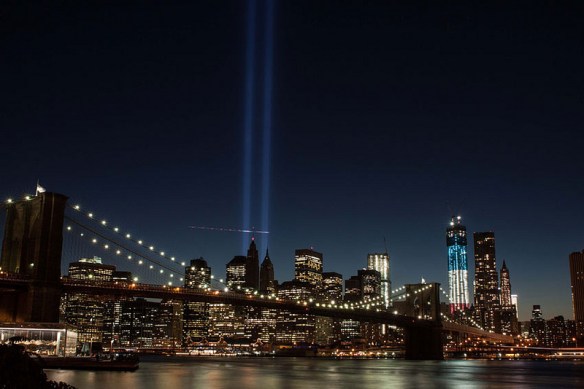
Twin Towers laser memorialIt began this way, 35,000 feet above the Atlantic, flying from London to Atlanta:
“The Boeing 777 droned on. Five hours to go before touchdown in Atlanta. Suddenly everyone’s attention locked on to the Texas drawl coming from the intercom. ‘Ladies and gentlemen, this is your captain speaking. May I have your attention. Your serious attention.’ The dreaded words. Worst nightmares sprung from the fuselage, the overhead compartment, the unconscious –  wherever you had stowed them before boarding. A kind of holy moment spread through cabin. No one spoke. No one dared. It seemed much longer than the millisecond it took before Captain William’s steady but troubled Texas drawl continued: ‘There’s been a major incident in the United States and all air space throughout the nation has been closed….’”

With all the reporting of criminal behavior, hate, violence, and terrorist acts that get dished out to us by the media everyday, I thought it would be good to take a break today, on September 11, and reflect on what is possible when we rely on the better angels of our nature to rule our actions. I was blessed to experience this in a hugely moving and inspiring way fifteen years ago over a five-day period that began the morning of another September 11. An essay I wrote about it was later published in magazines in the US and the UK for the one year anniversary of 9/11.

The above quote is from the beginning of that essay, which soon moves from the shocking and frightful to what is redemptively possible from the milk of human kindness in the face of great evil. For five days, I and hundreds of other “strandeds” were cared for by strangers where “selfish interest and alienation were transformed into opportunities for self-denial, cooperation among the different, unity in our diversity. A depth of compassion and caring had been awakened in us that I don’t think we knew we carried within, amid our wood, hay, and stubble. Heaven broke in and walls broke down between races, professions, classes, nationalities. Human suffering tasted something sweet of the saving grace of God as strangers became neighbors.”

If pain and murder is just a click away, why not grace and healing? Just click here to read the full essay.

Image courtesy Creative Commons.

©2016 by Charles Strohmer

Donald Trump is Wrong about the Founding of ISIS

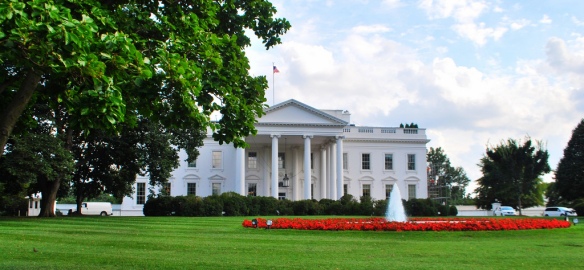
the White HouseMost people had forgotten all about it, but Republican presidential nominee Donald Trump recently revived a comment he had made in January, stating that President Obama was the founder of ISIS. “President Obama. He’s the founder of ISIS,” Trump said at a campaign rally in Florida on August 10. Apparently he did not want anyone to mistake his point, for he immediately added: “He’s the founder of ISIS. He’s the founder. He founded ISIS.” Then he added: “I would say that the co-founder would be crooked Hillary Clinton.”

Asked about his comment in interviews the next day, Trump did not back down. To conservative talk show host Hugh Hewitt, who seemed to be fishing around with Trump to try to find a way to soften Trump’s language, Trump said, “No. I meant he’s the founder of ISIS. I do. I don’t care. He was the founder.” It seems a ridiculous waste of time to have to state the obvious: President Obama did not found ISIS (see below). But Trump’s handle on foreign policy lends itself to the ridiculous.

Now I hold no brief for the CIA, but you really should read this New York Times op-ed by Mike Morell, the acting director and deputy director of the CIA from 2010 to 2013. No matter what you think of the CIA, it’s clear that one thing they do well is to identify vulnerabilities in people and exploit them. With that in mind, keep in mind that for months Trump has been singing various praises of Russian President Vladimir Putin (see this link also).
In his op-ed., Morell explains why.

He reminds us that Putin was a career intelligence officer, skilled at identifying people’s vulnerabilities and exploiting them. Noting Trump’s “obvious need for self-aggrandizement,” Morel writes that “[t]his is exactly what [Putin] did in the primaries. Mr. Putin played upon Mr. Trump’s vulnerabilities by complimenting him. He responded just as Mr. Putin had calculated.”

Egyptian lamp and jug (Matt Create)In his op-ed, Morrell also argues persuasively why Trump is not only unqualified to be President but that he has already posed a threat to U.S. national security. A few days later, Morell was on the Charlie Rose television show for a major interview, in which he explained in great detail why he wrote the op-ed. You owe it to yourself to listen closely to that interview.
But to return to Trump’s ignorance about the founding of ISIS… I wrote a series of articles for this blog two years ago that traced a large and important branch of the roots of ISIS back through al Qaeda and Osama bin Laden to the militant vision of Sayyid Qutb, a radicalized Egyptian intellectual in 1950’s Egypt. Never heard of Sayyid Qutb? Apparently neither has Donald Trump.

So, having suggested that you take time to read the above links and listen to Mike Morell on Charlie Rose, now I’m going to give you some more homework. For a crash course on what Trump doesn’t know about the religious-political roots of ISIS, set aside time to read this series of articles. It will take you about an hour, but it will be time well spent.

Here’s the first one in the series. They are all linked, so you can read through them at your own pace, or skip through them to find those that interest you. And lets talk about this along the way. The Comments area for those articles is open. I hope this helps you. If it does, do forward this post to your friends. This issue is too important to let an outrageous falsehood hang in the air unaddressed, as if it were true.

©2016 by Charles Strohmer

Images by Adam_Inglis (top) and Matt Create (lower) from Creative Commons.

For other posts about Donald Trump and Hillary Clinton, see these, beginning with this one: To Boldly Go: anti-Trump Republicans Speak Up [Jun 11]; A Christian View of Not Voting for Donald Trump of Hillary Clinton [Aug 25]; Is Donald Trump Merely Lending His Name to “America”? [Sept 16]; Predicting Presidential Debates [Sept 23]; Who Lost the First Presidential Debate? [Sept 26].

A note from Charles: If you want more of the perspectives that Waging Wisdom seeks to present, I want to invite you to follow this blog for a while to see if you like it. Just click here and find the “Follow” button in the right margin, enter your email address, and then click “Follow.” You will receive a very short email notice when I publish a new post. Thank you.

To Boldly Go: anti-Trump Republicans speak up

Crative Commons image“[T]here are certain standards more important than one year’s election. There are certain codes that if you betray them, you suffer something much worse than a political defeat. Donald Trump is an affront to basic standards of honesty, virtue and citizenship. He pollutes the atmosphere in which our children are raised. He has already shredded the unspoken rules of political civility that make conversation possible. In his savage regime, public life is just a dog-eat-dog war of all against all.”
That’s conservative Republican David Brooks in his New York Times editorial “No, Not Trump, Not Ever.” The widely-respected columnist and a commentator for NPR, who also teaches at Yale, is challenging Republican politics even if it costs him some readers.

“[Reinhold] Niebuhr always said politics is the art of making choices between relative goods and lesser evils. [When they hear me say that, people say], ‘Oh I hadn’t thought of that. Okay, now I can vote Romney or McCain or, you know, Bush Sr. over Dukakis.’ [But that was then.] I am now here to announce to you this doesn’t work anymore. If the candidates are Trump and Hillary, Niebuhr’s quote goes out the window. I see no good option between either one of them.”

That’s Evangelical Republican Michael Cromartie, speaking at the University Club in Washington, D.C., during a lunchtime discussion hosted by the Institute on Religion and Democracy. Cormartie holds a nationally influential position as vice-president of the Ethics and Public Policy Center, where he directs both the Evangelicals in Civic Life and Faith Angle Forum programs.

Brooks and Cromartie are but two of the trusted public voices speaking out within well-informed understandings. Knowing of both men’s moderation, I was at first surprised at, but then grateful for, their very frank and bold public opinions about Trump, for these are desperate times in our country.

The two above quotes are but mild excerpts from their opinions. Their detailed and resolute “not-Trump” convictions are well worth your time to read and ponder.

Here is Cromartie’s comments. Here is Brooks’s editorial.

Let’s have some conversation about this in the Comments area. But keep it civil or you won’t be heard. ‘Nuff said!

©2016 by Charles Strohmer

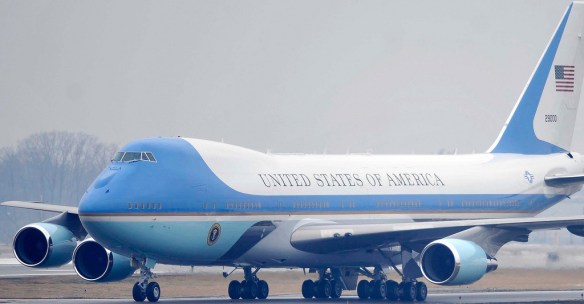
Image of Air Force One courtesy of Creative Commons. Who will next fly the world in its executive luxury?

For other posts about Donald Trump and Hillary Clinton, see these, beginning with this one: Donald Trump Is Wrong about the Founding of ISIS [Aug 12]; A Christian View of Not Voting for Donald Trump of Hillary Clinton [Aug 25]; Is Donald Trump Merely Lending His Name to “America”? [Sept 16]; Predicting Presidential Debates [Sept 23]; Who Lost the First Presidential Debate? [Sept 26].

A note from Charles: If you want more of the perspectives that Waging Wisdom seeks to present, I want to invite you to follow this blog for a while to see if you like it. Just click here and find the “Follow” button in the right margin, enter your email address, and then click “Follow.” You will receive a very short email notice when I publish a new post. Thank you.

“Politics”: Noah Webster v. Ambrose Bierce

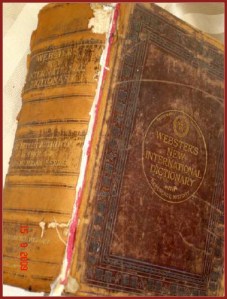
Webster's DictionaryIn a song by Sting, one of the world’s more intelligent singer-songwriters, he admits that he’s lost his lost faith in politicians because “they all seem like game show hosts to me.” It aptly expressed a sentiment held by many people twenty years ago, when “If Ever I Lose My Faith in You” was first popular. Here in the States today, presidential game-show politics has devolved into reality TV, with all of its scripted drama and adversity. Responsible citizens can only cry or laugh. Having cried, I suppose that’s why I posted Daffy Duck’s run for the presidency recently. The short cartoon made me laugh when I discovered it, quite by accident, on youtube.

Still, crying is what’s needed today. By a stroke of good fortune, I own of a massive tome, the 1919 edition of Webster’s New International Dictionary (with Reference History), which I rely on to tell me what people were thinking 100 years ago, or longer. I haul the heavy volume from the shelf and open it on the floor of my office more often that you might think. Inspired the other day by a comment by Mark Roques on the Daffy Duck post, I wondered what Webster had to say back in the day about politics.

I found this definition: “politics”: (1) “The science and art of government; the science dealing with the organization and regulation of a state, in both its internal and external affairs…. (2) The theory or practice of managing or directing the affairs of public policy or of political parties; Hence political affairs, principles, convictions, opinions, sympathies….”

Sounds like a pretty important area of life, politics, when put that way. As a Christian who believes that government is ordained by God and that we have obediences to fulfill to God in the realm of government, I thought that Webster’s definitions were pretty noble words to describe how political stewardship of government ought to be understood by citizens and conducted by our elected officials.

To get an opposing view, I turned to a near-contemporary of Webster’s, the influential satirist Ambrose Bierce, who was born in 1842, the year before Wesbster died. I wasn’t surprised to find in his witty Devil’s Dictionary, 1906, a (sadly) more accurate definition of today’s politics: “A strife of interests masquerading as a contest of principles. The conduct of public affairs for private advantage.”

It’s tragic that Bierce’s definition prevails over Webster’s today in America, although high marks to Webster who, in more polite terms, concluded his second definition (above) with these words: “… artful or dishonest management to secure the success of political candidates or parties.”

Ponder Webster’s two definitions. Then think about where we are today and have a good cry. It’s a place to start.

©2016 by Charles Strohmer

A note from Charles: If you want more of the perspectives that Waging Wisdom seeks to present, I want to invite you to follow this blog. Just click here and find the “Follow” button in the right margin, enter your email address, and then click “Follow.” You will then receive a very short email notice when I publish a new post. Thank you.

Daffy Duck for President

“Ehh, what’s up, duck?”

A blast from the past for today. About says it all.


In 2004, Warner Bros. released a four-minute animated short of the children’s book Daffy Duck for President. The film was produced by Tony Cervone, Spike Brandt, and Linda M. Steiner. It was considered for a 2005 Academy Award for Best Animated Short.