THE PATIENT RISE TO POWER OF THE NEOCONSERVATIVES part 1 of 3

the white houseIn January 2001, political neoconservatism moved from think tanks, journals, and university classrooms into the foreign policy decision-making process of the Bush White House as vice-president Dick Cheney and secretary of defense Donald Rumsfeld appointed leading neoconservative thinkers as advisers at the highest levels on their teams. The most notable of these appointments included, in the White House, I. Lewis “Scooter’ Libby as the vice-president’s chief of staff, and at the Pentagon, Paul Wolfowitz (deputy secretary of defense), Richard Perle (assistant secretary of defense), and Douglas Feith (undersecretary of defense for policy). Many other neoconservatives also held advisory roles in the administration, such as Elliott Abrams, one of President Bush’s deputy national security advisers.

As we will see, Rumsfeld’s stacking of his team with neoconservative advisers at the Pentagon well-suited the militaristic foreign policy of the United States that emerged after 9/11. Many Americans at the time, and I admit to having been one of them, were unaware of neoconservatism as an approach to U.S. foreign policy or what that would mean militarily. And when we began hearing about it after 9/11, it seemed to have come from out of nowhere. Not so. The neoconservatives rise to power has a patient history tracing back decades.

I thought it would be good to look at its odd history, its leading figures, and its foreign policy influence, especially its militarism, in order to come to grips with its absorption into American conservatism today.

1930s-1950s. Francis Fukuyama, a former neoconservative thinker, wrote in America at the Crossroads: Democracy, Power, and the Neoconservative Legacy that neoconservatism traces its origins to “a remarkable group of largely Jewish intellectuals who attended City College of New York (CCNY) in the mid- to late-1930s and early-1940s, a group that included Irving Kristol, Daniel Bell, Irving Howe, Seymour Martin Lipset, Philip Selznick, Nathan Glazer, and, a bit later, Daniel Patrick Moynihan.” (In an email to me in July 2006, Fukuyama said: “even though I continue to agree with them [neoconservatives] on some issues, I don’t feel like I’m in their camp anymore.”) During the 1930s-1950s, this loose-knit group of liberal politicians, social scientists, and intellectuals belonged to the Democrat party, and the two most important ideas around which most of these liberal intellectuals coalesced, writes Fukuyama, was an intense anticommunism and opposition to utopian social engineering.

1960s. Things now get interesting. During the 1960s, this loose-knot Democrats began tightening around what they had concluded were a number of wrong-headed approaches to the most pressing issues of the decade.

orange flowerDomestically, they were rattled by flower power and by the decade’s social upheavals, fearing that America was becoming ungovernable. They were, however, sympathetic to domestic social reform, racial justice, and to tackling poverty – all of which were towering issues in the 1960s. But they did not like the way President Lyndon Johnson (a Democrat) was handling these issues, and they reproached him for the expansive government policies behind his Great Society program, which arose in 1964-1965 to deal with such issues and sounded a bit utopian to these Democrats. Irving Kristol, for one, believed “that poverty could be overcome,” but not by government gigantism, “only by gradual economic growth that brought with it greater economic opportunities for outsiders” (Murray Friedman, The Neoconservative Revolution: Jewish Intellectuals and the Shaping of Public Policy).

Regarding U.S. foreign policy, the group in principle was not opposed to international organizations, treaties, international law, and the UN, but their higher principle was that the United States ought to spread democracy in the world unilaterally. And they were serious supporters of Israel.

Key to understanding them for our purposes in this series of posts is that the group was strongly anti-communist. They loudly criticized what they perceived was the too-soft approach of the radical left to the Soviet threat, and their approach to diplomacy was more hard-nosed than what either realists or idealists practiced. They favored an aggressive agenda to Soviet expansion that included not only the promotion of American ideals, democracy, and free market economics overseas but also the rollback of Soviet expansion by military interventions. This went against the grain of all U.S. presidents during the Cold war era, as well as many other powerful Democrats and Republicans, who adhered to “containment” – the perennial U.S. policy of preventing communist expansion by means other than military interventions.

The group’s foreign policy in general made them unpopular with the political left, who criticized them for having left liberalism. It was during the 1960s the word “neoconservatism” began to be used invidiously by such opponents to describe the group’s move to the right and its emerging political philosophy.

In 1965, Kristol, with help from Daniel Bell, founded the journal Public Interest, which addressed questions about Democrat policy, such as urban renewal, law and order, education, and racial justice, and communism. “Led by Podhoretz and Kristol,” writes historian John Ehrman, “the neoconservatives used the pages of Commentary and Public Interest to warn against the dangers of radicalism at home and Soviet expansionism abroad” (The Rise of Neoconservatism: Intellectuals and Foreign Affairs 1945-1994.)

Story continues in the next post.

©2014 by Charles Strohmer

Images by Adam_Inglis & marcusrg respectively (permissions via Creative Commons)

WHATEVER HAPPENED TO THE NEOCONSERVATIVES?

spiral staircase (Chris Smith Out of Chicago)You don’t hear the word “neoconservative” very often these days. It’s funny that, considering how much press the neoconservatives received not long ago, when they were high-level foreign policy advisers to President George W. Bush during his first term (2000-2004). In 2005, however, beginning with his second presidential term, Bush began replacing the neoconservatives in his administration with realists. They had fallen out of favor because neoconservatism was the prominent political ideology behind the U.S.-led war in Iraq.

Begun in March 2003, the war after less than two months seemed to have ended with an unquestionably decisive U.S. victory. The neoconservatives, whose program includes reordering the Middle East, were flying high. By late 2003, however, the situation in Iraq was rapidly deteriorating and in 2004 the project was turning into a disaster. In 2005, President Bush had become wise enough to discern the limits of neoconservative militarism, not to mention the gloomy mood of the electorate concerning U.S. policy in Iraq (many pundits were shocked, especially in Europe, that Bush had been reelected).

As the neocon advisers were being replaced, two important trends emerged. One, editorials, major articles, and books critical of neoconservative foreign policy fell from the publishing skies. Two, leading neoconservatives, seeking to dig themselves out from under the avalanche of criticism, responded on television, in print, and on the Web by blaming CIA intelligence, the State Department, President Bush, Donald Rumsfeld, and other high-level targets for the debacle in Iraq. There was blame enough, of course, for widespread sharing, but the neocons overreached. They pushed a revisionist history in which they accepted little if any responsibility for the debacle. When that did not convince people, the word “neoconservative” was quietly exorcised from the American political lexicon.

But neoconservatism itself, particularly its militaristic foreign policy toward the Middle East, has not disappeared. For one thing, neoconservative foreign policy under a different name, “conservative,” now finds a voice with numerous men and women in the U.S. Congress. As well, leading neoconservative thinkers have for several years been welcomed by the media and the press in America as “conservative” commentators and writers, including in Time and The New York Times. And it is not possible for the discerning to listen to conservative talk radio or Fox News political analysts for very long, on topics such as Iraq, Syria, and Iran, without hearing neoconservative militarism being touted as the solution.

As John Micklethwait and Adrian Wooldridge say in their book The Right Nation, the role of the neocons “may be exaggerated both by themselves and their enemies, but conservative American has moved in their direction.” This explains a good deal of the strong “conservative” pushback in America to President Obama’s diplomatic initiatives in the Middle East, especially regarding negotiating with Iran.

The absorption and promotion of neoconservative foreign policy into the worldview of American conservatism is an alarming development and little understood in this country outside of Washington, including by the conservative electorate that has bought into it. It is especially troubling to me as a Christian to see many well-meaning conservative Christians supporting it just because it’s being passed off as conservative. If they knew what they were being asked to sign off on, many would most likely reject it.

Beginning in the next post, I want us to look at this alarming development by exploring the fascinating history and influence of neoconservatism, its leading figures, and its militarism.

©2014 by Charles Strohmer

Image by Chris Smith/Out of Chicago (permission via Creative Commons)

WHAT IF IRAN AND THE UNITED STATES . . . .

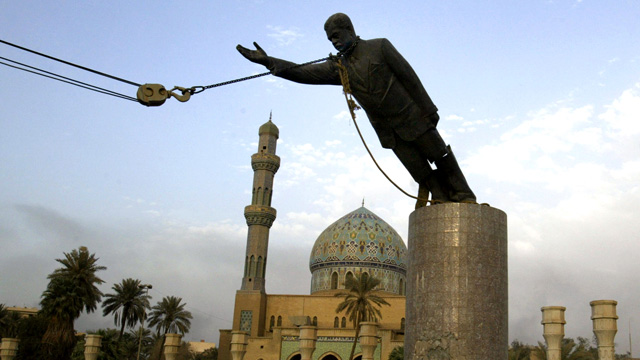
Statue - Saddam HusseinAs the implications of President George W. Bush’s “war on terrorism” became clearer in 2002 and 2003, editorials appeared in America wondering how Al Gore would have responded to the 9/11 attack on America had he been the U.S. president. Would Gore have begun a “war on terrorism?” Would he have gone to war in Afghanistan? Would he have invaded Iraq to get rid of Saddam Hussein?

These were not silly questions. For one thing, the election results were so close that it was a Supreme Court decision that decided who won the election. But the questions really went to the different political philosophies of the two politicians. Bush, a conservative Republican and former governor of Texas, was a kind of idealist realist on foreign policy who, it turned out, leaned strongly on neoconservatism immediately after 9/11 and for the rest of his first term. Gore, a liberal Democrat and Bill Clinton’s vice-president, was a fan of liberal internationalism and multilateralism. So it could reasonably be expected that President Gore would have responded to the 9/11 attack with at least some markedly dissimilar policies to those of President Bush.

Of course it’s impossible to know how things would have been different, if much at all, in Afghanistan and Iraq between, say, 2001-2004 had Al Gore been the president. Nevertheless, it was good to see a thought experiment from foreign policy community trickling down into the street to get people thinking and talking about this. In foreign policy circles it’s know as counterfactual analysis, in which policy makers and advisors imagine alternative pathways into the future.

Since history, so to speak, is path-dependent, and since paths are choice-dependent, the present was not historically determined. So if the present seems bad due to foolish choices in the past, policymakers may seek to understand how things would have been different by imagining a counterfactual: What if Gore had been president?

Foreign policy counterfactual reasoning is a tool for relating to history in a way that helps us not only to see things differently but, hopefully, to be able to make wiser judgments in decision making. There is much more that could be said about this, particularly concerning the criteria used to keep counterfactual analysis from running away with itself. But hopefully I have now said enough about it, here, to consider the following example.

What if President Bush had not snubbed Iran in May 2003 but had taken the Iranians up on their formal diplomatic reachout? More specifically, how much is the snub implicated in the direction that the political hardliners in Tehran Iran took their nations diplomatically and internationally after the snub? It’s a critical question for two significant reasons. One, it bears upon the direction of Iran’s nuclear program since 2003. Two, entering negotiations about its nuclear program was a salient point in Iran’s proposal for talks with the U.S. in May 2003 – when Iran was much more open to negotiations about its nuclear program. Relevant to this is what took place in Iran after May 2003:

Inside Iran after the Bush snub:

  • Ultrafundamentalists politicians and religious leaders had the political propaganda they had been hoping for to successfully undermine President Khatami’s reformist domestic policies and his “dialogue of civilizations” foreign policy with the United States.
  • Iran’s rigidly ideological Council of Guardians, which vets all political candidates seeking elected office, increasingly disqualified moderates and reform-minded candidates for the presidency and for parliament (they number in the hundreds every election cycle).
  • Iran’s Revolutionary Guards Corp (IRGC), a large branch of the military tasked with defending the Islamic republic from external and internal threats, expanded areas of its control, including  tightening its grip over many of the country’s economic sectors through multi-million dollar take-overs of key industries in Iran’s telecommunications and energy sectors. Today, according to the Council on Foreign Relations, the IRGC “presides over a vast power structure with influence over almost every aspect of Iranian life.”
  • dominoesIn June 2005, Mahmoud Ahmadinejad, the ultrafundamentalist mayor of Tehran and former member of the IRGC’s infamous Basij militia, became president of Iran and, in controversial speeches, makes his radical religious-political views known to the world.
  • In the summer of 2006, Iran is implicated in supplying military support, and in green-lighting, Hezbollah in the Israel – Hezbollah war fought in southern Lebanon.
  • With the Council of Guardians disqualifying candidates en masse for political office, the ballots are stacked with fundamentalists and ultrafundamentlists, who win a huge majority of seats over reformists and moderates in the March 2008 parliamentary election.
  • Supreme leader Ali Khamenei, who has final say in all things political in Iran, sides with the hardliners in June 2009 and authorizes the Basji militia to use extreme measures against hundreds of thousands of peaceful demonstrators in Tehran, who are protesting the suspected widespread vote rigging that saw Amadinejad reelected as president.
  • As organized protests continue to disrupt Ahmadinejad’s plans for a smoothly running government, the regime spends the second half of 2009 taking revenge on high-level moderates and reformist politicians and their supporters through bogus arrests and trials.

Iran’s nuclear program after the Bush snub:

  • The Iranian government intensified its cat and mouse game with the International Atomic Energy Agency (IAEA), shrouding the secrecy of its nuclear program with ever more riddles, while international appeals for Iran to suspend its uranium enrichment go unheeded.
  • Iran significantly reduced the IAEA’s inspection rights in 2006, opening paths to conduct nuclear activities in secret; it enriches uranium.
  • International tensions mount in 2006-2008, as both the United States and Israel think out loud about bombing Iran’s nuclear facilities.
  • News surfaces in 2009 about a secret uranium enrichment site being built underground near the holy city of Qom.
  • Despite four rounds of economic sanctions passed by the UN Security Council between 2006 and 2010, Iran continues to stonewall IAEA inspectors and double down on its nuclear program.

I’ll stop there.

Conclusion. Iran’s thickly veiled nuclear program since the Bush snub is central to why I have been arguing that the May 2003 snub of Iran may yet go down as the worst foreign policy decision in the history of the United States.

Since 2003, more than a dozen serious diplomatic initiatives, proposals, and negotiations from Western nations, China, Russia, and others, including from Iran itself, have taken place, with varying results but with no comprehensive agreement as yet having been reached. (Here is a detailed history of the official negotiations.)

Success on the issue became more promising after President Obama removed the Bush administration’s precondition that Iran first suspend certain nuclear work before the U.S. would enter talks about Iran’s nuclear program. At the time of this writing, detailed and very technical negotiations to reach a comprehensive solution are taking place in Geneva between Iran and the P5+1 nations (China, France, Germany, Russia, the United Kingdom, and the United States), as yet another deadline for reaching an agreement, November 24, approaches. The deadline may be extended. Who knows?

What is known is that the United States, the EU, Russia, China, and many other nations are not willing to take Ayatollah Khamenei at his word when, in February 2012, he said in a major foreign policy speech: “The Iranian nation has never pursued and will never pursue nuclear weapons … because the Islamic Republic, logically, religiously and theoretically, considers the possession of nuclear weapons a grave sin.” What is also known is that no one really knows if the United States or Israel will bomb Iran’s nuclear facilities if negotiations collapse.

palm tree (cariberri)In the spring of 2003, the George W. Bush White House was flying high. It had ridden the crest of its swift victory in Afghanistan into Iraq, and on May 1, after less than a month of the U.S.-led war on Iraq, a large red, white, and blue banner that read “Mission Accomplished” hung unashamedly on the USS Abraham Lincoln as President Bush landed on the flight deck. It signaled to all the world America’s precise, speedy, and bold defeat of the largest military in the Middle East, while President Bush gave a nationally televised speech under the banner.


Also in the spring of 2003, as a net result of Bush’s year and a half of wars in the Middle East, Washington found itself breathing the air most envied by many world capitals: extraordinary diplomatic negotiating power with capitals of the Muslim Middle East. In that atmosphere of diplomatic advantage, it was foolish for the Bush White House not to ride those winds into negotiations with Iran.

Today, after eight years of Ahmadinejad, Iran has another moderate president, Hassan Rouhani, whose cabinet includes a number of people from the reform-minded Khatami administration of 1997-2005. And the United States is deeply engaged in the nuclear talks with Iran. We do not want to see another decision, like the Bush snub, that can be used by the hardliners in Iranian regime as another “told you so” moment that provides political ammunition to destroy the Rouhani presidency and bring the ultrafundamentalist to power again.

If you can do nothing else, pray that the talks succeed. It may indeed take the wisdom of Solomon for them to succeed. If they fail, the United States or Israel may bomb Iran. If that occurs, it is likely to result in the Iranian government’s immediate marginalization of Rouhani and a protracted retaliation from Iran to the bombing that includes increased terrorism; greater instability in Iraq and Syria; disruption in oil distribution; military conflict between Shiite Persian Iran and some Sunni Arab states, such as Saudi Arabia; and many other terrible consequences, not to mention an Iran more determined than ever to become a nuclear weapons power.

Iranian retaliation and Western response might even lead to an escalation that draws in China and Russia, who are allies of Iran, on the side of Iran into a fullblown U.S. – Iran war. In short, a bombing campaign and Iran’s retaliation may result conditions that will make everyone rue the day.

Equally disturbing is the fact that even if the nuclear negotiations succeed in keeping Iran from going for the bomb, Iran will nevertheless have reached the threshold of becoming a nuclear weapons power. And that may be incentive enough for nuclear proliferation in the Middle East, if other Muslim countries set in motion their own threshold programs as a balance of power strategy to Iran. Iran then might decide to cross the threshold first, because it can do so in a short space of time. Then chances for a nuclear war increase.

This counterfactual analysis does not place the blame for the current Iranian nuclear dilemma on the Bush snub alone, for a host of national interests, regional strategies, and international maneuvers are also in play. It does, however, cry out for us to learn in an exceptional way from history why diplomacy is better than adversarial relations and war. And that can help us imagine a wiser way ahead today.

©2014 by Charles Strohmer

Dominoes image by Great Beyond, palm tree image by cariberri (permissions via Creative Commons)

THE BATTLE OF THE BUSH GIANTS OVER IRAN part 2 of 2

Continued from previous post.

Khatami & co, (andresmh)President Khatami of Iran, his foreign ministry, and other high-level reformists in his government had stuck their necks out since 1997 reaching out to the United States and it had been paying off for both nations. Hardline ultrafundmentalists inside the Iranian regime, however, were no fans of Khatami’s foreign policy, which was based on his dialogue of civilizations. Nor were they fans of his reformist domestic policies. The regime’s ideological hardliners fought against Khatami’s pragmatism inside Iran not only via political means but also by oppressing numerous dissidents and intellectuals who supported the president’s domestic reforms. Despite the strong opposition of regime hardliners to his foreign policy with the U.S., Khatami remained steadfast about bringing Iran out of the cold with America. To this, the hardliners acquiesced, biding their time. That time had now come.

From October 2001 to January 2002, Iran had proven itself to be a crucial ally with the U.S. in its war in Afghanistan and the forming of the new Afghan government. Khatami had been preaching to the hardliners inside the Iranian regime that Iran’s support of U.S. efforts in Afghanistan would reap U.S. rewards.

But then, incredibly, President George W. Bush included Iran, with Iraq and North Korea, in his “axis of evil” speech in January 2002. Khatami’s credibility inside the regime immediately tanked. Intentionally or not, the Bush White House handed the hardline ideologues inside the regime the political ammunition they needed to kill Khatami’s foreign policy with the U.S. Demonizing Iran as part of an “axis of evil” became a huge propaganda coup for the hardliners. It appeared that Iran was being hung out to dry by the Americans. The hardliners argued that the Bush administration had merely used Khatami and his reformist advisers.

But bilateral relations, especially between adversaries, are never straightforward, and they become even complicated when a major event, like war, takes place that affects the strategic interests of those nations. Then, you never quite know who is going to decide what or where the relations are headed. And so just when you think events have reached such a pitch that the hardliners inside the White House and inside the Iranian regime can congratulate themselves on defeating the diplomats, no. By late 2002, with the invasion of Iraq appearing increasingly imminent, neither Washington nor Tehran could afford to stop talking to each other. With the looming war, cooperation between the two parties had become too valuable to end.

Hubris book coverIran had at first opposed toppling Saddam Hussein, preferring the regional Iran – Iraq status quo to a pro-Western client government along its border. But when Tehran understood that the Bush administration was set on war with Iraq, it began using the Geneva Channel and other diplomatic tracks to quietly assist U.S. plans in ways that would benefit Iranian interests. Through such help, for instance, Iran would gain at least some degree of insight into what the Americans were going to be doing in Iraq.

But there were perks for Washington, too. Tehran, for instance, held valuable cards, such as its familiarity with Iraq’s leading Shia clerics and the country’s complex Shiite tribal networks. Also, Iran’s intelligence network would have information helpful to the U.S. military once it was in Iraq. Trita Parsi, in Treacherous Alliance, writes that although the Geneva – Paris talks by 2003 “lacked the cooperative spirit they enjoyed during the Afghan war,” they continued out of mutual necessity, focusing on Iraq, until the crude snub of Iran in May 2003 by the Bush White House. With that, the cabal of Cheney–Rumsfeld–Wolfowitz had finally succeeded in killing off the Powell diplomatic strategy with Iran.

I argued for many weeks on this blog, beginning here, about why wisdom and diplomacy are vital for easing adversarial international relations to prevent conflict or war. The Bush snub of Iran in May 2003, in its rejection of entering high-level diplomatic talks with Iran,  was not wise. It was largely a result of neoconservative political ideology in the Bush White House and directly implicated in the steep deterioration of U.S. – Iran relations that ensued. We will look at why neoconservatism is implicated in this in a future post.

But there was also a lack of wisdom in the Iranian regime’s response to the Bush snub, both in its domestic policies, which to this day have been terribly costly to the Iranian people, and in its relations with the West, which in recent years have been walking a knife-like edge. In the next post I want us to look at what took place politically in Iran after the snub, as the ultrafundmentalists in the regime, through elections and policies, ensured that Iran took a strong adversarial stance toward the U.S. and greatly re-energized its nuclear program.

This quick historical view will give us important insights into why the U.S., even today, retains its “all options are on the table” (war) policy toward Iran. It also gives us insight into why, if there is war with Iran, the Bush snub may yet go down in history as the worst foreign policy decision in the history of the United States.

<em>©2014 by Charles Strohmer</em>

Image by andresmh (permission via Creative Commons)

THE BATTLE OF THE BUSH GIANTS OVER IRAN part 1 of 2

town at nightIn the previous two posts we looked at the fascinating yet fairly secretive years of gingerly cooperation between the United States and Iran that began in 1997 and ended abruptly in 2003. Much of this history remains unknown to most Americans, including how in 2001 Colin Powell, as George W. Bush’s Secretary of State, sought and got Iran’s tactical help to work with the CIA, the U.S. military, and the Northern Alliance to oust al Qaeda and the Taliban from Afghanistan.

If you were the president of the United States, wouldn’t you to try to keep building on that cooperation? After all, President Khatami of Iran had seriously proposed to do just that. But when Iran formally reached out to President Bush in May 2003 to do just that, President Bush crudely snubbed Iran. In this current series of posts, begun here, I am arguing why I believe that the snub could go down in history as the worst foreign policy decision in the history of the United States. It was a needless decision, the outcome of a battle of giants over Iran that had been brewing inside the Bush White House since 9/11.

The evening of September 11, 2001, Secretary Powell and a team of his closest advisors worked through the night to produce a diplomatic strategy for Afghanistan, which became instrumental in getting Iran’s tactical help in Afghanistan to go after Osama bin Laden, al Qaeda, and the Taliban. Beyond that tactical help, Powell wanted to persuade Iran to move into a positive strategic relationship with Washington.

Trita Parsi, in Treacherous Alliance: The Secret Dealings of Israel, Iran, and the U.S., writes that Powell, Richard Armitage (Powell’s deputy), Larry Wilkerson (Powell’s chief of staff), and Ryan Crocker (a seasoned Middle East diplomat) had been working to build a proactive policy toward Iran, and they had incentive to push for a strategic opening with Iran after Iran’s tactical help in Afghanistan had paid off. But on Iran the Powell team faced ferocious opposition from Vice-president Dick Cheney, Secretary of Defense Donald Rumsfeld, and Deputy Secretary of Defense Paul Wolfowitz (a staunch neoconservative ideologue).

Flash forward to 2014.This year, President Obama has been chided from many quarters, including from his former Secretary of State Hillary Clinton, for what many are calling his “Don’t do stupid stuff” foreign policy. We can’t enter that discussion here, but I mention it because “Don’t do stupid foreign policy stuff” is an apt descriptor for what happened to Iran policy inside the Bush White House in 2002-2003.

Despite the successes of Powell’s diplomatic initiatives in getting get Iran’s help with Afghanistan after 9/11, President Bush began leaning increasingly on the advice about Iran from  Cheney, Rumsfeld, and Wolfowitz – all adamantly opposed to Powell’s push to get Iran into a strategic relationship with the United States. Bush himself would begin to scotch that possibility big time, when, in his January 2002 State of the Union address, he included Iran, with North Korea and Iraq, as part of his “axis of evil.”

Needless to say, the Iranians were shocked. In his book Confronting Iran, Ali Ansari writes that “few Iranians could reconcile themselves with the notion that they belonged in the same category as their old foe Saddam Hussein or the totalitarian regime in North Korea.” And what then took place inside the Iranian government ensured the break in relations. For there was a battle of political giants playing out in Tehran just as there was in the Bush White House. And, just as occurred in the White House, the diplomats in Tehran lost to the hardliners.

We’ll pick the story up there in the next post.

©2014 by Charles Strohmer

Image by Olgierd Pstrykotworca (permission via Creative Commons)

IRAN & THE U.S., THE SECRET YEARS OF DIALOGUE & COOPERATION part 2 of 2

doorway to autumnConcurrent with the mutual charm offensive from 1997-2003 between Washington and Tehran was the fascinating period of the so-called Six plus Two talks. Tentatively begun by the UN in 1997, Iran, Pakistan, China, Tajikistan, Turkmenistan, and Uzbekistan, plus the United States and Russia, were quietly meeting to discuss dealing with the Taliban’s solidification of power over Afghanistan and the increasing violence among warring factions in that country. As well, Osama bin Laden and his al Qaeda network had recently been given safe haven there by the Taliban and were now working in various capacities with the Taliban government.

None of this bodes well for Shiite Muslim Iran. The al Qaeda network and the Taliban movement are radical Sunni Muslim Islamists, which meant that Iran had a deep stake in the Six plus Two talks. In 1998, Iran nearly went to war with the Taliban, and more than one million Afghan refugees had fled Taliban rule and were in the safekeeping of Iran, which has a very long eastern border with Afghanistan.

Iran helps the U.S. The Iran – U.S. narrative now begins to sound like a John LeCarré novel. After 9/11, Iran, in definitive ways through its considerable resources, began helping the CIA and the U.S. military to oust al Qaeda and the Taliban from Afghanistan. Iran was a major supporter of the Northern Alliance (NA), a motley group of anti-Taliban forces who were already at war with the Taliban, and through Iran’s help the NA now became the chief U.S. ally in Afghanistan against al Qaeda and the Taliban.

Iran also agreed to allow any U.S. pilots who were in distress to land on Iranian soil, if necessary, and it agreed to allow the U.S. to perform search-and-rescue missions for downed American pilots on its soil. Iran also increased its troop strength along the long Iran – Afghanistan border and, according to Trita Parsi, it sent a dossier to UN Secretary-General Kofi Anan on hundreds of al Qaeda operatives Iran had detained (Treacherous Alliance: The Secret Dealings of Israel, Iran, and the U.S.).

In October or November 2001, the Six plus Two forum had discreetly spun off one-on-one talks between Tehran and Washington to focus on closer cooperation about Afghanistan. Barbara Slavin (Bitter Friends, Bosom Enemies: Iran, the U.S., and the Twisted Path to Confrontation) writes that more than a dozen secret meetings were held among a small, select group of high-level U.S. and Iranian diplomats (until the Bush administration rudely snubbed Iran in May 2003).

These secret meetings, Slavin writes, were cordial and professional and alternated between Geneva and Paris, often taking place in a hotel bar where the diplomats would chat over nonalcoholic drinks and potato chips. Parsi notes that the talks were dubbed the Geneva Channel and that the discussions were bilateral and at the highest level between officials of the two countries since the Iran-Contra scandal (mid-1980s). The talks included high-level Iranian diplomats and U.S. ambassadors Ryan Crocker and Zalmay Khalizad (both were senior Bush officials).

UN building (Jeffrey)Meanwhile, the Six plus Two group happened to be meeting at the UN in New York City just two months after 9/11, when American Airlines flight 587 crashed into a densely populated neighborhood in Queens shortly after taking off from JFK airport. Slavin writes that the assembled diplomats at first assumed another terrorist attack. She also reports that Karmal Kharrazi, Iran’s foreign minister, handwrote onto his prepared remarks the following words to a member of the U.S. delegation: “‘The United States should know that the Iranian people and the Iranian government stand with the United States in its time of need and absolutely condemn these violent terrorist attacks.’” Iranian President Mohammad Khatami, in New York City attending the annual UN General Assembly, told reporters that he hoped “this bitter event will be the last we will have, and that terrorism and hate will be replaced by coexistence, empathy, logic, and dialogue.”

Iran then proved to be crucial to the success of the Bonn Conference in December 2001, where, under UN auspices, an international delegation held meetings with prominent Afghan leaders to decide on a plan for governing Afghanistan, which had been without a nationally-agreed upon government since 1979. According to Parsi, Washington and Tehran had laid the groundwork for the conference weeks in advance, and at the conference it was the Iranian not the U.S. delegation which pointed out that the draft of the Bonn Declaration, which would create the new government, as yet contained no language on democracy. Slavin agrees that Iran played this key diplomatic role at the Bonn Conference, writing that Iran suggested that the draft communiqué call for democracy in Afghanistan and also declare that the new government should not harbor terrorists.

Parsi concluded that it was Iran’s influence over the Afghans, not America’s threats and promises, that moved the negotiations forward right up to the end of conference, when a crucial moment arose around a final sticking point with the NA about the high number of seats it should hold in the new government. Parsi writes that the issue seemed unresolvable and nearly scuttled reaching a final agreement until Iran’s lead negotiator, Javad Zarif, broke the deadlock by taking the NA delegate aside and whispering to him in Persian. A few minutes later they returned to the table, the NA inexplicably having agreed to give up two of the seats it wanted in the new government. (Zarif is currently Iran’s Minister of Foreign Affairs under President Rouhani.)

For Iran, its enemy the Taliban had been defeated. For the United States, its relations with Iran had become less adversarial. The two governments had demonstrated to each other how they could benefit from improved bilateral relations. Apparently the historic season of cooperation, ongoing since 1997 in various ways, was creating a thaw between the two adversaries. This did not go unnoticed at the Powell State Department, where it was hoped that the common interests that both countries had shared in Afghanistan could be continued and expanded to other areas. But that would soon be scuttled by the neoconservatives in the George W. Bush White House, despite Powell’s best efforts. We’ll take a look at that part of the history in the next post.

©2014 by Charles Strohmer

Image by raffacama & Jeffrey respectively (permission via Creative Commons)

IRAN & THE U.S., THE SECRET YEARS OF DIALOGUE & COOPERATION part 1 of 2

red and green building patternThe history of U.S. – Iran relations has traveled rough and tumble roads since 1979, when direct bilateral diplomatic relations ended with the seizure of the U.S. embassy in Tehran. But between 1997 and 2003, those relations were becoming a bit smoother. Unknown to most Americans, U.S. – Iran relations had been quietly, albeit gingerly, becoming slightly more cooperative during the closing years of the Clinton presidency when Madeleine Albright was U.S. Secretary of State.

This cautiously improving context was the one in which the George W. Bush White House snubbed the Iranian diplomatic reachout to the U.S. in May 2003. It soon became commonplace to blame that decision on the strong neoconservative element in the Bush administration. That seems right, and I want to explain why in a future post. But many people do not see the snub as foolish, largely, I think, because they are unaware that beginning in 1997 certain events and decisions taken by the U.S. and Iran were starting to thaw their relations. So I want us to look at that larger context here. We’ll return to the neoconservatives afterward.

Before there was the ranting sixth president of Iran, Mahmoud Ahmadinejad, there was the peaceable reformist politician and fifth president, Seyyed Mohammed Khatami (1997-2005). A surprise landslide election (70% of the vote) carried him into office and changed the tenor of Iranian politics.

Dialogue of civilizations. Khatami shaped a foreign policy around a remarkable initiative that he called “a dialogue of civilizations” and reached out regionally to the Sunni Arab world. As that began to lessen tensions between Shiite Persian Iran and Arab states, Khatami then too his dialogue farther afield and reached out to Europe and America. EU – Iranian relations improved, and a number of public speeches and warm comments from Khatami about the United States were reciprocated by President Clinton and Secretary of State Albright.

The signals being sent by both states were noteworthy, even if they indicated only the possibilities of a new beginning. But small practical steps ensued, although, as diplomatic correspondent Barbara Slavin puts it, Iran and the U.S. remained out of sync. In her book Bitter Friends, Bosom Enemies Slavin discusses this wobbly dance between the U.S. and Iran during the Clinton – Khatami years.

Early in 1998, when he was unveiling his dialogue of civilizations, Khatami, in a major interview with Iranian-born CNN reporter Christiane Amanpour, proposed cultural exchanges with the U.S. to chip away at what he called “the bulky wall of mistrust” between the two nations. In response, writes Slavin, the Clinton administration gave visas to Iranian filmmakers and university professors, and, wrestling being a popular sport in Iran, a team of U.S. wrestlers and their coaches flew to Tehran to compete in an international competition.

autumn cathedralIn September 1998, when Khatami was visiting America for the first time, attending the annual UN General Assembly, he praised President Clinton and got everyone’s attention when he said that the Iranian government would not carry out the death sentence (issued nearly ten years earlier by Ayatollah Khomeini) against Salman Rushdie. The Rushdie affair, he said, should be regarded as “completely finished.” Some commentators questioned why Khatami, as president, did not rescind the fatwa, or religious order, until they learned that since Khomenei had issued the fatwa only he could rescind it, and he had died shortly after he had issued it.

In 1999, the Clinton administration softened some U.S. sanctions on Iran, and on St. Patrick’s Day 2000, four days before the Persian New Year, Secretary Albright stunned the Iranians in a major speech in which she apologized for the role of the CIA in overthrowing Iran’s democratically-elected Prime Minister Mossadegh in 1953 and reinstalling the shah. She also said that U.S. support for Saddam Hussein [in the Iran – Iraq war, 1980-1989] had been “regrettably short-sighted,” and she hinted at a further easing of sanctions.

Albright also listed areas of mutual interest to the United States and Iran and hoped that the two nations could put aside their differences and “plant the seeds for anew and better future.” Although Albright also carefully include U.S. grievances against Iran, the speech, as Slavin writes, was “a major attempt to turn” Khatami’s dialogue of civilizations between America and Iran “into a true reconciliation.”

A number of Iranian gestures toward America ensued. Tehran stopped helping Baghdad smuggle oil in violation of UN sanctions. It toned down its anti-Israel rhetoric. It agreed to accept whatever final agreement the Palestinian leadership hammered out with Israel. The latter item was huge. By implying that it would in principle recognize a two-state solution, should that be the case, Khatami’s government was indirectly granting Israel recognition. Slavin recounts a conversation in which Javad Zarif, Iran’s then UN ambassador, and currently Iran’s Minister of Foreign Affairs under President Rouhani, affirmed that very point. Zarif said that although Iran does not officially recognize Israel, “We believe that that position is not incompatible with accepting whatever solution the Palestinians come up with.”

Ever hear the media or the pundits on talk radio discussing this stuff? I didn’t think so. I don’t want to give the impression that the picture turned rosy. Many thorny issues remained. But the progress was noteworthy enough that the gingerly improving bilateral relations, believe it or not, continued with President George W. Bush. We will pick up that part of this fascinating wobbly dance in the next post.

©2014 by Charles Strohmer

Images by Ars Electronica & Nick Kenrick respectively (permissions via Creative Commons)

AN AMAZING IRANIAN PROPOSAL

Iranian schoolboysIn this current series of posts, begun last time, we are exploring the broad arena of U.S. – Iran relations by calling attention to its narrower areas. By looking at the narrower questions, problems, and decisions we gain wisdom and insight for understanding the larger context. Following this method has given me a much different, and I hope a wiser, perspective of U.S. – Iran relations than the one I had many years ago.

I’ve chosen to begin the exploration by looking at the George W. Bush administration’s  uncalled-for diplomatic snub of Iran in May 2003. I said last time why this might one day be known as the worst foreign policy decision in the history of the United States. Why do I say that? Partly because of what was in the Iranian proposal. That’s a crucial question I want us to consider here. It wasn’t just a cordial letter from Tehran asking after the President’s health, and by the way, How’s the first lady?

A copy of the letter has been helpfully included by Trita Parsi as an Appendix in his book Treacherous Alliance: The Secret Dealings of Israel, Iran, and the U.S. Parsi, president of the National Iranian American Council, writes that the Iranians had prepared a comprehensive proposal. It had been drafted and known only to a closed circle of decision-makers in Tehran and approved by the highest levels of clerical and political authorities, especially Ayatollah Ali Khamanei, the supreme leader, who has the final say in all matters of state.

Apart from Khamanei’s imprimatur, the proposal would not be taken seriously by the Bush White House. Most significantly, then, the proposal was authoritative. Thus the Americans, Parsi writes, were stunned by the proposal, which called for a dialogue of “mutual respect” and listed major points of contention that Iran was willing to discuss with the U.S. When you think about how highly volatile U.S. – Iran relations were during the Ahmadinejad presidency (2005-2013), it seems unbelievable what Iran actually put on the table in May 2003. In the letter, Iran declared itself willing to:

  • talk about its nuclear program;
  • increase its cooperation with the U.S. on al Qaeda;
  • help stabilize Iraq;
  • end Iranian “material support to Palestinian opposition groups” (Hamas, Islamic Jihad, et al.) and pressure them “to stop violent action against civilians”;
  • lean on Hezbollah “to become a mere political organization within Lebanon”;
  • accept the Arab League’s Beirut Declaration for a two-state solution.

Of course bilateral negotiations are a two-way street, so the proposal also spelled out what Iran would like to see on the table in return from the U.S.:

  • the removal of Iran from the “axis of evil”;
  • an end of sanctions and impediments to international trade;
  • “full access to peaceful nuclear technology”;
  • recognition of “Iran’s legitimate security interests in the region”;
  • U.S. help against anti-Iranian terrorists.

The letter closed by suggesting mutual next steps, including public statements, the establishment of parallel working groups, and hammering out a timetable for implementation. Given that Washington and Tehran had had no embassy-level bilateral relations for a quarter of a century, the offer was unprecedented. How would the Bush administration respond?

Let’s think about this for a minute. As with all initial foreign policy proposals, this one was but a starting point. Both sides would know that the proposal was not set in stone. It was merely the potential beginning of the international game of give-and-take and of eventually getting to Yes. But first the waters needed to be tested by both parties. If they liked the temperature, then some next steps would include discussing the items. If the process continued, long story short, many items and issues in the original proposal would probably hit the cutting room floor, with the potential that remaining items might then be taken to an agreement, years down the road.

Iranian boyBut my point here, given the unprecedented nature of the proposal, is that it would be an exceptionally irrational move if the recipient did not engage with the sender to at least test the waters, perhaps by eliminating two or three items or issues while emphasizing one or two others that it was willing to consider as talking points.

The ball would then be in the other’s court. What would it think about the modifications? How would it reply? And so on. If the two parties kept at it, the history of foreign policy negotiations tells us that solid linkages would likely be forged on one or two issues. Somewhere around this point in a long tedious process, if an appropriate framework were found whereby the parties could sit down to work out a mutually beneficial arrangement, then seriously formal talks could begin toward signing an agreement.

This may seem like the wrong kind of compromise to some, but it is simply fundamental to successful foreign policy negotiations. Further, it would not be unusual to see the items and issues that made it through to Yes become, over time, ground for trust to increase between the parties, perhaps leading to the start of talks about new important items or about some on the cutting room floor. The Iranian proposal, in fact, seems to have been sent in such a spirit, having these words tucked into the middle of the letter: “We have always been ready for direct and authoritative talks with the US/with Iran in good faith and with the aim of discussing – in mutual respect – our common interests and our mutual concerns based on merits and objective realities….”

All of this the Bush White House knew. Yet it refused to test the waters. “An opportunity for a major breakthrough had been willfully wasted,” Parsi concluded. Larry Wilkerson, Secretary of State Colin Powell’s chief of staff at the time, believed the mistake was huge. According to BBC News security correspondent Gordon Corera, Wilkerson afterward said, “In my mind, it was one of those things” about which you say “I can’t believe we did this,” especially at a time when Iranian vulnerability was at its greatest and Washington at its most triumphalist.

In a future post we will look at the battle of rivals in the Bush White House that led to the decision to snub Iran. But that battle must be seen in the larger context of U.S. – Iran relations that had been gingerly improving and becoming slightly more cooperative in the years preceding the snub. That fascinating story will be subject of the next post.

©2014 by Charles Strohmer

Images by 350.org & Original Normal Boy respectively (permissions via Creative Commons)