
The Rest of the Square Inch

square inch with heartMany years ago when starting out as a public Christian, I had visions of changing the world. It didn’t seem like a ridiculous hope, if only because my first book had sold well in the U.S. and the U.K. and had been translated into six languages. So I was riding high, on the road to changing the world for God.

But soon I realized I couldn’t change the world. So I took a more humble stance: I’ll just change my nation instead. But then I realized that I couldn’t change America, so, wise guy that I am, I lowered my sights further: I can change my state. But then I realized I couldn’t change Michigan. So I wised up a little more: if I can’t change my state, I’ll change my city, Detroit. After all, we’ve got a ton of problems here.

Failing to get any traction down that road, I was getting desperate. After all, I had lowered my sights considerably. Maybe God was trying to tell me something. But what that was, I didn’t know.

Then it hit me: I’ve got it! If I can’t change the city, I can change my church. On reflection, of course, that was dumb idea. It’s not my church, it’s God’s. So I said: well, at least I can change my family. Right. That didn’t work either. So I said: I can change my wife. (When you’re done laughing, read on.) After getting over that painful move, I wondered how much smaller I could shrink my vision of change. If I couldn’t change the world or the nation or the state or the city or my church or my family or my friends or my wife, what else was there? What other area was there?

I did entertain some notions of changing myself. But that, too, was ridiculous. Although there were ways in which I had changed some things about myself, and othere things I could and should still do, I knew enough about myself as a sinner and what the Bible teaches about any notion of self-redemption to know that it’s a futile project.

What, then, could I do? Apparently, I couldn’t change anything! Yet that was the disillusionment God had been driving for in my heart. I remember praying: God, I can’t change the world or the nation or even my family, friends, or wife. Or even myself. I don’t have a vision of change any more. It’s hopeless. What’s going on?

You can change your square inch. That’s the answer that immediately popped into my spirit, and with it came understanding. I saw all the varied and diverse relationships that I had, near and far, with people I knew and did not know, and I saw that if I was willing God would give me grace and wisdom to change things for the better in those “square inches,” those realms of relationships. I no longer had to fuss and moan about changing the world, or Michigan, or my city, or my church, or my family, or myself. But if I myself cooperated with God’s grace and wisdom in whatever situtation I happened to be in, at any given moment and wherever in the world it was, I would be changing something for the good in my “square inch.”

This insight about what could actually be changed changed my understanding of both pubic and private Christian life and ministry. I already knew that it was about relationships. But now I had much more clarity about what that meant.

What does this mean in practice? Here’s some thoughts. We each have our own square inches, and their size varies all the time. They may be large or small, nearby or far away, with persons we know or don’t know. It depends on what we are doing and where we are at any particular time. And those realms of relationships and what is taking place in them are not static but dynamic, changing in any number of ways. Further, God is with us in those realms with grace and wisdom, and this means that changes can be made for the good.

Your square inch at any given time may be sitting on the couch with a child, or standing in a long, slow-moving queue of irritable shoppers, or working with an ornery boss. It may be may be talking on the phone with an old friend across the country, or sitting at a table with seven others at a wedding reception dinner, or in a moment of decision about what to post on Facebook or to comment on there. In other words, the sizes and situations of your square inches will always be different, depending on what’s going. But God will be there in them with you with grace and wisdom on offer for changing something for the better, and for making the already-good ever gooder.

But there are other considerations. Typically, a Christian’s square inches include  relationships and situations like those I’ve mentioned. But besides those, the square inches of some Christian man and women are a much larger pulpit for the grace and wisdom of Jesus to make a change. Some are pastors. Some are in classrooms teaching. Some run businesses. Some direct NGOs. Some sit on library boards. Some, like yours truly, write books, or get interviewed on the radio, or work in the field of diplomacy and negotiations.

My point is that in any given situation or context, one’s square inch, or realm of relationship, might entail reaching a congregation, a classroom, a city, or even a national audience.

Faced with the frequency and extent of suffering and injustice in the world, we can get overwhelmed with a sense of powerlessness. It seems futile to attempt to do anything about it – even though as responsible citizens and individuals we would like to change the world. The square inch rule, however, offers us rest from trying to change the world. We can’t change it. Christ has already changed it.

We can have a hand in changing one life at a time. We all know what our square inches are. No one needs to tell us that. And we know, or at least we have a pretty good idea of, what square inches may be on the horizon, at least in the near future. So instead of feeling disillusioned by a vision that is too big for us to handle, here’s an idea. Let’s focus on bringing God’s grace and wisdom into our existing realms of relationships so that we can partner with what Jesus is already doing in those relationships to change them for the better. And let’s start with our own square inch with Jesus.

©2015 by Charles Strohmer

Top images by istvanberta (permission via Creative Commons).

Floating Like Jellyfish with the Tide

Chagall WindowsOn my way to something else this morning, I unearthed a gem from Miroslav Volf that lay buried in a long-forgotten meditation on capitalism that I had published many years ago. While reading that gem today, I immediately remembered what Walter Brueggemann recently wrote about capitalism. Together, their ideas merged in my mind with the previous post, which is not about capitalism. It’s funny, is it not, the alchemy of independent and seeming disparate ideas meeting as if guided by, well, shall we say, an invisible hand to give birth to the Aha! moment of a new and important connection.

The birth this morning was the thought that capitalism is one of the love affairs we have that sidetracks us from a more consistent practice of the kind of Christian identity and subsequent relevance in society that Jürgen Moltmann’s words in the previous post remind us of. See if you too get the connection.

For some time now I have been troubled by the seeming disappearance of any robust alternative to the pervasive culture of late capitalism, whether in the church or in the society at large. We are drowning in floods of consumer goods and are drenched in showers of media images. We live a smorgasbord culture in which everything is interesting and nothing really matters. We have lost a vision of the good life, and our hopes for the future are emptied of moral content.

Instead of purposefully walking to determinate places, we are aimlessly floating with random currents. Of course, we do get exercised by issues and engage in bitter feuds over them. But that makes us even less capable of resisting the pull of the larger culture, a resistance that would take shape in formulating and embodying a coherent alternative way of life….

If we can neither state what the gospel is nor have a clear notion of what constitutes the good life, we will more or less simply float along, like jellyfish with the tide. True, a belief in our ability to shape the wider culture is woven into the fabric of our identity. So we complain and act. But in the absence of determinate beliefs and practices, our criticism and activism will be little more than one more way of floating. (The Christian Century, April 5, 2000)

The liberal U.S. state has morphed into a predatory economy of unfettered freedom for the powerful. (Walter Brueggemann’s shot across the brow, warning about the deep and unreserved affimations of the liberal state that come from some theologians. From The Christian Century, March 5, 2014.)

©2015 by Charles Strohmer

Photo: Chagall Windows, by Benjamin (Google Images)

Identity and Relevance

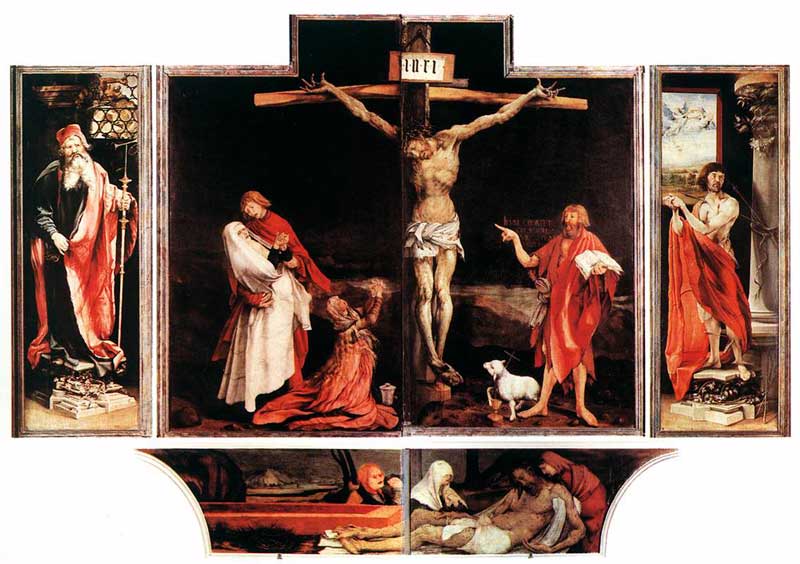
Gruenwald's Isenheim AltarpieceThinking lately about God’s solidarity in Christ with the suffering, the poor, and the marginalized, I ran across these words from Jürgen Moltmann, which I had made margin notes alongside, until today long-forgotten, in my copy of his book The Crucified God. While considering his words again today I realized why I so infrequently walk this path.

The Christian life of theologians, churches and human beings is faced more than ever today with a double crisis: the crisis of relevance and the crisis of identity. These two crises are complementary. The more theology and the church attempt to become relevant to the problems of the present day, the more deeply they are drawn into the crisis of their own identity. The more they attempt to assert their identity in traditional dogmas, rights and moral notions, the more irrelevant and unbelievable they become…

[In] these specific experiences of a double crisis, reflection on the cross leads to the clarification of what can be called Christian identity and what can be called Christian relevance, in critical solidarity with our contemporaries…

As far as I am concerned, the Christian church and Christian theology become relevant to the problems of the modern world only when they reveal the “hard core” on their identity in the crucified Christ and through it are called into question, together with the society they live in.

Faith, the church and theology must demonstrate what they really believe and hope about the man from Nazareth who was crucified under Pontius Pilate, and what practical consequence they wish to draw from this. But what kind of theology of the cross does him justice, and is necessary today?

To return to the theology of the cross means avoiding one-sided presentations of it in tradition, and comprehending the crucified Christ in the light and context of his resurrection, and therefore of freedom and hope.

To take up the theology of the cross today is to go beyond the limits of the doctrine of salvation to inquire into the revolution needed in the concept of God. Who is God in the cross of Christ who is abandoned by God?

To take up the theology of the cross further at the present day means to go beyond a concern for personal salvation, and to inquire about the liberation of man and his new relationship to the demonic crisis in his society. Who is the true man in sight of the Son of Man who was rejected and rose again in the freedom of God?…

[To] realize the cross at the present day is [to move] beyond a criticism of the church into a criticism of society. What does it mean to recall the God who was crucified in a society whose official creed is optimism, and which is knee-deep in blood?…

Jesus dies crying out to God, “My God, why hast thou forsaken me?’ All Christian theology and all Christian life is basically an answer to the question Jesus asked as he died… The issue is not that of an abstract theology of the cross and suffering, but of a theology of the crucified Christ.

(Jürgen Moltmann, beginning his book to disillusioned visionaries, The Crucified God, his emphases.)

©2015 by Charles Strohmer

Painting: Grunewald’s Isenheim Altarpiece

Christ the Editor

pen, poem, and inkI’ve been thinking again about a peculiar collection of poems that God is writing, and about how great poems get written.

Just as every note in a musical score is significant, every word in a poem tells, and tells significantly. And it does not line up that way by chance or sloth. Poetry, with its compact, exact language and precise punctuation, may be the most carefully crafted and painstakingly written, and edited, form of communication. Poets will fight tooth and nail with a publisher over placement of a comma. And long before that, poets, at least the best of them, may die a thousands deaths over just one poem. Without a will to erase, add, move, or revise lines, to puzzle perhaps for hours over the right word, image, or phrase – then decide to leave it as is – and then to run through the process again, and then again, you just don’t get ascending poetry.

Back in the days of the Greek epic poet Homer (eight centuries before Christ), pieces crafted from metal were called poiēma, a word derived from poiēo, which was a basic term for all kinds of craftsmanship. Within a few centuries, around the time of Plato, poiēma in Greek literature had developed into a word that often denoted what we today would call artistic work, including the work of someone who wrote a book or a play. Plato and others after him also used poiēma especially of poetical works. Quite easily, then, the early church pressed poiēo into service in New Testament Greek to indicate God’s works as creator and redeemer and Jesus’ works and deeds.

So along comes the literate St. Paul, apostle to the Greeks, or Gentiles (as he is called). Paul has a knack for raising the stakes of the common language of his day, as he does with poiēma. In the context of what it means for the believer to be saved by grace through faith in Christ, Paul says, “We are God’s poiēma,” which English translators typically render: “We are God’s workmanship,” or God’s “handiwork,” or God’s “masterpiece.” (I think the latter is the most accurate rendering in this context, Ephesians 2:10.)

The apostle has involved us in a little wordplay here. I don’t mean that we should get all sentimental and call for a new translation: “We are God’s poems.” But we do get our English word “poem” from poiēma. So we have good reason for meditating on the implications of what it means by God’s grace to be God’s poems. You can bet Paul was.

For God’s poiēma, the editorial process began when we submitted our stories to Jesus the Editor, for consideration to be published. Submission is the hard part. We have worked so terribly hard, and for such a long time, on our own stories. And we’re so proud of them. If anyone tries to touch them, look out! So we’re deathly afraid of editors. There may be too much we are going to have to part with, or they may not even like our stories. Never mind that, as any seasoned writer will tell you, working with a skilled editor makes for the emergence of an ascending story.

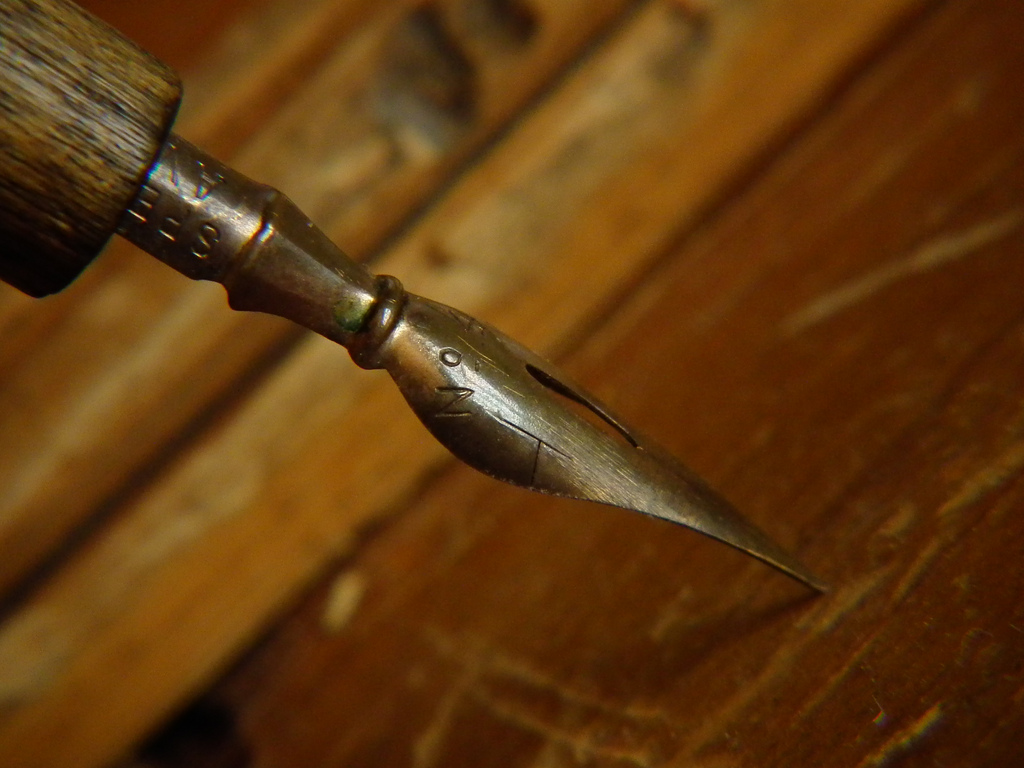
antique penAfter submission, the editor says, “I like what you’ve got in mind, but there’s stuff we’ve got to work on, correct a few lines, polish it up here and there, if you want to publish with us. Still interested?” Crumbs. More hard work! But what other choice is there if you you want to get published and read. Sure, you could submit elsewhere, but you’ve already done that and nobody else has come even close to the contract that this publisher has offered.

What to do? “Don’t worry,” the editor says. “I’ll save your story for you. I know what to do. I’ve been at this for a long time. I’ll get those flaws out of it. But you’ll need to leave it with me for a while. I’ll get to work on it and then send it back to you for some revisions. But you may need to delete some bits and add some new material, change a few things around here and there, which, by the way, may take you some time. But we will be working on this together. Don’t worry. And thanks for the submission.”

When your story arrives back in your hands you nearly faint dead away. You had no idea! Such extensive surgery. This is going to take time. Yet as you follow the Editor’s guidelines and margin notes, you start to gain a new intuition, which says, yes, this makes perfect sense now. This is the way it should be.

You make the changes and resubmit it. Further drafts of your story then pass back and forth, and you’re sometimes elated at the editor’s work, sometimes deflated. Man, this is taking longer than I thought. When will it be finished? When will it be published so that everyone can read it?

“Patience,” Christ the Editor responds. “You’re making good progress, but we’ve still got a few wrinkles to iron out. You have a tendency to get ahead of yourself or fall behind or forget about a change that’s been made. And your still inclined to insist on keeping material from the old story.

“I know it’s slow and painful at times. I get that. But keep in mind that I’ve already been sending parts of your story around for reviews and, as you know, they’re being well-received. So hang in there. You want that masterpiece I promised, don’t you?

“So when will you have that next draft ready for me?”

©2015 by Charles Strohmer

Images by Jonathan Blocker and Fantomette, respectively (permissions via Creative Commons)

A note from Charles: If you want more of the perspectives that Waging Wisdom seeks to present, I want to invite you to follow the blog. Just click here and then find the “Follow” button in the right margin, enter your email address just above that button, and then click “Follow.” Whenever I publish a new post, you will then receive a very short email notice. And, hey, if you really like this blog, tell some friends! Thank you.

BRIEFLY . . . .

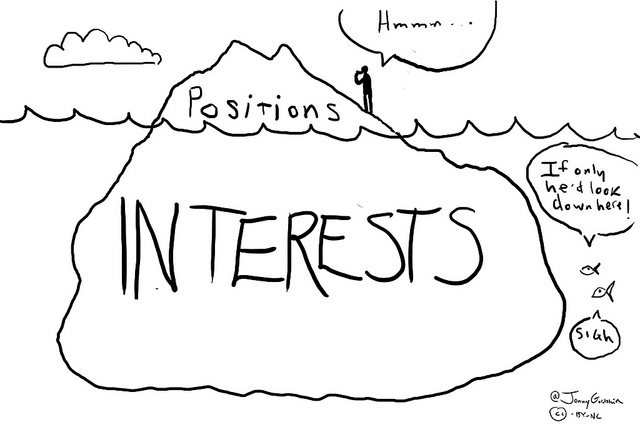
InteretsResponses to the question I asked in the previous post have been arriving via email and the Comments area. I am extending the time frame for responses for two more days. If you have not seen that question, just click here. I will be taking answers through Saturday. See you back here on Monday. Thank you.

HERE’S A QUESTION FOR YOU

InteretsWhat would you like to hear about on this blog during the next several months? Here’s why I’m asking. To date, we have explored vital features about the relation of wisdom to human diversity, focusing on the international relations of the old-world Middle East (Ancient Near East). This post lists the places we have been. Now that we have that foundation to refer to, we are transitioning from that ancient history to the contemporary scene. My general plan, now, is to write about issues, decisions, policies, and people that have loomed large during the past decade in U.S. – Middle East events.

I began that transition here, where we took a few posts to remember what is was like in America during the days of 9/11. But there are so many crucial, post-9/11 areas to consider, including current emerging situations, that I have been wondering where we might start doing that in this next series of posts.

I have some ideas of my own, but you can help. I would like to get your thoughts. What one or two areas would you like to hear about first? I would like to hear from as many readers as possible on this. If one or two post-9/11 areas stand out, I will seriously consider starting there.

So do make a suggestion. Brief or longish. You don’t have to be too specific. Send your suggestions via email or the Comments area. Thank you. I look forward to hearing for you. C. S.

©2014 by Charles Strohmer

Transition Week

Beginning today, I am taking several days away from posting. Three reasons, really. I need to think through the next series of posts, prepare for a speaking engagement, and tweak some technology.

Some recent discoverers of the blog have said that they are looking forward to digging into previous posts. This could be a good time for doing that. To assist all of us in that, I have revised and expanded the “categories” list in order to make it quicker to locate past topics and pieces (see here). So even if you have been here since the beginning, this might be a good time to check out past posts. And, as always, I look forward to reading reading and replying to your comments on any of the posts.

See you back here soon. We will then transition from the historical wisdom tradition into the contemporary scene.

Make every effort to live in peace with all. Hebrews 12:14

red loryImage by Rob Young (permission via Creative Commons)

Holiday Break

It may not be a holiday in your part of the world today, but here in the States it is, and I am taking advantage of it. I’m not posting today. I’m resting. May you have a good day wherever you are. See you back here on Monday, July 7.

“Love is a commitment of the will to the true good of the other person.” J. Budziszewski


love (aftab)
The “Wisdom of the Desert” posts continue on July 7.

Image by aftab (permission via Creative Commons)