President Obama, Symbolic Power, Paris, and Public Perception

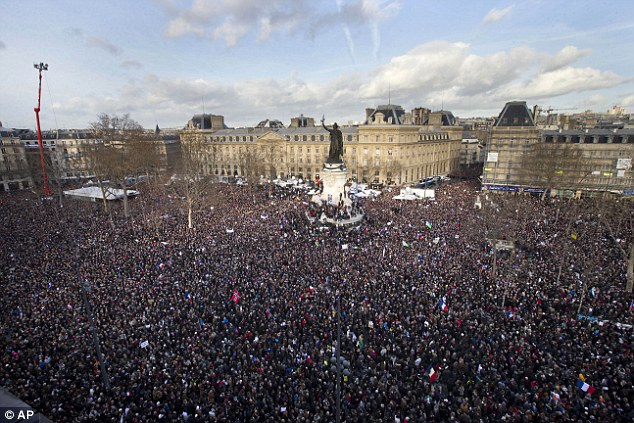
Paris march millions Every picture tells a story. Finally, instead of more excuses from the Obama administration about why the President was MIA among the world leaders at the Paris unity-against-terrorism March on Sunday, White House Press Secretary Josh Earnest said Monday afternoon that “we should have sent someone with a higher profile to the event.”

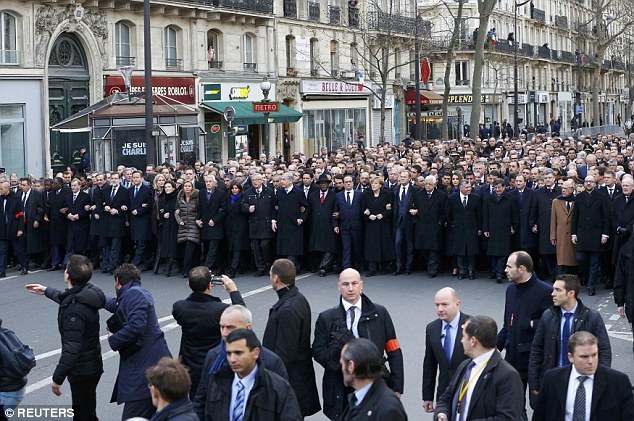
All day long Monday, images poured into and out of the media of the million+ people who had quietly gathered in the Place de la Nation Square to show the world’s solidarity for the victims of the Paris terrorist attack. At the head of the marching throng were pictured 40 world leaders walking arm-in-arm. But what many saw was: Where is the President of the United States?

Too short of a notice to get the President there, said the White House, given all the high security measures that would have been needed. It would have disrupted this important event.

And yet, there was British Prime Minister David Cameron, and German Chancellor Angela Merkel, and Israeli Prime Minister Benjamin Netanyahu, and Palestinian Authority President Mahmoud Abbas, and the King Abdullah II of Jordan, and Russian Foreign Minister Sergey Lavrov, and the others. Their security teams pulled off their attendance on short notice.

Paris march world leadersWorse, the scene lacked the presence of any top U.S. officials. That also stared everyone in the face. No U.S. Vice-President. No Secretary of State. Even Attorney General Eric Holder, who had been at a summit on terrorism in Paris that morning, did not take part. There were no senior cabinet officials either. Only U.S. Ambassador to France Jane Hartley and her staff were present.

Fareed Zakaria, host of CNN’s “Global Public Square,” called the absence of top U.S. officials a “pathetic” mistake. I agree. “I thought this was why God invented Vice-Presidents,” Zakaria quipped.

It’s true that the states represented their by their leaders at the Paris march don’t give a wit about the symbolic “message of the missing president.” The U.S. has been, is now, and shall remain adamantly united with them in their anti-terrorism policies. These leaders know that. Certainly France isn’t fussed about the symbolic message. After the Paris attack last week, President Obama made it a point to reassure French President Hollande of America’s solid partnership with its old ally France on the anti-terrorism front.

Nevertheless, emotional symbols in foreign affairs, like doctrines and explanations, play roles outside the corridors of a state’s power, where they can evoke public responses that can settle in and alter perception. The Paris solidarity march carries such a high degree of symbolism that President Obama’s absence was a glaring image that negatively affected world opinion. For a state that lacks the street cred it had in the world before the war about Iraq, it was indeed a pathetic mistake.

©2015 by Charles Strohmer

Top photo, AP. Bottom photo, Reuters.

IRAN NUKES DEAL

hour glass 1 (Willi Heidlebach)Behind the cautious rhetoric from President Obama about reaching an agreement with Iran on its nuclear energy program, you don’t have to listen very hard to know that he really wants a deal. And for more than a year now, the public pronouncements about the talks from Iranian President Hassan Rouhani seem to indicate that he has the same hope. But Rouhani’s most recent comment, made in Tehran, is instructive for both the United States and Iran.

As talks between Iran and the P5+1 group (the five permanent members of the UN Security Council plus Germany) wind down in Vienna this week, with the November 24 deadline fast approaching, the U.S. and Iran held a session of bilateral talks on the deal. In Tehran on Wednesday, November 19, Rouhani said that if “the opposite party in the negotiations with the Islamic Republic of Iran has the political will for a deal and avoids excessive demands, the conditions are prepared for the conclusion of a deal.” Apparently this means that the key players in Tehran are of one mind on core issues.

But this may be a misleading assumption. Although Rouhani and his team of nuclear negotiators are of a moderate political persuasion, at least according to Middle East lights, and may indeed be united in reaching an agreement, they have been battling strong opposition to a deal from political hardliners in the regime. And of course the Supreme Leader, Ayatollah Khamenei, has the make-or-break authority on any international deal. (For the record, he has stated many times that Iran does not want nuclear weapons because it is against Islamic law.)

Concurrently in the States, as Obama’s team seeks to reach an agreement, it too has been facing strong and sustained opposition from Israel’s Prime Minister Benjamin Netanyahu, and at home from political hardliners in Congress, the Jewish lobby, and talk radio pundits. The word “compromise” is anathema to the “anti-deal” groups, who are unable, or unwilling, to see the wisdom of keeping diplomacy going in order to bring this cliffhanger to an equitable agreement.

I wrote several posts, beginning here, about the serious ramifications that followed for many years after the George W. Bush administration’s diplomatic snub of Iran in 2003. When Iran reached out to the United States in 2003, Iran had a reform-minded president, Seyyed Mohammed Khatami, and a foreign policy team that sought, under Khatami’s leadership, cooperation with America and the rest of the West. The Bush White House rudely nixed further progress on that.

Now that the two states have been holding high-level talks for more than a year, a fair and just agreement must not be lost by the two president’s caving in at the last minute to the opposition groups.

If an agreement cannot be reached by the November 24 deadline, the talks should be extended to iron out the minutia. If an agreement is not reached and the talks end sans an extension, potential for cooperation between the West and Iran may be set back for years if not for decades.

Worse, hardliners in the U.S. who have been calling for bombing Iran may then get their way. If so, the hardliners in Iran will have the excuse they have been waiting for, as they had in 2003 with Khatami, to blackball the moderate Rouhani and install another Ahmadinejad. Worse still, you won’t like the blowback to the bombing.

Wisdom is better than weapons of war. Outside the meeting rooms of power, we ordinary mortals can feel so helpless in these situations. But there is an old saying: Prayer changes things. If you are a praying person, pray that the two presidents will succeed.

©2014 by Charles Strohmer

Image by Willi Heidelbach (permission via Creative Commons)

CONSERVATIVES BEWARE

smoking volcanoAfter the immediate success of the U.S.-led war in Iraq in 2003 turned into a worst-of-all-worlds counter-narrative, many keyboards were worn out in the ensuing years documenting what went wrong on many levels. There is no need, here, to go into what Thomas Ricks, the acclaimed Pentagon correspondent, aptly called a “fiasco,” in his book with that title.

Many analysts held neoconservative foreign policy thinkers responsible for it, and Donald Rumsfeld’s top neoconservative advisers – Paul Wolfowitz (deputy secretary of defense), Richard Perle (assistant secretary of defense), and Douglas Feith (undersecretary of defense for policy) – began demurring when critics implicated them, big time, in the unfolding disaster. As well, a chill toward neoconservatism set in among Washington’s political elite.

Then in 2005 and 2006, President Bush began removing neoconservative advisors from his administration and filling the positions with those who could be trusted to shift America’s Middle East policy in a more realist direction. Right after the November 2006 midterm elections, Bush accepted Donald Rumsfeld’s resignation and appointed the well-experienced Roberts Gates, a foreign policy realist, as his secretary of defense. In 2006, the Project for a New American Century (PNAC), a neoconservative think tank, was shut down, and by 2008 most of the Bush administration’s many neoconservative advisors were out of government.

Although neoconservative ideology nose-dived, it would be a mistake to assume that its adherents crashed and burned. As in the 1990s, they busied themselves. Many leading neocon thinkers engaged in what critics have called a rewriting of their role in the Bush White House, trying to salvage their political philosophy. Claiming that they were merely getting the truth out, setting the record straight, their revisionist history typically has included identifying the State Department, the CIA, and many realists and idealists as having had an exaggerated the role of neoconservatism in the Bush White House. It also has included blaming CIA intelligence, the State Department, President Bush, Donald Rumsfeld, Condoleezza Rice, and other high-level targets for the debacle that arose in Iraq.

Certainly there is enough finger-pointing to go around, but the neoconservatives go too far, accepting little if any responsibility for the fiasco – everyone else is at fault (see, e.g., Douglas Feith, War and Decision; Richard Perle, “Ambushed on the Potomac,” The National Interest online; and Nathan Guttman, “No Longer in Power, Free to Talk, Neocons Seek to Rewrite History,” The Jewish Daily Forward online). In my view, the neocons lack the humility to see that when you point a finger elsewhere, three more fingers point back at you.

The neoconservatives, however, still had many high-level admirers, such as Republican Senator John McCain. When he was running for the presidency against Barack Obama in 2008, McCain included leading neoconservatives on his team of foreign policy and national security advisors (he also received ad hoc advice from realists Henry Kissinger and Richard Armitage).

human eyeAlso around this time, formidable neoconservative thinkers such as the columnists Charles Krauthammer and William Kristol were getting regular bylines in Time magazine, and Kristol was writing for The New York Times. And both men became FOX News analysts. But also by this time, the word “neoconservative” wasn’t heard much in the mainstream media, and commentators such as Kristol and Krauthammer were doing their thing under the umbrella “conservative.”

That is, the mainstream media, not to mention talk radio, was now content to use the word “conservative” to test drive neoconservative ideas for U.S. policy in the Middle East. Bombing Iran’s nuclear facilities and denouncing President Obama’s diplomatic efforts toward Iran are part of that ride. Of course it is not only the neocons and some conservatives who push such ideas but liberal hawks as well.

Jacob Heilbrunn, a foreign policy realist who knows a thing or two about neoconservatism, writes that the neocons want to engage in regime change around the world, and because that’s not current U.S. foreign policy they are blaming President Obama, big time, and anyone else of consequence who does not believe what they believe. “What the neocons are offering,” Heilbrunn concludes, “is a message of power worship, one that is a recipe for a permanent revolution abroad that will further ensnare the United States in foreign predicaments that it cannot reasonably hope to resolve.” To much of the world, then, it seems as if all the United States has to offer it is “unremitting combat.”

Conclusion. Much of American foreign policy conservatism during the Cold War era saw the world through an “us vs. them” / “good vs. evil” lens. Communism was the enemy, and many of  conservatism’s staunchest foreign policy apologists followed William F. Buckley Jr., whose aggressive anti-communism was at odds with the bipartisan doctrine on “containment – the organizing principle of U.S. policy toward the Soviet Union – because it was not consistent with his “good vs. evil” policy frame for U.S. – Soviet relations. Unlike the majority of Americans and U.S. presidents (liberals and conservatives) who supported containment, Buckley was not opposed to rolling back the spread of communism with the weapons of wars, and many conservative politicians followed his lead.

With the collapse of the Soviet Union, these conservatives lost the foreign enemy over against which they had organized their foreign policy, and their Manichean frame of reference virtually dissolved, at least until the neoconservatives reconstituted it on September 11, 2001. Now intoxicated with power inside the George W. Bush administration, they used their considerable intellects to sway Bush, Cheney, and Rumsfeld to restore America’s “us vs. them” / “good vs. evil” foreign policy militarism and point it not toward Eastern Europe but the Middle East.

Despite the fact that “neoconservatism” is little heard today, its militarism since 9/11 has been, and continues to be, a heady brew, and much of foreign policy conservatism in America today walks around in that stupor. If you are an American and consider yourself a conservative, pay attention to the language you’re hearing on talk radio and from conservative politicians about what ought to be U.S. foreign policy in the Middle East. Caveat emptor.

The previous three posts discuses the strange history of political neoconservatism.

Wisdom is better than weapons of war.

©2014 by Charles Strohmer

Images by Rudolfo Araiza G. & Cesar R. respectively (permissions via Creative Commons)

WHATEVER HAPPENED TO THE NEOCONSERVATIVES?

spiral staircase (Chris Smith Out of Chicago)You don’t hear the word “neoconservative” very often these days. It’s funny that, considering how much press the neoconservatives received not long ago, when they were high-level foreign policy advisers to President George W. Bush during his first term (2000-2004). In 2005, however, beginning with his second presidential term, Bush began replacing the neoconservatives in his administration with realists. They had fallen out of favor because neoconservatism was the prominent political ideology behind the U.S.-led war in Iraq.

Begun in March 2003, the war after less than two months seemed to have ended with an unquestionably decisive U.S. victory. The neoconservatives, whose program includes reordering the Middle East, were flying high. By late 2003, however, the situation in Iraq was rapidly deteriorating and in 2004 the project was turning into a disaster. In 2005, President Bush had become wise enough to discern the limits of neoconservative militarism, not to mention the gloomy mood of the electorate concerning U.S. policy in Iraq (many pundits were shocked, especially in Europe, that Bush had been reelected).

As the neocon advisers were being replaced, two important trends emerged. One, editorials, major articles, and books critical of neoconservative foreign policy fell from the publishing skies. Two, leading neoconservatives, seeking to dig themselves out from under the avalanche of criticism, responded on television, in print, and on the Web by blaming CIA intelligence, the State Department, President Bush, Donald Rumsfeld, and other high-level targets for the debacle in Iraq. There was blame enough, of course, for widespread sharing, but the neocons overreached. They pushed a revisionist history in which they accepted little if any responsibility for the debacle. When that did not convince people, the word “neoconservative” was quietly exorcised from the American political lexicon.

But neoconservatism itself, particularly its militaristic foreign policy toward the Middle East, has not disappeared. For one thing, neoconservative foreign policy under a different name, “conservative,” now finds a voice with numerous men and women in the U.S. Congress. As well, leading neoconservative thinkers have for several years been welcomed by the media and the press in America as “conservative” commentators and writers, including in Time and The New York Times. And it is not possible for the discerning to listen to conservative talk radio or Fox News political analysts for very long, on topics such as Iraq, Syria, and Iran, without hearing neoconservative militarism being touted as the solution.

As John Micklethwait and Adrian Wooldridge say in their book The Right Nation, the role of the neocons “may be exaggerated both by themselves and their enemies, but conservative American has moved in their direction.” This explains a good deal of the strong “conservative” pushback in America to President Obama’s diplomatic initiatives in the Middle East, especially regarding negotiating with Iran.

The absorption and promotion of neoconservative foreign policy into the worldview of American conservatism is an alarming development and little understood in this country outside of Washington, including by the conservative electorate that has bought into it. It is especially troubling to me as a Christian to see many well-meaning conservative Christians supporting it just because it’s being passed off as conservative. If they knew what they were being asked to sign off on, many would most likely reject it.

Beginning in the next post, I want us to look at this alarming development by exploring the fascinating history and influence of neoconservatism, its leading figures, and its militarism.

©2014 by Charles Strohmer

Image by Chris Smith/Out of Chicago (permission via Creative Commons)

WHAT IF IRAN AND THE UNITED STATES . . . .

Statue - Saddam HusseinAs the implications of President George W. Bush’s “war on terrorism” became clearer in 2002 and 2003, editorials appeared in America wondering how Al Gore would have responded to the 9/11 attack on America had he been the U.S. president. Would Gore have begun a “war on terrorism?” Would he have gone to war in Afghanistan? Would he have invaded Iraq to get rid of Saddam Hussein?

These were not silly questions. For one thing, the election results were so close that it was a Supreme Court decision that decided who won the election. But the questions really went to the different political philosophies of the two politicians. Bush, a conservative Republican and former governor of Texas, was a kind of idealist realist on foreign policy who, it turned out, leaned strongly on neoconservatism immediately after 9/11 and for the rest of his first term. Gore, a liberal Democrat and Bill Clinton’s vice-president, was a fan of liberal internationalism and multilateralism. So it could reasonably be expected that President Gore would have responded to the 9/11 attack with at least some markedly dissimilar policies to those of President Bush.

Of course it’s impossible to know how things would have been different, if much at all, in Afghanistan and Iraq between, say, 2001-2004 had Al Gore been the president. Nevertheless, it was good to see a thought experiment from foreign policy community trickling down into the street to get people thinking and talking about this. In foreign policy circles it’s know as counterfactual analysis, in which policy makers and advisors imagine alternative pathways into the future.

Since history, so to speak, is path-dependent, and since paths are choice-dependent, the present was not historically determined. So if the present seems bad due to foolish choices in the past, policymakers may seek to understand how things would have been different by imagining a counterfactual: What if Gore had been president?

Foreign policy counterfactual reasoning is a tool for relating to history in a way that helps us not only to see things differently but, hopefully, to be able to make wiser judgments in decision making. There is much more that could be said about this, particularly concerning the criteria used to keep counterfactual analysis from running away with itself. But hopefully I have now said enough about it, here, to consider the following example.

What if President Bush had not snubbed Iran in May 2003 but had taken the Iranians up on their formal diplomatic reachout? More specifically, how much is the snub implicated in the direction that the political hardliners in Tehran Iran took their nations diplomatically and internationally after the snub? It’s a critical question for two significant reasons. One, it bears upon the direction of Iran’s nuclear program since 2003. Two, entering negotiations about its nuclear program was a salient point in Iran’s proposal for talks with the U.S. in May 2003 – when Iran was much more open to negotiations about its nuclear program. Relevant to this is what took place in Iran after May 2003:

Inside Iran after the Bush snub:

  • Ultrafundamentalists politicians and religious leaders had the political propaganda they had been hoping for to successfully undermine President Khatami’s reformist domestic policies and his “dialogue of civilizations” foreign policy with the United States.
  • Iran’s rigidly ideological Council of Guardians, which vets all political candidates seeking elected office, increasingly disqualified moderates and reform-minded candidates for the presidency and for parliament (they number in the hundreds every election cycle).
  • Iran’s Revolutionary Guards Corp (IRGC), a large branch of the military tasked with defending the Islamic republic from external and internal threats, expanded areas of its control, including  tightening its grip over many of the country’s economic sectors through multi-million dollar take-overs of key industries in Iran’s telecommunications and energy sectors. Today, according to the Council on Foreign Relations, the IRGC “presides over a vast power structure with influence over almost every aspect of Iranian life.”
  • dominoesIn June 2005, Mahmoud Ahmadinejad, the ultrafundamentalist mayor of Tehran and former member of the IRGC’s infamous Basij militia, became president of Iran and, in controversial speeches, makes his radical religious-political views known to the world.
  • In the summer of 2006, Iran is implicated in supplying military support, and in green-lighting, Hezbollah in the Israel – Hezbollah war fought in southern Lebanon.
  • With the Council of Guardians disqualifying candidates en masse for political office, the ballots are stacked with fundamentalists and ultrafundamentlists, who win a huge majority of seats over reformists and moderates in the March 2008 parliamentary election.
  • Supreme leader Ali Khamenei, who has final say in all things political in Iran, sides with the hardliners in June 2009 and authorizes the Basji militia to use extreme measures against hundreds of thousands of peaceful demonstrators in Tehran, who are protesting the suspected widespread vote rigging that saw Amadinejad reelected as president.
  • As organized protests continue to disrupt Ahmadinejad’s plans for a smoothly running government, the regime spends the second half of 2009 taking revenge on high-level moderates and reformist politicians and their supporters through bogus arrests and trials.

Iran’s nuclear program after the Bush snub:

  • The Iranian government intensified its cat and mouse game with the International Atomic Energy Agency (IAEA), shrouding the secrecy of its nuclear program with ever more riddles, while international appeals for Iran to suspend its uranium enrichment go unheeded.
  • Iran significantly reduced the IAEA’s inspection rights in 2006, opening paths to conduct nuclear activities in secret; it enriches uranium.
  • International tensions mount in 2006-2008, as both the United States and Israel think out loud about bombing Iran’s nuclear facilities.
  • News surfaces in 2009 about a secret uranium enrichment site being built underground near the holy city of Qom.
  • Despite four rounds of economic sanctions passed by the UN Security Council between 2006 and 2010, Iran continues to stonewall IAEA inspectors and double down on its nuclear program.

I’ll stop there.

Conclusion. Iran’s thickly veiled nuclear program since the Bush snub is central to why I have been arguing that the May 2003 snub of Iran may yet go down as the worst foreign policy decision in the history of the United States.

Since 2003, more than a dozen serious diplomatic initiatives, proposals, and negotiations from Western nations, China, Russia, and others, including from Iran itself, have taken place, with varying results but with no comprehensive agreement as yet having been reached. (Here is a detailed history of the official negotiations.)

Success on the issue became more promising after President Obama removed the Bush administration’s precondition that Iran first suspend certain nuclear work before the U.S. would enter talks about Iran’s nuclear program. At the time of this writing, detailed and very technical negotiations to reach a comprehensive solution are taking place in Geneva between Iran and the P5+1 nations (China, France, Germany, Russia, the United Kingdom, and the United States), as yet another deadline for reaching an agreement, November 24, approaches. The deadline may be extended. Who knows?

What is known is that the United States, the EU, Russia, China, and many other nations are not willing to take Ayatollah Khamenei at his word when, in February 2012, he said in a major foreign policy speech: “The Iranian nation has never pursued and will never pursue nuclear weapons … because the Islamic Republic, logically, religiously and theoretically, considers the possession of nuclear weapons a grave sin.” What is also known is that no one really knows if the United States or Israel will bomb Iran’s nuclear facilities if negotiations collapse.

palm tree (cariberri)In the spring of 2003, the George W. Bush White House was flying high. It had ridden the crest of its swift victory in Afghanistan into Iraq, and on May 1, after less than a month of the U.S.-led war on Iraq, a large red, white, and blue banner that read “Mission Accomplished” hung unashamedly on the USS Abraham Lincoln as President Bush landed on the flight deck. It signaled to all the world America’s precise, speedy, and bold defeat of the largest military in the Middle East, while President Bush gave a nationally televised speech under the banner.


Also in the spring of 2003, as a net result of Bush’s year and a half of wars in the Middle East, Washington found itself breathing the air most envied by many world capitals: extraordinary diplomatic negotiating power with capitals of the Muslim Middle East. In that atmosphere of diplomatic advantage, it was foolish for the Bush White House not to ride those winds into negotiations with Iran.

Today, after eight years of Ahmadinejad, Iran has another moderate president, Hassan Rouhani, whose cabinet includes a number of people from the reform-minded Khatami administration of 1997-2005. And the United States is deeply engaged in the nuclear talks with Iran. We do not want to see another decision, like the Bush snub, that can be used by the hardliners in Iranian regime as another “told you so” moment that provides political ammunition to destroy the Rouhani presidency and bring the ultrafundamentalist to power again.

If you can do nothing else, pray that the talks succeed. It may indeed take the wisdom of Solomon for them to succeed. If they fail, the United States or Israel may bomb Iran. If that occurs, it is likely to result in the Iranian government’s immediate marginalization of Rouhani and a protracted retaliation from Iran to the bombing that includes increased terrorism; greater instability in Iraq and Syria; disruption in oil distribution; military conflict between Shiite Persian Iran and some Sunni Arab states, such as Saudi Arabia; and many other terrible consequences, not to mention an Iran more determined than ever to become a nuclear weapons power.

Iranian retaliation and Western response might even lead to an escalation that draws in China and Russia, who are allies of Iran, on the side of Iran into a fullblown U.S. – Iran war. In short, a bombing campaign and Iran’s retaliation may result conditions that will make everyone rue the day.

Equally disturbing is the fact that even if the nuclear negotiations succeed in keeping Iran from going for the bomb, Iran will nevertheless have reached the threshold of becoming a nuclear weapons power. And that may be incentive enough for nuclear proliferation in the Middle East, if other Muslim countries set in motion their own threshold programs as a balance of power strategy to Iran. Iran then might decide to cross the threshold first, because it can do so in a short space of time. Then chances for a nuclear war increase.

This counterfactual analysis does not place the blame for the current Iranian nuclear dilemma on the Bush snub alone, for a host of national interests, regional strategies, and international maneuvers are also in play. It does, however, cry out for us to learn in an exceptional way from history why diplomacy is better than adversarial relations and war. And that can help us imagine a wiser way ahead today.

©2014 by Charles Strohmer

Dominoes image by Great Beyond, palm tree image by cariberri (permissions via Creative Commons)

THE BATTLE OF THE BUSH GIANTS OVER IRAN part 1 of 2

town at nightIn the previous two posts we looked at the fascinating yet fairly secretive years of gingerly cooperation between the United States and Iran that began in 1997 and ended abruptly in 2003. Much of this history remains unknown to most Americans, including how in 2001 Colin Powell, as George W. Bush’s Secretary of State, sought and got Iran’s tactical help to work with the CIA, the U.S. military, and the Northern Alliance to oust al Qaeda and the Taliban from Afghanistan.

If you were the president of the United States, wouldn’t you to try to keep building on that cooperation? After all, President Khatami of Iran had seriously proposed to do just that. But when Iran formally reached out to President Bush in May 2003 to do just that, President Bush crudely snubbed Iran. In this current series of posts, begun here, I am arguing why I believe that the snub could go down in history as the worst foreign policy decision in the history of the United States. It was a needless decision, the outcome of a battle of giants over Iran that had been brewing inside the Bush White House since 9/11.

The evening of September 11, 2001, Secretary Powell and a team of his closest advisors worked through the night to produce a diplomatic strategy for Afghanistan, which became instrumental in getting Iran’s tactical help in Afghanistan to go after Osama bin Laden, al Qaeda, and the Taliban. Beyond that tactical help, Powell wanted to persuade Iran to move into a positive strategic relationship with Washington.

Trita Parsi, in Treacherous Alliance: The Secret Dealings of Israel, Iran, and the U.S., writes that Powell, Richard Armitage (Powell’s deputy), Larry Wilkerson (Powell’s chief of staff), and Ryan Crocker (a seasoned Middle East diplomat) had been working to build a proactive policy toward Iran, and they had incentive to push for a strategic opening with Iran after Iran’s tactical help in Afghanistan had paid off. But on Iran the Powell team faced ferocious opposition from Vice-president Dick Cheney, Secretary of Defense Donald Rumsfeld, and Deputy Secretary of Defense Paul Wolfowitz (a staunch neoconservative ideologue).

Flash forward to 2014.This year, President Obama has been chided from many quarters, including from his former Secretary of State Hillary Clinton, for what many are calling his “Don’t do stupid stuff” foreign policy. We can’t enter that discussion here, but I mention it because “Don’t do stupid foreign policy stuff” is an apt descriptor for what happened to Iran policy inside the Bush White House in 2002-2003.

Despite the successes of Powell’s diplomatic initiatives in getting get Iran’s help with Afghanistan after 9/11, President Bush began leaning increasingly on the advice about Iran from  Cheney, Rumsfeld, and Wolfowitz – all adamantly opposed to Powell’s push to get Iran into a strategic relationship with the United States. Bush himself would begin to scotch that possibility big time, when, in his January 2002 State of the Union address, he included Iran, with North Korea and Iraq, as part of his “axis of evil.”

Needless to say, the Iranians were shocked. In his book Confronting Iran, Ali Ansari writes that “few Iranians could reconcile themselves with the notion that they belonged in the same category as their old foe Saddam Hussein or the totalitarian regime in North Korea.” And what then took place inside the Iranian government ensured the break in relations. For there was a battle of political giants playing out in Tehran just as there was in the Bush White House. And, just as occurred in the White House, the diplomats in Tehran lost to the hardliners.

We’ll pick the story up there in the next post.

©2014 by Charles Strohmer

Image by Olgierd Pstrykotworca (permission via Creative Commons)