
BECOMING A NATION AMONG NATIONS

dominoesOne of the great tipping points in the history of ancient Israel was its choice to become a formal nation among nations (a monarchy among monarchies). Israel’s process toward national self-determination, to what today we call statehood, began with the establishing of organized settlements throughout the land of Canaan. The process culminated a few centuries later when Israel the people became Israel the state – that is, they became like the nations around them – a monarchy state – and Saul was made its first king (1 Samuel 8–10).

This historical tipping point affected the entire society, including, and perhaps especially, its domestic and international political life. Books have been written about this. But here I just want to consider an often overlooked fact. On becoming a formal nation, and to be accepted as such by the regional powers, it was necessary for Israel to make the kind of governmental changes whereby it could formally participate in the international system of the old-world Middle East. The newly established monarchy therefore had to enter into that international monarchial system, that is, into the established way that international politics and foreign policy was being conducted – think of how a new state today joins the United Nations.

By becoming a state (I’m using that term in a general political sense), old-world Israel had turned a political corner, one that demanded significant changes to its existing political structure. The new state established the governmental apparatus and bureaucracy necessary to gain an international footing and acceptance like the other nations.

This meant, for instance, enthroning a king, picking a cabinet, establishing a capital, and drafting and institutionalizing new domestic laws, such as for raising an army and the taxes to fund both it and the new and growing government bureaucracy. As William McKane put it: “Israel became a state with a new political structure which demanded the creation of a cadre of royal officials through whom the king governed this people” (Prophets and Wise Men, 42.) But it also entailed political changes whereby the new state could enter formal relations with the other regional powers, such as Egypt.

What needs to be recognized and acknowledged is that Israel the state could not create a foreign policy structure that was, so to speak, completely foreign to the existing international paradigm. Now that existing regional paradigm, of course, was not perfect, and the nations in it were often adversarial due, in no small part, to their conflicting religious-political ideologies.

But that international system was also hugely informed, as we noted in previous posts, by the wisdom tradition and the royal court officials who (prior to becoming government officials) were educated in that tradition’s peaceable way of reasoning. In other words, once Israel rounded the corner, it would be formally participating in an international system that had been in play in the region long before “Israel the state” entered it. We should therefore not be surprised to see many governmental similarities between Israel the state and the other regional powers.
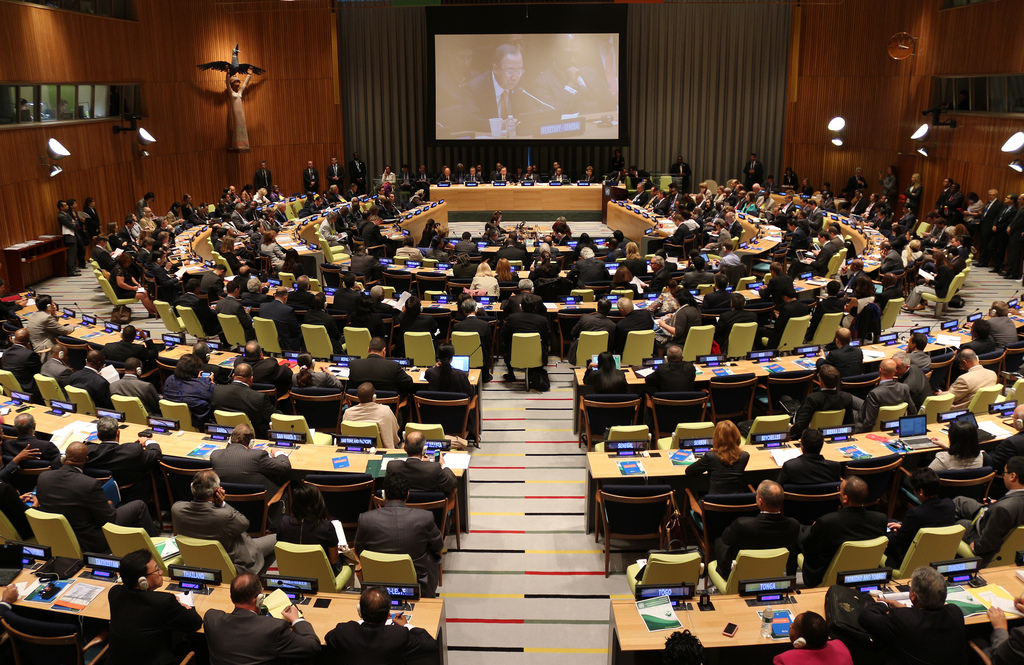
UN meeting (UN Info Centers)Think of the founding of the United States. Although the nation was not established after the order of a European monarchy, but as a republic, it nevertheless had to function within the existing international systems of its period. To put it crudely, the United States could not say, We’re not going to play the game because we’re a republic and not a monarchy. The United States, then, beginning with its first president, George Washington, engaged in diplomatic missions, negotiations, treaty agreements, and so forth. These took place across the Atlantic in European and north African nations and in  islands in the Pacific, including Hawaii, with a view toward engaging with China.

So too with ancient Israel. There is a pretty solid consensus among scholars, for instance, that during the long reigns of Israel’s second and third kings (David and Solomon), “Israel was in the Egyptian … sphere of influence,” and that in the close relations between Solomon and Egypt, “we ought to seek there for the models of Solomon’s bureaucracy” (Ibid., 23.) Citing the period during Solomon’s commercial enterprises with Hiram, king of Tyre, and Solomon’s alliance with Egypt through marriage, McKane concludes that “the Israelite state was modeled on the great states of the ancient Near East and so acquired a structure similar to that of Egypt.” It was a “political structure” in which there was associated with the king “a class of royal officials who had to do with the army, finance, foreign embassies and administration. Such officials were a ‘people of the king’ and had a common interest with him in maintaining the regime and suppressing popular resistance and discontent” (Ibid, 43).

The wisdom tradition played a vitally huge role in all of this, especially internationally. We have already considered the significant point that the wisdom tradition was cross-cultural and transnational in the old-world Middle East. Further, it was taken for granted in the corridors of power throughout the region that royal officials, especially those working internationally, would have been educated in their countries’ wisdom traditions. This seems to have been such an accepted part of international political life that it was unquestioned. It was a given. I want to call attention to two upsides to this.

(1) A ruler such as a Babylonian or a Persian king could feel comfortable and confident to include religious outliers, such as a Daniel or an Ezra, in his government, even as an official at the highest levels. This was an accepted norm in the international system of the region.

(2) A believer in Yahweh, such as a Daniel or an Ezra, could serve in a “pagan” government with a clear conscience.

Neither of these facts may seem a big deal in the context of today’s western nations, in which people of different faiths may serve in their nation’s government. But it is not a universal international norm today. In many Middle East governments, for instance, such as Iran or Saudi Arabia, Jews and Christians need not apply.

In the next post I want us to consider this international norm in the life of Joseph, an Israelite who served as a high-level diplomatic official for many years in Pharaoh’s Egypt.

©2014 by Charles Strohmer

Images by Great Beyond and UN Info Centres, respectively (permissions via Creative Commons)

THE DIPLOMATIC COMMUNITIES OF THE OLD-WORLD MIDDLE EAST

light at end of tunnellBeginning with this post some months ago, we began looking at the wisdom tradition’s close, albeit the forgotten, relationship to cooperation, peace, and diplomacy in the old-world Middle East. A few weeks later I began to illustrate those ideas, and this surprised people, on the diplomatic roles that were hiding in plain sight in the narratives of  Daniel and Ezra.

Now it is never good procedure to rest a case for the recovery of a lost way of seeing – in this case wisdom and the diplomatic – on one or two narratives – even if they are as impressive and convincing as Daniel and Ezra. Fortunately, the theme of wisdom and diplomacy is not an irregularity in the Scriptures. Daniel and Ezra are merely two narratives of many disclosing political actors, in one way or another in the old-world Middle East, functioning as part of what today we today would a regional foreign policy community.

In these narratives, the two most prominent classes of high-level officials that we see in the diplomatic corps were known in the Hebrew Bible as the hakamim and soperim. In brief, the former served chiefly as what we today would call ambassadors, diplomats, foreign ministers, secretaries of state, international negotiators and mediators, and so forth. The latter included diplomats, royal secretaries, master secretaries (usually professional writers whom English translators usually call scribes), and even, occasionally, high-level ecclesiastical figures and civil servants.

These two classes of high-level officials would have been educated in the wisdom traditions of their royal courts, they worked alongside each other, and their their roles could overlap. Both the hakamim and the soperim, along with other kinds of royal court officials, were indispensable to a nation’s domestic politics and international relations.

One of our difficulties is that we may be so familiar with reading the Bible in certain ways that we don’t see the wisdom-diplomatic connection and the vital insights that this way of seeing Scripture has to offer for today. For instance, if we are reading chiefly for our devotional life and personal moral development, and perhaps for help with our families and our finances, it will probably take a deliberate turning of the head to see wisdom in its diplomatic role.

There is of course nothing wrong with engaging with Scripture in those other ways, and we wouldn’t want to ignore them. But on this blog we are turning to Scripture, “reading” it, in a way that asks different, yet importantly relevant, kinds of questions.

I began getting a buzz on how significant wisdom and the diplomatic corps of the old-world Middle East was many years ago, when I was researching the period when “Israel the people” became “Israel the state.” In other words, when ancient Israel became a nation among the nations (a monarchy among monarchies) and was recognized internationally as such. There are some telling clues about this in the Scriptures, which may help us in furthering our understanding of the diplomacy of wisdom. I want to look at those clues in the next post.

©2014 by Charles Strohmer

Image by Silver Rose (permission via Creative Commons)

“WAR/NO MORE TROUBLE” playing for change

diplomacy or warWhen a war is being waged, diplomacy gets shushed in the corridors of power and marginalized by the media. Wars running concurrently intensify the quietism. When those wars are running a long time – the war on terrorism, the war about Iraq, the war in Afghanistan – one may be forgiven for concluding that diplomacy has been completely scrubbed from the nation’s lexicon. Sans diplomacy, the next logical step would be perpetual war. Although there are ideologues in America subtly arguing for that next step, there has been a great sense of relief across America the past few years to see diplomacy making a resurgence in Washington.

Rumors of wars will continue, and more wars will occur, but those who are discerning that this is a time for peace, and may it be a long time, please God, are wiser than those who want war. Rather than me rambling for a few more minutes on this, jump to this song, “War/No More Trouble.” A brilliant production, musically and lyrically. Enjoy. And be inspired.

©2014 by Charles Strohmer

INSIGHT FROM EZRA THE SHUTTLE DIPLOMAT part 2 of 2

wisdom traditionEzra, a priest-scribe with a pedigree in the line of Aaron, was a prominent Jewish religious figure in Babylon, but he also functioned as a shuttle diplomat for king Artaxerxes of Persia. Previously, we discussed the ongoing religious and political crisis in Jerusalem that arose over the rebuilding of the Jewish temple. This necessitated many and varied diplomatic missions and letters between Jerusalem and the Persian capital.

We are introduced to Ezra the shuttle diplomat in chapter seven of the book of Ezra, in which a detailed letter that Ezra has carried from the Persian capital to Jerusalem explains his royal commission. The letter is from king Artexerses himself. And, apparently, this was one of the last, if not the last, of the diplomatic missions necessary for resolving the crisis surrounding the temple’s reconstruction.

Just as a U.S. president will appoint special envoys to foreign nations to try to resolve troubled situations, this seems to have been the case with Artexerses’s appointment of Ezra. Ezra appears to have been serving in Artaxerxes’s Persian government (in conquered Babylonia). It is not clear what his duties were, but he seems to have held a distinguished position under the rather cumbersome title: “scribe of the law of the God of heaven” (Ezra 7:12, 21; King James translation). Ezra may have received his title from Artaxerxes himself.

In his diplomatic role, Ezra may have been something like Artaxerxes’s “Secretary of State for Jewish affairs,” given his religious pedigree, scholarship, and distinguished reputation. This would have been a crucial and sensitive political post at the time, for Artaxerxes and his cabinet (the seven counselors of the realm in 7:14-15) had inherited an imperial Persia that, having conquered and ruled many lands over many generations, was now experiencing political and social destabilization in various parts of the realm, including in Jerusalem. So it seems likely that Ezra had high-level connections with the cabinet, who looked upon him favorably and trusted him.

By the time of Artaxerxes’s reign, the temple had finally been reconstructed and Ezra, commissioned by the king, is dispatched from the Persian capital to Jerusalem with extensive political powers and a royal decree explaining his commission and detailing further Persian policy concerning the returned Jewish exiles. Although the text states that it was “the Lord God” who put it into the mind of the king to do this, we may assume that it was also a good foreign policy decision by Artexerses that would help strengthen Persian national interests in the region.

ancient JerusalemFor instance, Ezra’s commission as a diplomat to that highly religious city was aptly suited to his role as a distinguished Jewish priest-scribe, and the Jewish population in Jerusalem would have been glad to have been sent such a figure. Ezra arrived in Jerusalem with economic aid (a shipment of silver and gold) from the king in support of further work to be done, which would have further strengthened those international ties. Ezra also had been given carte blanche by the king to raise whatever further funds he needed and to solicit whatever help he needed to fulfill his commission.

It was also a fact-finding mission. Ezra is to make a detailed inquiry into life of the Jews in and around Jerusalem, including their religious health, and to take whatever steps he deems necessary to ensure the peaceableness of that community under Persian rule. Having concluded that inquiry, he is to “appoint magistrates and judges to administer justice to all the people of Trans-Euphrates” (Ezra 7:25). And the policy is backed by force. Those who fight against it can be legally prosecuted within the bounds of various penalties.

Much remains unknown about this tumultuous, decades’-long crisis in Jerusalem. Ezra’s diplomatic history is but a thin slice of imperial Persia’s complicated international politics. There may have been long periods when this diplomatic channel was not a priority or went silent.

My focus on Ezra the shuttle diplomat is meant to suggest that Artaxerxes could have imposed a military solution in Jerusalem. Instead, he followed in the footsteps of his Persian predecessors, beginning with Cyrus, and relied on diplomacy. Through diplomatic initiatives, the Jews in Palestine reestablished their religious identity and thereby regained a sense of cohesion as a people in Jerusalem, even though they remained under Persia’s rule.

©2014 by Charles Strohmer

INSIGHT FROM EZRA THE SHUTTLE DIPLOMAT part 1 of 2

rebuilding the templeThe person known to Jews and Christians as “Ezra the priest” or “Ezra the scribe” was also a political actor. He served as a shuttle diplomat for King Artaxerxes of Persia toward the end a long period of Israelite change and reorganization under Persian rule. Although Ezra’s role as a diplomat is often ignored, it is a fairly prominent role in the book of Ezra.

The book is complicated, controversial at points, and cannot be separated from the book of Nehemiah. Reasons such as these may help to explain why Ezra’s diplomatic narrative has not stood out to theologians and historians. Nevertheless, as with Daniel, what has interested me about Ezra is his diplomatic role and trying to puzzle out questions related to that role. Because much remains unknown about the regional political history that bears upon Ezra’s diplomatic mission, insights into that role run far short of the insights that were available to us about Daniel’s role as a diplomat. Yet let’s begin with what seems pretty certain about the regional history of the time.

The Israelites were living in exile in Babylonia, which was now largely ruled by the Medes and the Persians. Just before Ezra’s time, the Persian king Cyrus the Great had favored the Jews by issuing a royal decree authorizing the rebuilding of their Jerusalem temple and freeing any Jews who wished to return to Jerusalem to help in that rebuilding project. For the Jews of the shattered nation of Israel it was a turning-point foreign policy.

A foreign policy, however, can be resisted by powerful domestic constituencies and lobbies, and this occurred in Jerusalem when the returning exiles began settling in and implementing Cyrus’s policy to rebuild the temple. Strong, sometimes violent, opposition groups from Persian nationals and others arose against the exiles’ reconstruction efforts. Those efforts would then grind to a halt until Cyrus’s Persian administration, or subsequent ones, would intervene.

The book of Ezra makes clear Cyrus’s religious motivation for setting up the Jews back in Jerusalem (Ezra 1:1-4), but it does not indicate how that cohered with the king’s foreign policy interests. It may have been something as pragmatic as strengthening Persia’s presence in Palestine as a buffer against Egypt, which Cyrus’s eldest son, Cambyses II, later invaded and partly conquered for Persia.

At any rate it is clear that, following Cyrus’s death, political, religious, and racial turmoil arose in Jerusalem over rebuilding the temple. The reconstruction project entered a long period of halts and resumptions, during which many missions of shuttle diplomacy took place between Jerusalem and the Persian capital to resolve the crisis. Those missions spanned the reign of several Persian kings and involved three key groups of actors: the Jewish leaders in Jerusalem, the opposition groups, and various Persian kings and their administrations in Babylon.

The preservation of a number of detailed diplomatic letters in chapters 4-7 of Ezra, which were exchanged between Jerusalem and the Persian capital, offer rare insight into the shuttle diplomacy that was instrumental in resolving the long crisis. These diplomatic initiatives:

  • voice the concerns of the opposition groups and of the Jewish leaders in Jerusalem;
  • reveal what the opposition groups wanted clarified as to the original policy or subsequent amendments;
  • include royal edicts from Persian kings to the opposition groups and to the Jewish leadership;
  • detail the precise policies, explain the desires of a current Persian ruler, and charge the opposition groups not to obstruct the reconstruction project;
  • show that the diplomatic initiatives had varying effects in Jerusalem, including temporary reversals of policy.

In the next post we will see how Ezra fits into this regional religious-political situation as a skilled diplomatic figure.

©2014 by Charles Strohmer

Image by Irish Dominican Foundation (permission via Creative Commons)

PERSPECTIVES: THE WISDOM OF TURNING THE HEAD

perspectivesI was recently with a group of friends and we were talking about how our perspectives limit our understanding of what we see going on around us everyday and in the news. Everyone in this room can experience the same event, one lady said, but we will all see it somewhat differently because of where we’re coming from. I will see something that “Tim” doesn’t see and he will see something that “Rick” doesn’t see. And I probably need to see what they see and listen to it, because I don’t see it all.

This of course is a fact of life that we are all aware of – just think of a traffic cop taking an accident report! But just as commonly we may not be aware of how much our individual perspective limits what we can imagine to be true. So someone says, You won’t believe what happened to me! And we may not believe it. Even if it’s true.

At the risk of oversimplifying this, let me say that our individual perspectives affect the way we relate to others and how we make decisions about things across the spectrum of life. How we vote. Where our children are schooled. What we think about the economy and our political leaders. The kind of entertainment we permit ourselves to enjoy. Who we turn to for counseling in crisis. Our views on spending and saving. What we think about climate change our nation’s foreign policy. The kind of church we attend, or why we don’t attend. What we drive, where we live, who our friends are. You get the picture. It’s your perspective on life and you are working it out all the time daily in the decisions you make.

The same principle holds true for how we experience the Bible and tell others about it. Just as I would tell that cop how I, myself, witnessed the car wreck, my perspective will also determine how I answer if someone asks What is the meaning of that Bible story? Of course, many people don’t experience the Bible at all. But even so, that is still a perspective. (A friend once told me that he had been talking to a guy who had never heard of Adam and Eve.)

For the past several weeks, we have been exploring the first half of the book of Daniel (chapters 1-6) through the perspective of the wisdom tradition. And here’s an important thing about that. That kind of engagement with the text has helped us to see a Daniel we may not have noticed before. Seeing Daniel through the lens of wisdom made possible insights into Daniel as a statesman/diplomat. Such insights do not emerge, in my experience, when one’s perspective is that of “Daniel the prophet.” You have to turn your head from looking at Daniel the prophet to see Daniel the diplomat.

As one recent commentator aptly said about the Daniel posts: They have “given me a great opportunity to look at him from a perspective that I have not considered. Our society and leaders could find a lot of value in the wise approach of Daniel.” To this I would just add that I hope it will also be of value to us lesser mortals every day, as we make decisions across the spectrum of life.

There is much more that can be said about Daniel the diplomat. But I want to move on now, to look further at what I often call “the diplomacy of wisdom,” as it is seen in other, perhaps surprising, places in Scripture. So let’s now turn our heads from “Ezra the priest” to see “Ezra the shuttle diplomat.”

©2014 by Charles Strohmer

Image by Aphrodite (permission via Creative Commons)

ENDURING STICKING POINTS part 4 of 4

choicesOne of the most distressing dynamics among close colleagues of the same faith or political persuasion can arise when the sticking point of one colleague now means that he or she must diverge from the unity that has been built up among the group. This is particularly true over a big issue. You find yourself at an impasse: “I can’t go with the group on that. I’ve got to go another way on the issue.” The clear departure from what has become the norm for the group may really rock the boat, say, of a particularly crucial church project or public policy, especially if it is a prominent leader who has swerved from what was expected to be unity on the plan of action.

In the three previous posts, we have seen that four devout Jews (Daniel, Hananiah, Mishael, and Azariah) who were officials in the Babylonian government had the same sticking points about their schooling, their diet, and dream interpretation. But these four close colleagues may have had contradictory sticking points on two stunning policies. I am going to speculate a little, here, but there does not seem to be anything in the text that weighs in against what may be imagined here.

One of the two policy events, unfortunately, has been somewhat trivialized in a children’s Bible lesson called the “Tale of the Fiery Furnace.” It is, in fact, as we might say in today’s lingo, a story about religious intolerance (Daniel 3). In short, King Nebuchadnezzar has built a huge statue of gold in the plain of Dura and everyone is required to bow down and worship it. All goes well until Hananiah, Mishael, and Azariah (to use their Jewish names) make quite a public display of refusing to bow, even when given a second chance. In a fit of rage, Neb has them bound and thrown into a “burning fiery furnace” – perhaps the same one used to refine the gold? But God steps in and saves the three men. The king watches this all take place and is so moved by the rescue that he offers a doxology to The Most High God.

Question: Where was Daniel? What was he doing when his three friends were trussed up and thrown into a roaring blaze? Wasn’t he among all the government officials on the plain of Dura? The text is clear that the king had summoned all of his officials. So why wasn’t Daniel thrown into the roaring blaze? Did he bow to the statue? If so, he clearly had a different sticking point on this matter that did his three Jewish friends. If so, it makes one  wonder what that conversation among the four was like!

sticking pointOne day, however, the roles are apparently reversed, as seen in another famous children’s Bible lesson called “Daniel in the Lions’ Den,” which is really a story of political jealously (Daniel 6). Very briefly, Daniel is now a leading cabinet official in the government of King Darius, who is thinking out loud about making Daniel prime minister over the entire nation. But Daniel’s political enemies are jealous and plot to frame him as a corrupt politician.

When they cannot find any evidence of that, they seek to have him executed on religious grounds. So they con Darius into enacting a religious law of the land that they know Daniel will not obey, and he will have to be executed. Now the king really likes Daniel but he twigs to the con job too late. He deeply regrets that Daniel refuses to obey the new law, but he has no choice in this matter. He sends Daniel off to die and he is “thrown into the lions’ den.” But when God sends an angel to save Daniel, Darius is overjoyed and offers a doxology to “the living God who endures forever.”

Question: Where were Hananiah, Mishael, and Azariah? What was their position on the new religious policy? Did they obey it? If not, why weren’t they also thrown into that den of hungry lions? Or perhaps it wasn’t a sticking point for them, as it was for Daniel.

Nowhere does the book of Daniel, as far as I can tell, preclude us from considering the “Where was?” question I have proposed. The text leaves open the possibility that Daniel, Hananiah, Mishael, and Azariah had contradictory sticking points – as devout Jews and close political allies – on two huge issues at the heart of their religious-political lives.

As I see it, the agency of wisdom left them free in their consciences to believe and act as they would – as the pagan kings’ doxologies put it: To God be the glory.

©2014 by Charles Strohmer

Images by Lauren Macdonald & Aphrodite, respectively (permission, Creative Commons)

ENDURING STICKING POINTS part 3 of 4

identityThe question I want to begin with, here, is why did the four Jewish friends have a sticking point about the king’s menu but not about a change at the heart of their identities? That is, they accept radically different personal names (Daniel 1:7). This must have been a most distasteful compromise to these devout Yahwists, whose birth names are in various ways associated with characteristics of the God of Israel. But when they enter the Chaldean Institute their Hebrew names are formally changed to denote various pagan gods. Although some of these names have not been satisfactorily explained, the following indicates the enormity of the changes:

  • “Hananiah” in Hebrew means Yah has favored [me]. His new name, “Shadrach,” means something like Command of Aku (Aku being a Mesopotamian lunar deity).
  • “Mishael” means Who is what God is? His name is changed to “Meshach,” Who is what Aku is?
  • “Azariah,” whose name means The Lord helps, gets saddled with the “Abednego,” Slave of Nego (or Nebo; Isaiah 46:1). (Some scholars believe that “Abednego” has a relation to “Aradnabu,” Servant of Nabu, who was King Nebuchadnezzar’s personal deity.)
  • “Daniel” – God is my judge or God will judge or Judge of God – becomes “Belteschazzar,” a name similar to “Belshazzar,” a king of Babylon (Daniel 5). Both names stem from “Bel,” the chief god of the Babylonians, but it is unclear what “Belteschazzar” meant, possibly Bel is my prince or Protects the prince’s life.

Personally, I think I would have eaten the king’s food but put my foot down about being called Baalzebub or some such thing. But if these guys had any qualms about being identified with pagan gods, the text is silent about that. Although they submitted to radical changes of name, imagine what it would have been like to have been told – you a pious Jew – to walk around with one of those names and respond to it all the time in the royal court.

So someone asks Daniel, “What’s your name, sir?” To which he has to reply, “Bel is my prince.” Just think what that must have cost his soul as a devout Yahwist. Would it not have been a sticking point for many godly Jews of the time, for whom any association with the gods of the nations was a religious bugaboo? Yet Daniel, who is certainly aware of this deeply inbred religious antipathy, makes not a peep of protest. Apparently it is not a mountain that he, or his three friends, are willing to die on.

Although the text is silent as to why this was not a sticking point for them, we may assume that the changed names was not meant to wipe out their religious identity, for the text is clear that they remained free to worship Yahweh and that they did indeed do that. This, in fact, is consistent with a certain amount of religious freedom that the empire of Babylon  was known for. Instead, the radical changes of name went to the heart of their Jewish national allegiance, and as such served a political purpose. As a political official of Babylon, no way would Daniel be permitted to answer his king or a foreign dignitary who asked “What’s your name?” with the Jewish implications of God is my judge.

If these four Jewish men, then, were to be fully integrated into the Babylonian government, if not into society itself, their allegiance to Israelite nationalism would have to go away, at least symbolically. As with Joseph in Egypt, they would need new names that matched their political status as Babylonian officials. Some scholars believe that the change of names was probably part of an official ceremony in which the four swore allegiance to Babylon as naturalized citizens.

In the next post we will look at two more controversial sticking points in the narrative of Daniel the statesman/diplomat.

©2014 by Charles Strohmer

Image by John Nicholls (used by permission via Creative Commons)