What’s going on in America?

An old pal of my in England recently emailed me, saying that it’s almost impossible to find someone to say something pleasant about Trump on this side of the Atlantic, especially after the way he treated Zelensky in their White House meeting (Feb, 28, 2025). He also mentioned that his daughters can’t understand how a convicted felon, racist, someone who falsifies his tax and incited an attack on the Capital is even allowed to be elected, let alone President, adding that Prime Minister Boris Johnson was kicked out for way less. Paul concluded his note to me with, “What’s going on in America?” He is too perceptive a thinker for me to fall back on the lazy way of clichés, sound bites, or memes. We have had many long serious conversions over the decades. Here is my reply, sent on March 13, 2025.

Hi Paul,

Always good to hear from you. I can well understand why you and your daughters ask, “What’s going on in America?” I have often said that I write to know what I think. Your question has “forced” me to put into writing a task I’ve put off: to see what I myself think about what’s going on. Here’s some summary thoughts that came to mind. I have always appreciated the fact that you try to understand the behavior of others, even those you find offensive. I hope the following thoughts, although briefly stated, provide you and your daughters with some understanding.

I see several significant social and political shifts that have contributed to what’s going on in America today: the rise of the imperial presidency; government run increasingly as a business; the steadily escalating division between the conservative-minded and the liberal/progressive minded; Trump’s working principles; Trump’s pivot to Putin.

1) The rise of the imperial presidency. Trump is the current Oval Office heir to what’s been called “the rise of the imperial presidency.” In the modern era this was given a boost when the U. S. Congress, which alone has the sole constitutional power to declare war, did not declare war on Vietnam but instead authorized Presidents Kennedy and then Johnson to use “military force.” After Johnson, President Nixon held a vast view of executive power, which, in my view, grew considerably as a result of what he saw he could get away with (e.g., illegal wire taps, withholding information from Congress, circumventing judicial processes) until he got busted through what became know as the Watergate scandal, which broke in the news (1972-1973). Eventually, with his near-impeachment at hand, Nixon resigned the presidency (Aug., 1974). Afterward, some attempts were made by the U. S. Congress to try to curtail presidential power to shore up constitutional restraints. Yet neither the political liberals nor conservatives gave up wanting a president to be the guy who dreams big dreams for the nation and promises to make them a reality (one hears this bs implied or directly stated all the time in presidential campaign speeches).

Then came a tipping point: 9/11 and U.S. responses. Besides Congressional authorization of George W. Bush to conduct military actions (but called wars) against Al-Queda, the Taliban, and Iraq, Congressional acquiescence played an important role in allowing Bush, and President Obama after him, but especially Bush, to exercise presidential power domestically that was virtually unchecked by meaningful legal limits (e.g., Guantanamo Bay, spying on US citizens, Obama’s military strikes against Libya and ISIS exceeded constitutional limits).

It seems to me that constitutional brake pads meant to stop the movement of increasingly abusive executive authority have worn thin over the decades. Apparently Congress has not been able or is willing to slow down, never mind stop, what has become the ever-evolving executive authority a president gets away by using presidentially appointed teams of clever constitutional lawyers. It doesn’t matter which political party sits being the so-called Resolute desk in the Oval Office. Each president, in his own way, has a field day (for 4 or 8 years) bypassing constitutional restraints on presidential power, each in their own (partisan) ways, getting much of what it and his party wants, while Congress does little or nothing about it, or even endorses it, as the majority party in Congress will usually do – currently the Republicans. Large segments of the population of the party in follow in step.

The raft of Executive Orders adds to the problem. EOs are created and signed by presidents because EOs do not need Congressional approval. They can at times be good for the country, but they can also be vehicles whereby a president gets around federal laws. EOs are often reversed or cancelled by the next president if that person is from the other party. Congress and federal courts can strike down bad or unnecessary EOs, but that takes time, and all the while the limits of executive authority continue to be tested if not crossed. Although we are currently only weeks into Trump’s second term, many of the EOs that his administration are carrying out are having the effect of a guillotine upon agencies and institutions rather than being actual reforms (no one disagrees that actual reforms of various agencies and institutions are necessary).

The imperial presidency (the cult of the presidency, as some now call it) seems to be reaching what the Old Testament person would call idolatrous proportions in more recent years. All sorts of social and political unrest here has emerged and contributed to this, including a number of Supreme Court rulings that have reified the social and political divisions of an already split country. Into the volatile mix, add Trump’s first term, the rise of MAGA, his absolute refusal to admit he lost the 2020 election, the January 6, 2021 violent riot at the Capital, the Biden administration (4yrs), and now Trump’s second term, which seems to be taking of monarchial dimensions, fueled by strong support from Republicans in Congress and some strange brew of MAGA people and many Evangelicals. Trump is having his own field day. The imperial presidency seems to have been unleashed. My question to myself has been: is it unlikely that Trump will try, with Congressional support or not, to make an end-run around the constitution and go for a third term, or worse?

2) Government run as a business. About 20 yrs ago I began collecting occasional pieces of analysis which argued that a subtle and at-times not so subtle shift was occurring in which our federal government was being steadily transformed into a business enterprise. I don’t have access at this time to my notes on this development, but the thesis seems to have been prescient. Our “government” has slowly been moving outside of functioning within the laws, norms, and principles respective of a constitutional republic to be increasingly run, “governed,” as a business enterprise. Jim Skillen has done extensive research into this. He recently summed it up this way: “the federal constitutional order of the United States republic is increasingly being governed – as well as interpreted by the Supreme Court – as a marketplace.” Trump moved this shift along during his first term (2016-2020), with various political moves that directed more government benefits and power to big corporations and the wealthy. He is strengthening, if not solidifying, the shift of the U.S. to become increasingly identified as marketplace. As Skillen muses, “the outcome might look more like a privately owned company whose chief investors and directors constitute a corporate oligarchy under his autocratic authority. In either case,” he concludes, “Congress and the Supreme Court my find themselves shrunken to toddlers tagging along for the ride.”

Trump is a businessman and, as you say in your email, he seems to think international politics is like real estate deals, which seems to be dragging us into a dangerous and darker future. He seems to know no other way that being a businessman. That’s how he’s running the presidency. As he’s found of saying: “I’m a deal maker. I do deals.” Interestingly, he never adds, “and I’ve been bankrupt many times.” I mention that little omission since he’s now running a country, and it makes me wonder what he is running it into.

3) The slow revolt of the conservative-minded against the liberal/progressive-minded. Or, to put it this way: the steady movement of social liberals/progressives away from religious conservatives. This movement now seems to have spanned into unbridgeable gap, playing itself out politically in the near-absolute division today between the Republican Party and the Democratic Party. Its social-political roots can be traced to the rise of the moral majority (late 1970s). The movement gained a lot of traction during Reagan’s 8-year tenure (1980s), with the division at times becoming more defined during the 16-year period that gave us the Bill Clinton and George W Bush presidencies, respectively(1992-2008).

After presenting himself as a kind of left-of-center Democratic candidate, when elected President Obama (2008-2016) slowly influenced the Democratic Party leftward, particularly when he publicly came out in support of gay marriage, which seems to have been a subtle factor in setting in motion enough social momentum across the country for the Supreme Court’s landmark decision in 2015 to legalize gay marriages. Further contributing to the liberal/conservative division in our country was the Court’s decision in 2022 to end the 49-year old law that guaranteed a constitutional right to an abortion. The decision was seen as a huge victory for conservatives (it put the ball back with the states, and it so far has not slowed down the rate of abortions, and it has resulted in previously unheard of complicated lawsuits). Since then all sorts of trans-related issues are making the (so-called) left-right division here even more absolute. Further, Trump’s first, and now his second term, are solidifying the country’s social, political, and religious divisions.

4) Trump’s working principles. In brief: deny, deny, deny; obfuscate, obfuscate, obfuscate; sue, sue, sue. To understand these, one needs to look into the life of Roy Cohn, the lawyer who was key in Trump’s rise to power in real estate; the two men had a close business relationship. I researched this around 2016-17. That research explained a lot about Trump, which is in evidence even more consistently to this today. Cohn (d. 1986) was known as the person who mentored Trump in many and varied ways to exploit power and instill fear; Cohn’s formula: attack, counterattack, never apologize. Cohn was also expert at media manipulation. Apparently the 2024 biographical film, “The Apprentice,” (I’ve not seen it) is partly about this relationship.

5) Trump’s pivot to Putin. There’s no need for me to say anything about this because it’s been so much on Trump’s own lips and in some of his actions, beginning in his first term, but now quite often; it’s become self-evident. In my opinion, Trump is edging his way into ruling the U. S. like Putin and Xi Jinping rule their nations.

It’s over to you now, mon ami. These significant five shifts in American life (there would be others) seem pretty clearly implicated as motivating social and political factors. Thanks for the opportunity to know what I think! Which, as always, seeks further understanding. I hope these five begin to help us build up a comprehensive picture re what’s going on here today. I look forward to your further thoughts on this.

Continued grace, strength, and wisdom.
Charles
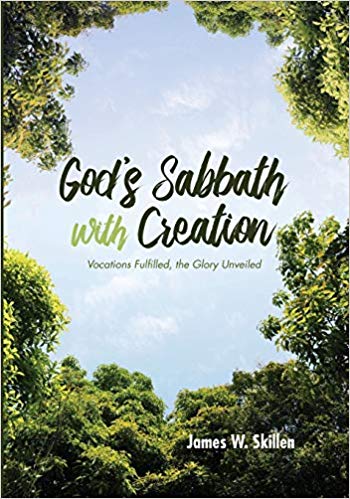
Past, Present, Future: Christian Belief, Life, Expectation

God’s Sabbath with Creation: Vocations Fulfilled, the Glory Revealed
James W. Skillen
Wipf & Stock Publishers
368pp

Reviewed by Charles Strohmer

During the 1970s, the combined influence of books by Francis Schaeffer, the presidency of Jimmy Carter (the first self-described “born again” Christian), and the rise of the moral majority motivated many Christians to start reevaluating what it means to live in the world. A longstanding pietism in which Christians had opted out from as much of “the world” as they could possibly afford to gave way to a focus on social and political activism. This rather ad hoc and inchoate period of Christian rethinking and engagement had, by the 1990s, grown more visionary. An entire industry had arisen in Protestant circles for educating believers about serving God in all of life – work, art, philosophy, education, economics, science, the environment, and all the rest of it. The troubling tension of how to be in the world but not of the world had become passe. Now it was simply a matter of discovering how best to engage.

Today it is easy to find biblically-grounded books, conferences, activist non-profits, and courses in Christian colleges and universities nourishing and training believers in well-thought-out ways to live in the world for the glory of God in their chosen fields. As one of many writing and teaching voices of this expanding universe, I’ve had to keep abreast of developments. Space and time constraints preclude saying more about that universe here. Instead, I want to focus on James Skillen’s remarkable book God’s Sabbath with Creation: Vocations Fulfilled, the Glory Revealed.

This is a book of exceptional importance. Rarely have I come across a work with weightier significance about what it means to live for the glory of God today, in the here and now. Of course this is a theme familiar to Christians. Yet familiarity can breed inattention. That would be a mistake with God’s Sabbath with Creation. For it is Skillen’s pioneering way of getting us to think about what it means to live today for the glory of God that marks this as a standout book. His subject is the great biblical drama from the creation to the future we anticipate in the age to come, and, importantly, human responsibility within that drama. For Skillen places how we live today not in some existential moment but within God-commissioned human responsibilities, which run throughout history from the creation to the age to come. Even seasoned public voices on this subject should find the book stimulating and memorable.

Begun in seminary and college and continuing irregularly afterward, this book was a long time coming; it is easy to see why it is Skillen’s magnum opus. In it, he steps back from the subjects of his many previous books, which enter into problems of contemporary politics and obstacles to just governance (domestically and internationally). In God’s Sabbath with Creation he offers invigorating insights from decades of hard-won wisdom as an elder statesman in the body of Christ and a respected public figure who has wrestled with the Scriptures about the meaning of both the creation and human life as they are related to the future that Christians anticipate in the glory of the age to come. He aims to show, and in ways that may surprise, essential connections between the creation, how life in this world is lived, and the future that God has promised.

To set the stage, he writes that two questions had been growing on him throughout seminary and college: “1) is the fundamental identity of humans their sinfulness?, and 2) is the fundamental identity of Jesus that he is the savior of sinners?” He eventually concluded that “the sin-and-salvation story is an insufficient abstraction from the larger biblical story.” Although sin and salvation are fundamental to his thought, the book’s thesis takes seriously the larger biblical view that Jesus is not first of all the savior of sinners, and that humans are not first of all sinners. Instead, he explains, Jesus, the incarnate savior, is first of all the one through whom all things are created and hang together, and humans, though sinful, are first of all the creature made in the image of God. Having set that stage, Skillen raises the curtain on “how the sin-and-salvation story unfolds within God’s seven-day creation order, culminating in the celebration of divine glory in God’s sabbath with creation” (his emphasis).

Because what we believe about the age to come is influenced by how we understand our origin, Skillen starts us on our journey to the anticipated future with a distinct interpretation of the seven days of creation. Calling attention to the Creator, he explains how and why Genesis chapters one and two tell the story “of God’s days, not sun-and-moon days, geological eons, or evolutionary stages.” In other words, “it is clear that the ‘time’ of God’s creation week does not belong to the time of our days and weeks under the solar-lunar order, which God establishes as his fourth creation day. God’s days constitute everything including the sun and moon days of God’s fourth day.”

Especially important, he continues, “is the way the days are defined by their content, that is, by what God makes. . . . The text does not say, ‘On the third day, God made this or that,’ as if a sequence of days already existed and the creator simply made different things on each successive day. No, the creation days are God’s days and they are distinguished by what God makes.” Skillen helpfully illustrates this by noting that it is one of the ways we talk about time when speak of dinnertime, bedtime, or harvest time. “Each of those ‘times’ is defined by an action or subject matter, not by a pre-determined number of minutes, hours, or days. God’s seventh day does not even have an evening and morning, yet, it, too, is called a day – the day when God’s creation reaches its climax.”

A full range of thoughts about God’s days and God’s time, and connected topics, are developed in Part 1, themed as “Created Reality.” Topics include the evening and morning phrases of Genesis one, human identity, creation as architectural wonder, cosmic temple imagery, and the male and female image of God. Skillen has much to say about God’s days as encompassing all of creation, from beginning to fulfillment, and that the full reality of God’s seven-day creation week entails both this age and the age to come.

The stage is now set for us to move from being mere onlookers at the biblical drama to commissioned participators in it. Skillen writes that human identity includes “the exercise of high-level responsibilities in God’s creation,” and the theme of “human responsibility” is  a central focus of the book. Skillen often discusses our many and varied responsibilities in this age in terms of our “sixth-day commission from God” – a commission that very much matters for the age to come. “The meaning and purpose of human life on earth has not yet reached fulfillment” because “men and women have not yet completed their sixth-day commission from God.”

Understanding human purpose on earth is essential to Christian thought. One of the invigorating insights Skillen makes to this is his way of including the nonhuman things of creation, which also very much matter for the age to come. For instance, “humans are unable to exercise their responsibilities without light from the sun, moon and stars, food to eat, water to drink, dry land to live on, plants and animals, and fellowship with one another and with God. . . .” Thus nonhuman creatures are made for distinctive purposes and functions. “Sun, moon, and stars govern the day and the night. Plants, trees, fish, fowl, and animals bear fruit or generate offspring.” Beyond that common understanding, every nonhuman creature, he writes, has its commission and reveals “something of God because they are constituted in their very identity to be revelatory in anticipation of the fulfilled creation.” The nonhuman creatures, then, “host humans as part of the creation’s hospitable welcome and praise of God. . . . That is why the psalmist [Psalm 148] can call on all of them to worship and praise God.”

Skillen’s emphasis on the nonhuman things of God’s creation is a key to his thesis of human responsibility throughout history. We live in “the arena of human generational development, a narrative that can be nothing other than the drama of sixth-day human creatures in their relations to one another, to all other creatures, and, above all, to God who orients the whole creation toward its seventh-day climax.” It is in this created context (nowhere else) that we have been given commissions to fulfill. “Humans are able to obey or disobey the creator, but they cannot sidestep or escape the responsibility inherent in their identity and commission from God.”

Throughout the book Skillen sheds fresh light on diverse responsibilities that we have – to God, to nonhuman creatures, to each other, and to all of life in the here and now – as we move through this world toward the future glory. These are responsibilities that include much more than practicing spiritual disciplines, such as faithful praying, or obvious moral behaviors, such as not flirting with the secretary and no longer cheating on your taxes. Human responsibilities are, he writes, “seemingly innumerable.” They are many and varied, multifaceted, vast in scope, and develop in ever-greater complexity over generations.

The book explores areas of responsibility that reach into the future, but that we may not have thought about, or that we may have decided to ignore as unimportant in the long run. Here is a sampling. Tilling and harvesting, animal husbandry, medical care, music-making, engineering, writing and speaking, exploring the microcosmic and the macrocosmic, economic development, public governance, clothing design, preparing food, working in the law courts, care for the elderly.

Since “none of God’s six creation days has yet been wrapped up,” Skillen argues that every human responsibility is always contextualized within the ongoing days of creation, from the beginning. “With the unfolding of the human generations and the historical development of their talents and capabilities, their responses to God’s commission diversifies into a vast array of responsibilities. Humans name the animals, begin to tend the garden, bear children, and in the course of their generational unfolding discover more and more ways to develop the creation and their own talents in exercising royal and priestly responsibilities. Humans make music, invent tools, nurture friendships, engage in commerce, and govern clans, cities, and nations.”

Skillen connects his appeal for increased human responsibility to the word “vocation,” which appears first in the book’s subtitle and provides another key to his thought. He is not limiting the idea of vocation to the sense of a religious calling, such as to the ministry, nor to one’s chief occupation, or career. He does not preclude those senses of the word, but he is employing “vocation” somewhat correspondingly to what some call the “cultural mandate.” In fact, however, he is opening that mandate up in a way that may be surprising, yet hopefully helpfully so, to many Christians.

Here I am thinking of the Christian circles where an understanding of the cultural mandate has been framed by what has been called the seven mind molders, or seven spheres, of Christian influence: family, church (religion), education, media (distribution of information), government (law), business, and arts (including entertainment). Although Skillen does not directly engage with this framework of understanding, he certainly includes the seven areas as in need of being transformed by biblical thinking. But he unfolds and diversifies human responsibility into aspects of life, and, significantly, a way of thinking about them, well beyond even the most sophisticated developments of the seven mind molders paradigm.

There is much solid food in this large book, which is helpfully organized in seven parts, each with several short chapters that shed light on the continuity between the creation, what we do each day, and the future glory. Part 2 considers the meaning of four of creation’s “revelatory patterns,” which Skillen names with the doublets: honor and hospitality, commission towards commendation, covenant for community, and revelation in anticipation, including insights about the revelatory nature of creation. For instance, he writes: “The Garden of Eden, the tabernacle, the temple, the people of Israel, the body of Christ – all these reveal something about, and point toward, the climatic, seventh-day fulfillment of them all. Every earthly expression of God dwelling with his people and the people with God serve as revelatory images of God’s larger, creation-wide building project. The architectural wonder of creation is that all creatures in their glory are made for God, for relationship with God, and fulfillment in God’s unending sabbath celebration.”

Part 3 provides biblical examples of the “covenantal disclosure of reality,” which, Skillen explains, is cumulative and multi-generational in purpose from the beginning, forward moving in time from simplicity to complexity. This “dynamic of an ever-expanding revelation of God with, to, and through the human generations keeps intensifying in anticipation of the culminating fulfillment of all that has been, and is being revealed. To underestimate or to miss the intensification of this mounting covenantal disclosure is to miss the revelatory and anticipatory character of God’s purposes for and with creation.”

Parts 4, 5, and 6 take up themes of lively debate in biblical interpretation today, to show how an understanding of creation as God’s seven-day week sheds light on those subjects. These three parts explore the relation of the first Adam to the last Adam, the biblical tension between the “already” and the “not yet” of God’s kingdom, and, relying on Romans 9-11 and Hebrew 4, the historically weighty questions of the relation of God’s covenant with Israel to the new covenant in Messiah Jesus, to the church, and to what Skillen calls “becoming Bethel.”

The book abounds with a mature, biblically-based practical wisdom for running the race that has been set before us in the here and now, as individuals, groups, institutions, and nations in anticipation of entering into God’s rest, the seventh day of creation. Part 7, in fact, includes much discussion about wisdom itself. There, Skillen has averred that wisdom is what parents need for nurturing loving families through many stages of development and unanticipated crises. It is what government officials need for conducting sound statecraft and to uphold justice. It is what responsible farmers, engineers, teachers, artists, entrepreneurs, and others of all sorts need “for the development and practice of their distinctive crafts, the organizing of interrelated disciplines, and for training apprentices who will eventually be able to go beyond their mentors in creative and fruitful achievements.”

When “humans conduct their affairs worthily, build sound institutions as well as trustworthy relationships, and do right by one another and other creatures, then they reveal something of the wisdom and glory of God that anticipates the full disclosure of the glory in the age to come.” In short: “Wisdom is not first of all a tool for survival, but the fuel for flourishing in God’s creation as we learn to know ourselves ever more truly in the process of knowing God ever more profoundly.”

The book’s aim, then, is broadly threefold, weaving together the creational, the teleological, and the eschatological. In these three areas, pastors, seminary and university professors, child reading a Bibleand students who work in the area of biblical studies will benefit from Skillen’s clarifying insights throughout the book as he engages with the views of prominent theologians, philosophers, and scholars. Among them: N. T. Wright, Jürgen Moltmann, Abraham Kuyper, Karl Barth, Craig Bartholomew, Meredith Kline, Herman Ridderbos, Eric Voegelin, Richard Gaffin, and Terence Fretheim. Skillen’s many generously footnoted, discerning outcomes with his interlocutors alone are worth having this book to-hand, as does its bibliography and extensive index.

Having said that, I should add that just about anyone with a serious interest in the Bible will benefit from the book, even those who run across an occasional page where they may be unfamiliar with an idea of one of Skillen’s interlocutors. The footnotes for any such moment may prove helpful, but if not, I would suggest just keep reading. You don’t need to grasp all of the more specialized ideas to benefit from the book’s overall wisdom. On the other hand, readers who hold to an eighth-day view of the age to come, or those with a prodigal exuberance for being transported to the streets of gold, may be particularly challenged.

All readers, however, even if meeting with new ideas at times, will journey through God’s Sabbath with Creation in the kind of rest that is classic Skillen, writing, as he does, with a humility and grace that gives readers room to make their own decisions. Even when he is critically engaging with his scholarly interlocutors, collegiality stands out. The spirit and tone of the book is a refreshing relief from the incessant viewpoint screaming on social media and the braying of absolutized social and political values and interests by so many pundits.

Skillen summons us to reach toward maturity in our many and varied responsibilities, to live a life worthy of the vocations we have received. Laurels are not to be rested on. Skillen has, through much experience, earned the wisdom to admonish us where that is needed. He points out, clearly and perceptively, paths whose means and ends, if we follow any, will prevent us from being all that we can be as the image of God in our world. We may, to note just one here, fall prey to a subtle reliance on the ideals of freedom and human autonomy. In short, “self-generated preferences” must go. Instead, what is required is our “attentive listening above all to God and to the reality of God’s ordered creation, a reality which we did not create and in which we are not the only creature.” We have “God’s promises of a reordered world,” he writes, ever mindful that “there are no cheap and quick answers for those suffering great harms.”

In rabbinic thought, there is an old parable that seeks to aid in understanding God’s call of Abram to leave home (Genesis 12:1). The gist of the parable is this. Abram has left Tehran, his home, and while traveling he is bewildered by all the injustices and evil he sees during his travels from place to place. Somewhere he becomes deeply distressed when seeing a palace in flames. If its owner went to all the trouble to build something so beautiful, he wonders, why isn’t he looking after it, why does he leave it to the flames? While pondering this evil, the owner of the palace looks out at him and says, “I am the owner of the palace.” Suddenly the penny drops for Abram and he associates the experience with God and God’s good creation. He now understands that God has not abandoned his creation, not left it to the flames.

Modern rabbis tend to interpret the parable as a calling for Abraham to instruct his children and posterity to fight against the moral disorder, bloodshed, and chaos of the world by keeping the way of the Lord by doing what is just and right (Genesis 18:19). In the words of Rabbi Shai Held, Abraham “and his descendants are called to embody a different way of being in the world, to present a living alternative to the horrors of the world as it is.”

James Skillen has given us a book about the meaning that Christian difference and presence can make in the world, today, in light of glory of the age to come. Like Abraham and the biblical prophets, we as Jesus Christ’s followers are called to embody a living alternative to the evil, injustice, and horrors of our day. Things are not currently what they should be. The creation is not yet what it is ultimately intended to be.

But the palace is not going to be destroyed. God’s Sabbath with Creation explores why, and how, maturing fulfillment of God-commissioned responsibilities play prominent roles in the great drama of what the creation is ultimately intended to be, when, as Skillen concludes, the time of God’s sabbath arrives – the seventh day creation – when human will rest from their labors in God’s rest.

©2020 by Charles Strohmer

Images: courtesy of Creative Commons, in this order: Sam Mac Entee, National Geographic Society, Samantha Sophia

Stranger at the Gate

The second time I saw the aged gentleman was at the gate where my wife and I were waiting to board our flight back east. He had been pushed there in a wheelchair by a muscular sheriff, equipped in full gear and accompanied by a social worker. I could understand the social worker’s presence, but a sheriff’s? Law enforcement did not fit the scene I had witnessed the first time that I saw the fragile but well-dressed figure, an hour earlier, standing unsteadily in the queue at the airline’s check-in counter, just ahead of me and my wife.

He was alone and should not have been. Shrunk down with age, he was standing alongside a rolling walker that was supporting him as if he were balancing on thin ice. He would inch a tentative step or two closer to the walker and then slightly stoop to grab support from one of its handle grips. The walker sometimes wiggled on its small wheels as he moved like this. Then as if having second thoughts, he would release his grip and stand as straight as his frail frame allowed, for as long as possible – never for long.

He wore the pained expression of a helpless person deeply disturbed about something. But what? He regularly alternated his gaze toward the check-in counter and then to the nearby large plate glass windows and sliding doors that offered a view of the drop-off area at the curb. He seemed to be searching for an explanation to come from either counter or curb. But none came.

Although it was 9:30 in the morning, there was hardly a soul in the small airport on California’s central coast. Four ticket holders had arrived before me and my wife, and we had all arrived too early to check in; there were no airline personnel at the counter. The third in the queue was the elderly gentleman. One of the ticket holders talked briefly with him from time to time, but he spoke softly and I couldn’t catch what he was saying. When I mentioned this to my wife later, she explained that he was agitated and kept whispering, Where is she? Why did she leave me here? When is she coming back?

Around 10am, he seemed to give up expecting any help to arrive from the counter or the curb. I was a mere two arm-lengths distant, but by the time my wife and I quit negotiating about whether to offer him assistance, he had labored himself down upon the rolling walker’s padded seat. As if on cue the check-in crew appeared. My wife rushed to assist him and to ensure that a flight attendant got the picture.

In a matter of minutes we had been checked in for our flight to Dallas and ushered uneventfully through the TSA scanners. In the waiting lounge near our gate – an hour to fill, and eager to finish an engaging book – I promptly forgot about the man I would soon know as “David,” whom I had last seen talking with a flight attendant at the check-in counter. A half-hour passed and suddenly there he was. The sheriff had left him with the social worker at a convenient spot near the gate. The two were sitting next to each other but not talking. I had a good view of his downcast face. When we made eye contact, he looked sorrowful.

They boarded him first. My wife and I were among the last. A ticketing issue and a full plane prevented us from sitting together. Never mind. We had been given window seats. As we boarded I followed her profile up the narrow aisle with my eyes until she found her seat, then I looked for mine. And there he was again, in a bulkhead seat on the aisle, the window seat next to him empty, no social worker in sight. He was clutching a wad of papers and a prepackaged sandwich in his right hand. He looked preoccupied and I hated to interrupt him.

Excuse me, I said. He looked up and turned sideways as best he could to make room as I bent to squeeze past him – banging my head sharply on the low overhead compartment – to occupy the seat next to him for the three hour flight. On planes I often argue with myself about whether to engage the person next to me, or to pretend invisibility and disappear into a book. This time I favored the book I hadn’t finished in the lounge. (Good Prose: The Art of Nonfiction, if you’d like to know.) I pulled it out of my carry-on bag and made sure my seatmate knew what I had planned. I wondered about the sheriff, but felt it wasn’t my place to pry.

Before I could get back into issues of prose structure and style, however, the joke I made about banging my head had brought a smile to his face. We introduced ourselves and made some small talk. He carried a gracious, almost dignified, manner, and seemed keen to tell me something. And he tried, but I wasn’t getting it. At times he spoke in complete thoughts and was easy to follow. Sometimes he fell silent, leaving a thought uncompleted. Other times he jumped from topic to topic sans any segues that I could detect. Even when I leaned in, it was hard to hear his softly spoken words above the engines. I thought I caught the words “her daughter,” “kidnapping,” and “two women,” but I wasn’t sure, so I let it go.

Do you live in Dallas? I asked. I’m going to Connecticut, he said. Oh, you must have been visiting someone in California, I said, wondering why anyone had allowed this fragile figure to travel across the country on his own. No, he said, I’ve been living in California with my wife.

helping handA hostess locked her cart next to us at the bulkhead and handed out pretzels and drinks. I accepted a cranberry drink and took a protein bar from my carry-on. Papers and sandwich still clutched in his hand, David folded the papers out of the way and began slow work on the sandwich.

Man, you’ve got a long day ahead of you, I said after he’d finished eating what he could of his sandwich. You’re probably not going to get to Connecticut until midnight. My children are in Connecticut, he said. They want me and my wife to live with them there. I’m going to make arrangements. Then I clearly heard “her daughter” and “kidnapping,” and also “two women” and “one-year-old boy,” but for no apparent reason. I wanted to ask why he said this but decided not to.

My wife had a stroke in Florida last year, he said, emerging from silence. She can’t walk. Her daughter got her to move to California. Said she would take care of her. So we moved. But I’m done with her now. Who does he mean? I wondered, now more curious. [Unclear] we never should have done that, he added. [Unclear] worst decision we ever made. We lost everything.

As we flew on, I learned that he was eighty-six and that for thirty-two years he had been an assistant to the headmaster of a large boys’ school in the Midwest, and that afterward he had retired to Florida. That long career accounted for his gracious, disciplined deportment, but it could not hide his distress whenever he returned to “the kidnapping.”

This put me in a dilemma. The journalist in me wanted to probe, question, conduct an interview, get the story. The Christian in me wanted to be a listening ear, to befriend the stranger, to reach out somehow with grace.

I carefully slid from my seat and walked the long aisle to the toilet. Earlier in the flight, David and I had talked about our churches, and discovered we were brothers in Christ. When I got back to my seat, I said I was sorry to hear about his wife and that I would pray for her and the move to Connecticut. Thank you. I’ll say a prayer for you, too, he said. We had a nice house in Florida, he added after a pause. We should have stayed there.

I was learning something. But what? Even though he occasionally repeated himself, I was still missing many of his words. Whatever story he was telling, I wasn’t getting it. Afterward, it reminded me of trying to understand a movie you had walked in on in the middle of. I did catch that the kidnapping had taken place in California. It clearly pained him to talk about it, but talk about it he did.

When he asked if I’d seen the Amber Alert on the news in California, I explained that I’d been on vacation and tried not to listen to the news. They kidnapped a one-year-old boy, he said. Can you believe it? A one-year-old. It was on the news for days. When? I asked. A few days ago, he said. The boy was in protective custody. But they caught them. Her daughter put a knife to the social worker’s throat. Told her she’d kill her if she didn’t let them take her son. That’s terrible, I said, words failing me. They kidnapped him, a one-year-old boy, he said again. Can you believe that? David again fell silent and I wondered who he was talking about.

Will you have to fly back to California to bring your wife to Connecticut, I asked? No, he said. The social worker is arranging that. We’ve lost everything. After my wife had her stroke, her daughter convinced her to move to California so she could look after my wife. So we moved there from Florida. But we found out that she only wanted my wife’s money. Her daughter spent it on herself and her daughter. The social worker told me that after they caught them. Caught who? I blurted out.

My wife’s daughter and her daughter, he said. They caught them in Los Angeles. The social worker told me they think they were headed for Mexico. Kidnaping, attempted murder. Can you believe it? They’ll go to jail for a long time, won’t they? I guess so, I said. My wife is heartbroken, he said. When I told her about her daughter she cried. But the little boy is safe now. But can you imagine him growing up with them?

I could not.

But I could reflect on our conversation, and I had plenty of time for doing that during the four-hour layover after my wife and I deplaned in Dallas, before our flight home to Knoxville. As we said our goodbyes, David warmly shook my hand, said Thank you, and added: Say a prayer for my wife. He was wheelchaired to the gate where he would connect with a flight to LaGuardia. There, his family would pick him up for the drive to Connecticut. I kicked myself for not having asked him for his number so I could follow up. Many times I almost asked, but it never seemed appropriate.

I found a comfortable chair in a quiet area of the large terminal, where I pulled a pen and a small spiral notebook from my shirt pocket and scribbled pages of notes about the last three hours. Who would’ve thought this likable person was suffering so much? I spent days afterward thinking about him, and whether I’d been the right kind of seatmate.

God and AdamThen the penny dropped. He was heartbroken and needed to talk with someone other than with social workers, the police, or even his family about what had just happened to him and his wife. Talking with them, as necessary as that had been, had not been a means to the emotional distance he needed from so much anguish. Perhaps our long, off-and-on conversation had been that means of grace. David had seemed seem calmer, more at peace, when we said our goodbyes.

In a gentle, beautiful book, The Shape of Living, David Ford notes that people who suffer from severe evil and injustice are overwhelmed by it; they suffer alone and need to be held in non-physical ways that bring divine grace. But how do you hold a stranger that way in the middle of an airplane on a flight across the country?

I remembered something else as I say next to this kindly African-American gentleman, one of many insights I’ve learned from reading Abraham Joshua Heschel. It’s a line from God in Search of Man: “Something sacred is at stake in every event.” As a Christian, I’ve come to interpret this to mean that when I come into the presence of another human being, especially a suffering one, I can enter into the presence of Christ for that person and then it’s no longer about what I want, it’s about what Christ wants.

If I could talk to David again I would of course ask how life was going now for him and his wife, but I would also ask him if he was checking me out early on in our conversation to determine how much he could say to this stranger at the gate. And I was glad that by God’s grace that I’d set aside the journalistic me and instead leaned in as a listening ear.

©2019 by Charles Strohmer

Images courtesy of Creative Commons: Richard Lehoux; Mandajuice; Waiting for God

Snow, a novel

crescent moonIn his aesthetic masterwork The Little Drummer Girl, acclaimed novelist John LeCarré has his main character, the British actress Charlie, lured from the London stage into the violence and intrigue of Middle East terrorism – you’ll have a part in “the theater of the real” is the way Charlie’s Israeli intelligence handler puts it to her. The novel itself is superior layered theater. Snow, by Turkish novelist Orhan Pamuk, is remarkable theater in its own way.

Many are the nonfiction books today about the play of religion and secularism between Islam and the West, but Snow as novel takes us into that story in a way that “issue” books cannot possibly do. Snow as art invites readers into a world of conflicting impulses, tormented loves, and even farcical actions that can emerge from the warring values residing within individuals caught in the bitter and very real theater of today’s collision between Western ideals and Islamic extremism. Pamuk, a Turkish writer and recipient of international literary awards, sits his readers down to a compelling drama that takes place during a three-day period in the life of the poet Ka, who has just returned from twelve years of political exile in Frankfurt to the remote Turkish town of Kars, the home of his cultured, middle-class youth.

Many are the threads of Snow’s absorbing plot. Ka, hoping for an anodyne solution to a long and depressing period in which poems have quit coming to him in Germany, has accepted an assignment as a journalist to go to Kars to write about a wave of suicides by teenage girls forbidden to wear their head scarves at school. He arrives by bus at the start of a blinding three-day snowstorm, which quickly seals Kars off from the Western world, Ka’s frame of reference for more than a decade. But it’s the possibility for love, we learn, which is Ka’s real motivation for accepting this assignment. For in Kars there lives the beautiful Ipek, a recently divorced friend of Ka’s from his youth. He has gone to boldly and abruptly declare his love (read: obsession).

The elation of romance is matched, if not surpassed, by the happiness Ka finds when a flurry of poems suddenly begin accumulating in his notebook, poems which Ka finds upon reflection to be organized around the “mysterious underlying structure” of a snowflake. But neither romance nor poetry can save him from a personal crisis of faith, which becomes as disorienting as the city itself becomes in the play between religious radicals and secularists.

Ka’s crisis of faith touches not only in his romance with Ipek but also his encounters with her sister (a political Islamist) and others: the police, several of the town’s odd and zany characters, poverty-stricken families, and militant religious and secular groups. There’s Nicep, a curious irony of religious student wanting to become the world’s first Islamic sci-fi writer, who tells Ka that because Ka is of the intelligentsia he will never become a believer in God. There’s the mysterious, charismatic Blue, who is in hiding. In one of Ka’s long conversations with Blue, in which Ka reasons that surely God must be the source of the happiness he is now experiencing through the new poems, Blue replies: “I don’t want to destroy your illusions, but your love for God comes out of Western romantic novels… And know this: People who seek only happiness never find it.” Through such scenes, there are many of them, we enter into the sympathies, cognitive dissonance, and conversational insights of Kar’s townspeople, who are entangled in the interplay of religious-secular tensions and contradictions.

And in what is central to the novel, Ka, through the forceful personality of the famous actor and playwright Sunay Zaim, finds himself becoming the pawn of a leftist theater troupe. In collusion with a military determined to restrain local Islamist radicals, Zaim pulls off a bloody coup during a theater production in a packed house. The intrigue that follows sets in motion events that endanger Ka’s life, and it is only after the snow finally ends, the roads are cleared, and Kars reopens to the West that we discover the end of Ka’s bid for love and happiness.

Even though it has been eighteen years since September 11, 2001, many people in the West, arguably more so in America than in Europe, still hold remorselessly to caricatured pictures of Muslims and their communities. Pamuk invites us to look elsewhere. In Snow, he opens the curtain on a world we are not familiar with. You won’t be disappointed if you accept his invitation. But then again, as LeCarré’s Charlie learned, you might find some roles back in the theater of the real, including perhaps your own, disturbing.

Reviewed by Charles Strohmer

©2019 by Charles Strohmer

Image: Creative Commons, courtesy of Marshall Space Flight Center

“Waiting”

“Waiting,” by guest writer Art Stump

I sit beside the bed holding her hand as she lies still. A ventilator gives her breath, a monitor silently displays her heartbeat. We’ve been left here alone.

All the commotion and confusion has stopped. The machines have been muted. There’s no more rush to save, no more race to stop time. No more adrenaline. No more reviving.

Just waiting.

I cheer her on even though I don’t know if she can hear me.

“You can do it. You can beat this. We can walk out of here. You’re strong. I love you. The girls love you. We need you. Keep that heart beating. Come on. You can do it.”

I refuse to let her know how hopeless I feel, trapped on this day’s wild ride, powerless to make it stop. It’s quiet in this room but the noise inside my head is piercing. I can’t see. I can’t make out the shapes. Is her heart beating faster? My heart is pounding.

I can’t breathe. I move my head from side to side, then open and close my eyes slowly, then quickly, then close them again as tightly as I can. There’s a blur.

The monitor. She’s okay.

I clutch her hand tighter and send more rallying cries.

“You can do it. Don’t give up. We need you.”

Early this morning she woke me up saying, “I think I need to go to the emergency room.” She had been restless and unsettled all night, coughing in fits, struggling to catch her breath. As she stood there dressed and ready to go, I felt caught in the middle of a half-awake dream. On our way to the hospital, I questioned to myself whether it was necessary. It seemed so routine. We would be home in a few hours and life would go on. Only a small disruption in the weekend.

But then suddenly she seemed to be tumbling downhill like a speeding skier falling off the side of a mountain out of control. All I could do was try to smile, keeping positive and hopeful. Now, thinking back, I realize she knew. And she was scared. I don’t know that I ever got scared. It all happened so fast.

Four statements burst into me like rapid rounds of machine-gun fire.

“You need to prepare yourself for the worst.”

“We’re sending her to another hospital by helicopter.”

“We made it here and she’s stable.”

“She has a 10% chance of surviving.”

These words—spoken by three different doctors over the course of several hours—are cascading into my mind all at once. Time has stopped.

I see the monitor flutter and the line goes straight.

“Come on. Don’t give up. You’re strong. You can do it!”

Numbers are back, the lines are jumping again. She’s okay.

Everything that has happened all day slowly gathers inside me. Words spoken and not spoken. Fears. Doubts. Phone calls. Prayers. Hope. I’m still cheering her on, but I’m watching it all happen. Two minutes play out like two lifetimes.

The monitor stops again.

And then a grenade explodes in my heart, triggering a silent scream of pain. A scream no one will ever hear, yet so loud it will drown out everything around me for a long, long time.


My thanks to Art Stump for submitting this moving reflection about the sudden loss of his wife, Lee Ann, to this blog. Art is a friend I met through church, where he plays keyboards in the worship band and hosts a podcast with our pastor. He is a loss prevention manager for a national chain that sells small appliances.

Image: Creative Commons, from Scott Mac Entee

©2019 by Charles Strohmer

Solace in the Shadows – Book Review, by Charles Strohmer

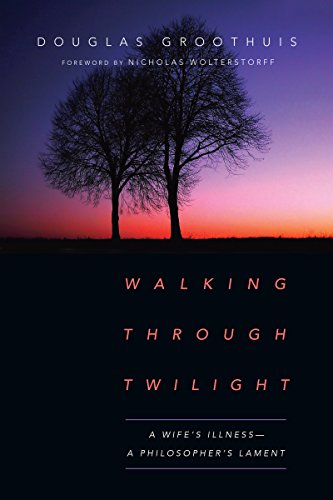
“The meaning of history,” wrote Abraham Joshua Heschel, “is to be a sanctuary in time.” With that subtle insight, the noted twentieth century rabbi drew attention to the paradoxical standing of human presence in the world. By our individual acts we can either increase the misery, suffering, and pain of others or contribute to their relief, healing, and well-being. Whenever we do the latter, Heschel writes in God in Search of Man, we are creating sanctuaries for people in distress. When you see someone who is a living epistle of that kind of compassion and care, you really must stop and wonder. And when you see it taking place day after day in a loving marriage, and in the bitterest of conditions therein, you are beholding a blessed sanctuary indeed. In Walking through Twilight: A Wife’s Illness – A Philosopher’s Lament, Douglas Groothuis invites us to experience what daily life is like in one such sanctuary of compassion and care.

The eloquently written memoir begins with the tragic reversal of fortune that has come to him and his wife, Becky, and from its opening lines we learn how difficult it was to write. For Groothuis had to speak not only for himself but also for Becky, a once-talented author, editor, and member of the Mensa society who now lives virtually without language capabilities. She suffers from primary progressive aphasia (PPA), a rare disease that disables the speech and language centers of the brain.

In scenes poignantly described by Groothuis – in their home, at a restaurant, in an art gallery – we meet an embattled couple whose better half is nearly completely unable to speak or to understand what she hears. “She must fight a bloody war,” he writes, “to secure the simplest word.”

Thankfully, Groothuis, who teaches philosophy of religion and ethics at Denver Seminary, does not offer a time line of his wife’s mental deterioration. Instead, he recounts many and varied experiences along what he calls the “darkening footpath.” And he does not mince words. His willingness to be dead honest about his confusion, anguish, denial, anger, and lament is both painfully moving and biblical in its realism.

In his Introduction to the memoir, Nicholas Wolterstorff aptly captures this tenor when he writes that Groothuis “does not flinch from the painful reality [that] this ravaging disease has wreaked in his life and that of his wife.” Each chapter bears this out, as do chapter titles such as: “Rage in a Psych Ward.” “The Temptation to Hate God.” “Learning to Lie to My Wife (as Little as Possible).”

“Under the tyranny of her disease,” Groothuis writes, “I learned of depths of sorrow and distress I had never known before. . . . Little did I know how much psychological agony a human soul could bear. . . . I learned how it feels to weep often and to cry unexpectedly, even in public. When my eyeglasses are smudged, and I take them off to look at them, I often find the marks of tears. I now behold much of the world through tears and am alert to the tears of others.”

Such unflinching honesty runs throughout this beautiful love story, and it made me wonder: how in the world does he keep going? Eventually it hit me. It isn’t only Becky who is changing. As Christ was changed by his cross relevant to our sin, the caregiver himself is being changed by his cross relevant to her disease. And in the process he, like Christ, is being carried along in his sufferings by the loving, caring grace of God, even during days when the sun is eclipsed by the moon.

That narrative of grace is the secret story of Walking through Twilight. And it recalled to mind Marilynne Robinson’s idea of finding a story that has a suggestive power far beyond its subject.

tear dropsThis, then, is no woe-is-me memoir. Groothuis writes “to offer courage, hope, and meaning.” Scenes throughout the book run between the tender and the tragic, giving witness to the couple’s experiences of grace and meaning on their distressed path. There is the amusement and comfort the couple receives from Sunny, their almost-human Goldendoodle. There is the weight and effect of Becky’s illness on Groothuis in his classrooms, where we see him struggling to answer the question: “how can my sufferings be nobly born before students?” There is a groundbreaking and probing chapter of lessons he has learned from lamenting online. And the penultimate chapter – an Interlude given the title “Resting” – is so intimate a sanctuary moment that I wondered if the veil should not have been left drawn across it.

The story is rich in wisdom from Christian writers such as W. H. Auden, G. K. Chesterton, J. R. R. Tolkien, and C. S. Lewis. Groothuis also draws clarity and inspiration, often during the darkest moments, from unlikely sources: the essayists Michel de Montaigne and Christopher Hitchens, the music of Pink Floyd or Metallica, and the paintings of Jackson Pollack and Mark Rothko.

Groothuis’s greatest solace, however, is found in scripture, especially in the Bible’s literatures of lament and wisdom. He digs deeply into these waters, refusing to rely on cliché or rest in simple explanations. The book of Ecclesiastes is a particular saving grace for him. He writes that the book gives him “the perspective and language of lament necessary for my own sad sojourn during the last fifteen or so years with my chronically and now mentally ill wife. It is a deep well of tough wisdom for the weary and wasted soul.”

By contrast, Groothuis and his wife find moments of relief, surprisingly, in simple laughter. “Becky’s humor,” he writes, “while not so fine-grained as it was, remains more in tact than most of her other mental functions.” A laugh momentarily “removes us from Becky’s memory loss, speech loss, happiness loss, and the near loss of faith.”

And their closeness over many years, he writes, gives him “a comedic freedom not afforded to others. Becky cannot dish it out as she used to. But she can take it and laugh.” Even at gallows humor. Of course there is nothing funny, he explains, about Becky’s condition itself. “To ridicule it would be sadistic. But humor can find odd angles of vision on even the worst situations and without rancor or ridicule.” One such moment happened after dinner:

“I anomalously left a piece of pie with cream on the dining room table and went to my desk to do some paperwork. (Me doing paperwork can be quite humorous in itself.) Becky soon walked to me with that piece of pie, but without a fork. I said, ‘Where’s the fork?’ She looked perplexed and said she didn’t know where they were. I went with her into the kitchen, opened the utensil drawer, pointed, and said, ‘Well, there they all are.’ We both laughed again.”

Contrary to popular belief, and Superman mythology, real diamonds are not formed from lumps of coal. Neither are literary diamonds. Both require a combination of extremely high temperatures and intense pressures found in the deep depths of the Earth’s mantle. Yet over time, some get forced to the surface. Walking through Twilight: A Wife’s Illness, A Philosopher’s Lament is such a literary find. Grace-giving love is its underlying narrative. Because of that love, this memoir will help readers who are beset by real troubles to face them with courage, wisdom, and hope. And find sanctuary.

Charles Strohmer is a freelance writer and the author of eight books and numerous articles. This review was originally published in Touchstone (Sept/Oct, 2018).

©2019 by Charles Strohmer

Images courtesy of Creative commons.

A note from Charles: For more of the perspectives that Waging Wisdom seeks to present, try following the blog for a while to see if you like it. You can always “unfollow” anytime. Just click here, find the “Follow” button in the right margin, enter your email address, and click “Follow.” You will receive a very short email notice when I post a new article. Thank you.

Prophetic Wisdom?

From 40 years ago:

“Without the self-restraint derived from a common moral ideal, a nation becomes ungovernable except by tyranny. Unless our nation has a spiritual awakening soon, we will probably have little freedom at all to debate Christian attitudes. The trouble is, there isn’t that much time. Revival doesn’t guarantee results that fulfil all its possibilities. An expanding church might still fuss about a few obvious moral problems in society but be unable to relate its faith to the basic problems. Indeed, it might not even be able to handle its own problems. If God’s people propagate a Christian faith without proliferating a Christian mind—a Christian philosophy of life, or way of looking at the world – then there may follow a vengeful reaction from a society deprived of truly Christian insight into its problems; a society driven by spiritual ignorance into despair, despotism, and persecution.”

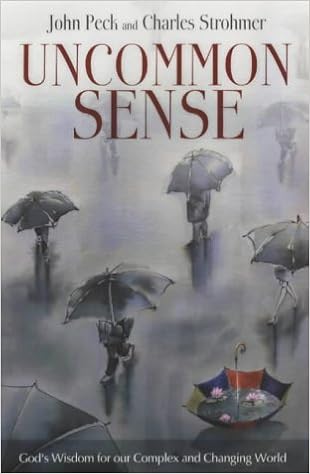
I’ve been thinking a lot about those words lately. They are from the late John Peck, Christian theologian and philosopher, writing in 1978 about his country, England. Quoted in: Uncommon Sense; God’s Wisdom for Our Complex and Changing World, John Peck & Charles Strohmer; The Wise Press, 2000; SPCK, 2001; p 10.

The book was written to both English and American Christians. We included those words in Uncommon Sense because as we were writing the book (it took 4+ years) we felt their relevance also to America. The book is not a polemic. It actually offers a way ahead. Just saying.

©2018 by Charles Strohmer

A note from Charles: For more of the perspectives that Waging Wisdom seeks to present, try following the blog for a while. See if you like it. You can always “unfollow” anytime. Just click here, find the “Follow” button in the right margin, enter your email address, and then click “Follow.” You will receive a very short email notice when I post a new article. And, hey, if you like this stuff, tell a friend! Thank you.

The Clock Shop That Tells More Than Time

ten Boom house HaarlemA note from Charles. Today, January 27, is Holocaust Remembrance Day, to commemorate the six million Jewish victims and the millions of other victims of Nazism, and to honor the dwindling number of still living survivors. Often overlooked are the countless families who risked their lives hiding Jews and others in their homes. The story of the Anne Frank family, of course, is well known. Not so much the story of the ten Boom family. As I was thinking about this family this week, I remembered that one of the first articles I ever had published (25 years ago) was about this family. I dug it out and read it. I had forgotten what motivated their sacrificial love for the people they sheltered in their homes. It was the deep Christian faith that had been passed down through generations of ten Booms. I offer that overlooked part of their story here, in the original article, in the hopes that it inspires young families today.

The Clock Shop That Tells More Than Time

Hurtling alongside narrow canals and cutting through golden flatlands, the train from Amsterdam took twenty minutes before grinding to a halt at Haarlem. Number 19 was my destination. A three-story corner building on a small intersection once heavily patrolled by the Gestapo, it was now the most famous of all of Haarlem’s hiding places.

I strolled from the station and meandered the branching, cobbled streets past sleepy cafes, chocolate concessions, and fresh smelling bakeries famous for their croissants and shortbread. The closer I got to Barteljorisstraat 19, the more impressed I was by the clean, quiet, respectable air of the town. And then a great contrast broke in on me. Not many years previously, that pleasant environment had been plunged into hell on earth. A reign of terror had been ushered in by German tanks and trucks and Nazi soldiers. Their nailed boots pounded the streets and kicked open doors as Gestapo raiders shouted ultimatums and seized the town for Hitler.

During World War 2, many Dutch citizens, students, and all Jews had to go either into hiding or become secret resistance workers. As I entered Barteljorisstraat street and saw the bright red sign of number 19, marking the ten Boom family house and clock shop, it was hard to imagine that fear and chaos once reigned in this calm, respectable atmosphere.

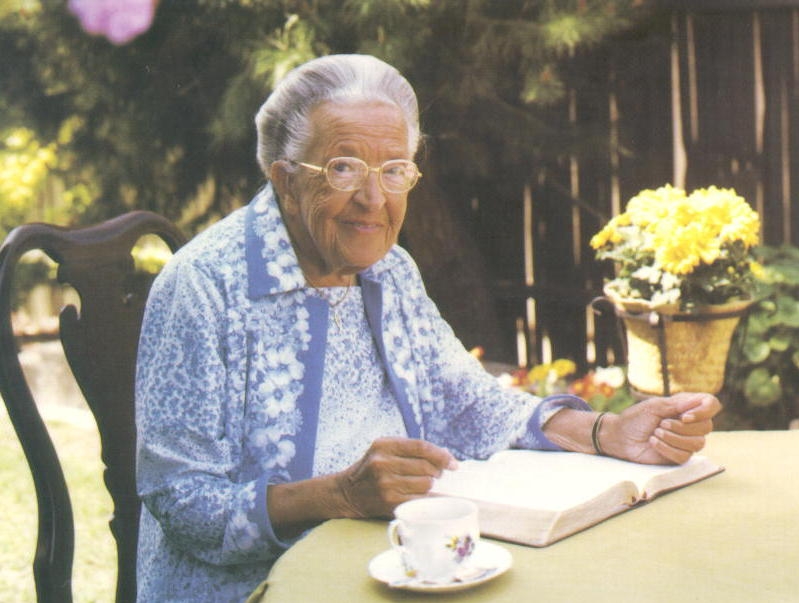
Corrie ten Boom (April 15, 1892 – April 15, 1983) was imprisoned in Ravensbruck concentration camp for sheltering Jews in her home at No. 19. After her dramatic release she traveled the world (64 countries in 32 years) speaking the gospel message. Many people know that inspiring part of her story, from her book, and the movie, The Hiding Place. Not so well known is another important part of the family’s story, which I learned in Haarlem, where I had come to meet Anthony Huijser.

The founder and director of the Corrie ten Boom House Foundation, Anthony gave me a private tour of the large house and sat for a long interview, in whichten Boom dining rom I learned of the ten Boom family’s deep Christian faith and commitment to serve others that stretched back generations. Without that spiritual DNA, I wondered if the family’s sacrificial activism during the Nazi occupation of Haarlem would have taken place.

“In 1837,” Anthony told me, “Willem, Corrie’s grandfather, founded the clock and watch shop. In 1844, at the suggestion of a Jewish friend, he began a weekly prayer meeting every Monday evening above the clock shop to pray specifically for the peace of Jerusalem,” which, he noted to me, is a command from Psalm 122. Willem passed this prayer meeting on to his son, Casper, Corrie’s father, a Dutch watchmaker, who passed it on to his children, Corrie, Betsie, Nollie, and Willem. No doubt it would still be going on today, except….

From May 1943 until February 1944, the ten Boom family opened their home to hide Dutch students, resistance workers, Jews, and even deserting German soldiers.

One Monday evening in February 1944, as people were arriving for the weekly prayer meeting, the Gestapo also arrived. They stayed and arreseted all who came that evening (about 30 persons, plus the ten Booms). Except for two resistance workers and four Jews who managed to slip into hiding behind the false wall in Corrie’s bedroom, everyone was chained in pairs, packed into trucks, and delivered to jails, and later to concentration camps. The ten Boom meeting to pray for Jews had lasted exactly 100 years, the home no longer a hiding place.

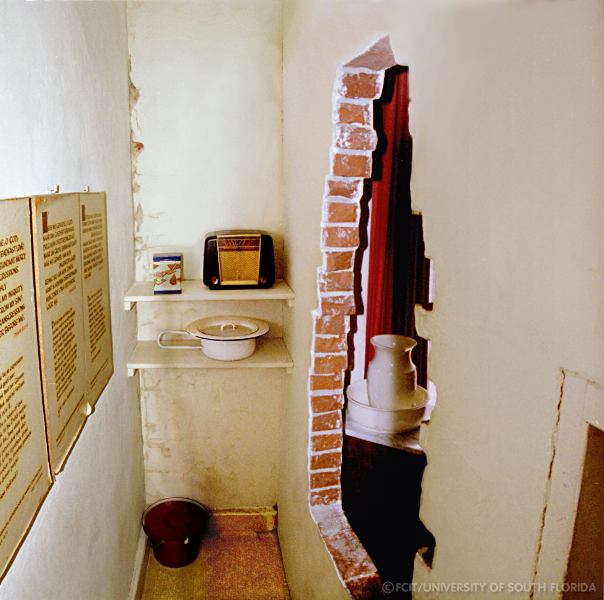
It had been quite natural for the family to do resistance work and to hide Jews and others. It wasn’t as if they suddenly discovered how to love that way, nor was it just the result of praying regularly for the peace of Jerusalem. ten Boom hiding placeTheir love for the Jews and the others they sheltered arose from a broader love – to love their neighbor as themselves. This kind of love had been instilled in the ten Boom children for generations by their parents.

Grandfather Willem, and after him Casper, had taught their children to be obedient to Christ in the community with an “open heart, open arms” policy toward others. Corrie’s mother, for example, when Corrie and her siblings were young, made a “blessing box” that she kept out in the home, into which the children and their friends could drop coins to help the poor and missionaries. And as her children grew, Mother ten Boom would show them how to reach the neighbors through Bible studies.

Such early spiritual training led to the creation of “The Triangle Ladies.” Formed by Corrie, Betsie, and Nollie, this work, Anthony said, “was symbolized by the circle of Christ around the triangle of body, soul, and spirit, representing the whole human being controlled by Christ.” Prayer and praise “circles,” not “meetings,” arose around this concept. The idea was that if you kept your family surrounded by the “circle of Christ,” unwanted influences would remain outside.

Early childhood training also helped the ten Boom children gain a love for the disadvantaged and alienated. Before World War 2, one of Corrie’s many admirable pursuits became the schooling of mentally handicapped children in Haarlem. Tragically, those youngsters were spiritually neglected by the churches. But Corrie developed ways to teach them about Jesus. Though their minds were weak, she found ways to teach them through the senses, especially eyes, ears, and hands. It was through that process, Anthony said, that Corrie learned how to teach spiritual realities easily. “It become one of the classrooms where Corrie learned to become a teacher and evangelist, which would later help her to tell the world how simple it is to open your heart to the gospel.”

Raised by their parents within a climate of prayer and vibrant, practical, love-of-neighbor Christianity, the ten Boom children, as adults, found it quite natural and ordinary to open their home to the persecuted. “The Hiding Place” thus began easily enough as the usual course of things. In May, 1943, Corrie happened to be talking to the mother of a student whom the Gestapo were seeking. “He has no place to hide,” she told Corrie. “Well,” said Connie without flinching, “he can live with us.”

Corrie brought the young man home, saying to her father and Betsie, “We have a guest this evening. He has to hide himself.” And that was that. It was the expected thing to do for the entire family. A work for which most of the family would eventually die had begun – dare I say it – as easy as loving neighbor as one’s self.

Corrie ten BoomWhen the Gestapo arrived at No. 19 on that fateful (and faithful) Monday evening, it was as a family that they were all arrested, a family rich in generational faithfulness to God. The “circle of Christ” may have been breached by “unwanted influences,” but the love of Christ could not be deterred.

The ten Boom house and clock shop tells more than time. It is a testament about being faithful in little early on in order to be faithful in much later on. It is a lesson to never underestimate parental influence upon children. It is a memorial to the spiritual strength of Calvary that denies self for others’ sake, a love which entire Christian families may live and breathe.

©2018 by Charles Strohmer

This article, slightly edited here, was originally published under a different title in The Christian Family (April, 1992).

Images courtesy the Corrie ten Boom museum.

A note from Charles: If you would like more of the perspectives that Waging Wisdom seeks to present, I want to invite you to follow the blog. Just click here, find the “Follow” button in the right margin, enter your email address, and click “Follow.” You will then receive a very short email notice when I post a new article. And, hey, if you like this stuff, tell a friend! Thank you.