“STRANGE DAYS HAVE TRACKED US DOWN”

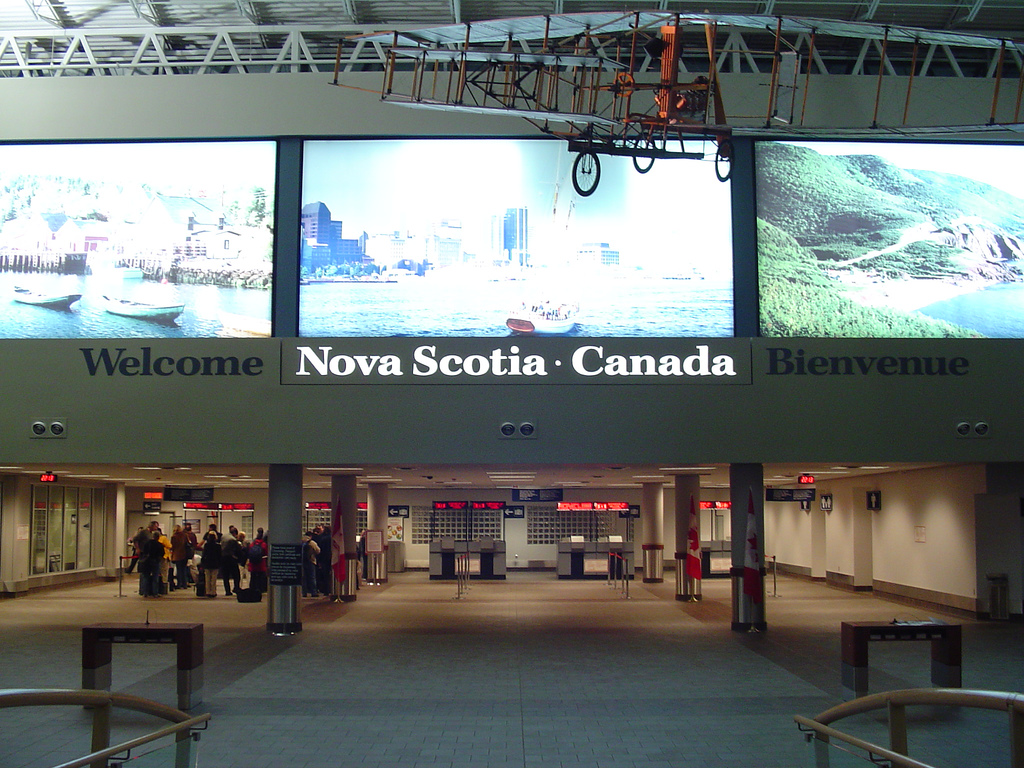
Halifax Nova Scotia AirportDelta Flight 59 from London to Atlanta became the penultimate of forty-two jet loads of now stranded international travelers being granted safe harbor at Halifax International before the airport ran out of wing space for the huge 747s, 767s, 777s, Air Buses, and L1011s. I later calculated that about 10,000 people had arrived – a small town and all the problems that come with that. The scene from the air as we circled for landing looked as if a child had carefully positioned dozens of huge toy planes in two long rows, nose-to-tail and wingtip-to-wingtip on a long strip of black ribbon.

Still circling, I was also surprised to see that the service road that ran for a mile or more alongside the airport was bumper-to-bumper with cars, vans, and pickups. Like bystanders congregating to stare at a blazing house fire, onlookers had queued to watch the landings. But for them, it wasn’t just the odd sight of forty huge planes from all over Europe landing in close succession. That was not the only thing that had brought them out. They knew what had happened in the States. We did not. They were talking about it. We didn’t know what to talk about.

Similar emergency landings had been repeated across Canada, from Newfoundland to Vancouver, although many trans-Atlantic and trans-Pacific flights headed toward American cities had been ordered back to their departure cities. Across America and Canada, the extreme sudden workout demanded of thousands of air traffic controllers and pilots had the astonishing result of going without incident. The FAA had ordered some 5,000 civilian planes to be landed immediately so that the military could isolate any rogue planes still in the air. Within four minutes, 700 planes had been landed. Nearly 3,000 within the next hour. All 5,000 had been safely guided to the ground in under two hours. A truly impressive impromptu performance, never once rehearsed in aviation history.

Taxiing to the end of the queue, far from the terminal, we eased past the staring congregation of onlookers until Captain Williams brought the 777 to a gentle halt. He cued the mike, thanked us for our “patient cooperation,” and gave us the sketchy details that were available to him. It was now hours after the attack but the news reaching Halifax was still an ambiguity of facts and rumors.

Two hijacked passenger jets had crashed into the Twin Towers, which had collapsed in rubble and dust. Thousands were dead. The Pentagon had been attacked. Hundred were dead. A passenger jet may have crashed in Pennsylvania. Hundreds were dead. Whatever any of that meant. America may be going to war. But against whom?

I’m not even going to try to describe our complete bewilderment. Quite unlike those watching television and getting to hear about the major events sequentially – as they happened, that is, having some breathing space between them to digest what was going on and talk to people about that – we did not have any breathing space. Astonishment upon astonishment piled up on us in seconds as we listened to Captain Williams over the intercom.

There were no televisions to watch on the plane and the crew was relying on information from the tower, from other pilots, and from whatever occasional news reports came over a scratchy, AM radio signal in the cockpit. “Hopefully,” Captain Williams concluded, “the FAA will re-open U.S. airspace to get these international flights to their destinations. So maybe we’ll be able to get out of here in a few hours.”

It was now around 1p.m. Halifax time. At 3 a.m. – fourteen hours later – we were deplaned, hustled through customs, and bussed twenty miles through the cool night air to Shearwater Air Force Base, at Dartmouth, where we would live as guests of Canada until Saturday morning, though that departure date was unknown to anyone at the time. Everyday were told that we would probably be flying home “tomorrow.”
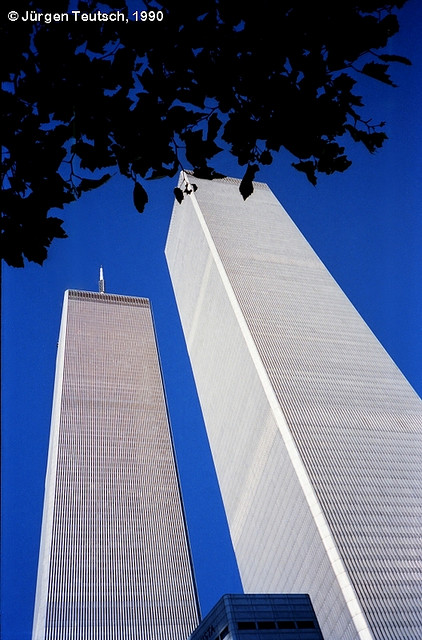
Twin TowersAltogether, about a thousand of us strandeds were now encamped at the Air Force base – two Delta flights besides ours, two British Air flights, and an Air Tours flight filled with Scots who had been on their way to Florida. I was first off the first yellow school bus to arrive at the base. It was 4 a.m. Two hundred of us were walked from the buses to a huge gymnasium, where I soon fell asleep on one of the military cots that had been set up for us in that large facility.

I awoke at 7 a.m. amid dim lighting to the sound of snoring, my lower back aching madly. I slipped from under the dark blue blanket, sat on the edge of the cot, and stretched to touch my toes. I took in the unfamiliar surroundings. Nearly everyone was asleep, but a few souls were shuffling in and out of the gym carrying white bath towels, evidently going to and from the showers. We had only been allowed to take our overhead bags from the plane. I wondered what I would do for fresh clothes, pajamas, underwear, deodorant, a shaver, my hairbrush.

Grabbing a white towel from beneath the cot, I walked into the corridor and leaned against a wall to get my bearings. My shirt and trousers were not too wrinkled, but I needed a shave. Military personnel wandered the long hallway and nodded at me as they passed. I saw Canadian Red Cross workers manning tables down in the lobby and a few strandeds milling about there. They seemed to be rummaging through large cardboard boxes. I heard a television blaring from somewhere and immediately remembered my wife cautioning me on the phone, when I had finally been able to reach her from the plane several hours earlier, about the horrible images I’d see. I would shower first.

It would be nearly twenty hours after the attacks before my imagination would be seared by the never-ending television images of the flying machines disappearing with a metallic burr into the Twin Towers and never coming out, of the intrepid jumpers who leapt hand-in-hand to their deaths rather than be burned alive, of the twisted I-beams crashing and billowing in the explosive alchemy of avi-fuel, office furniture, and the dust of human remains.

It was unbelievable. September 12, I realized, had dawned. Life would be different now. How different I did not know. But different it would be.

Story continued next post…..

©2014 by Charles Strohmer

Images by Phil LaCombe & Frank Culbertson respectively (permission via Creative Commons)
MAN INTERRUPTED

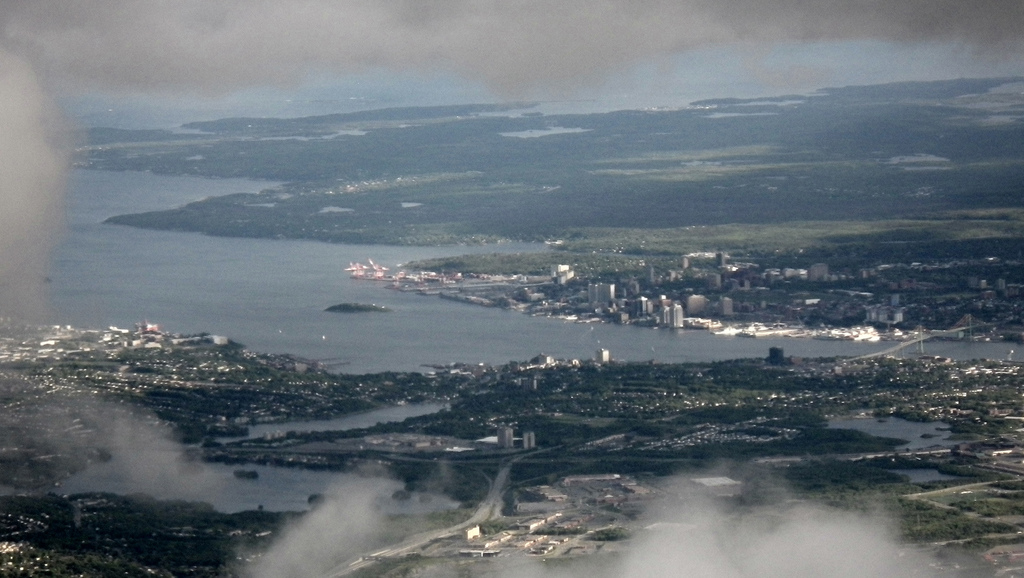
Halifax Nova ScotiaThree hours out of London and six miles above the Atlantic flying uneventfully through a brilliant blue sky, the passengers aboard Delta Flight 59 to Atlanta were as contented as possible on a nine-hour flight. The meal service had ended and people were now quietly absorbed in their laptops, reading novels, or drowsily captive to that vespertine atmosphere created on planes when the movies are running. Other than departing Gatwick Airport thirty minutes late, so far so good.

But then all the video screens went blank. A hushed buzz arose as passengers wondered why. Not to worry, an air hostess soon announced. “The movies should be back on in a few minutes. A computer needs re-booting. It happens. We apologize for the inconvenience.”

Yawn. Passengers stretched, some ordered drinks, some queued for the toilets. A few broke the spell of counterfeit evening by sliding up their porthole shades. Outside, the bright blue heavens – pilots call it severe clear – stretched out into forever. It hurt one’s eyes to stare there for too long. Twenty minutes passed. The Boeing 777 droned on. The video screens remained blank. People fidgeted and some wondered why their cells phones had quit working. And then like restless compass needles locking on magnetic north, everyone’s wandering thoughts suddenly fixed on the thick Texas drawl now coming over the intercom.

“Ladies and gentlemen, this is Captain Williams speaking. May I have your attention. Your serious attention. There’s been a major incident in the United States and all air space throughout the country has been closed. All planes in the air over the United States are being directed to land at the nearest airports, and all international flights into the U.S. are being diverted. We are okay. I repeat. We are okay. But we cannot land Atlanta. We have been directed to Halifax, Nova Scotia, where we should be landing in about two hours. We can’t give you any more information at this time. Please be patient and bear with us. We will have more details for you when we get on the ground in Halifax. Thank you for your cooperation.”

A kind of holy moment filled the cabin as passengers turned to face their seat-neighbors. No one spoke. No one dared. Finally some whispers. What do you think it is? Must have been a huge earthquake? A nuclear bomb, maybe? Who knows? Maybe that announcement was just a ploy and we’re really going down? Maybe the air traffic control system has failed? Does the captain even know what’s going on?

None of these events seemed likely to me, passenger 34G. Even if a nuclear catastrophe had occurred in one part of the country, why had all the airports been closed? What had happened? I had to know. Knowing would at least help me beat back the worst-case-scenario self-talk I now battled. I calculated to Eastern Time and concluded that my wife would be in class with her first-graders. But then how could I be sure about that, if I didn’t know what had happened and where? It had to have been huge, but who had been effected? I was returning home from a demanding three-week book tour and speaking trip. I was completely knackered and just wanted to get home. Was I even going to get home?

Someone on this plane must know. Because I usually travel alone on these long flights, I like to make a connection with a flight attendant after I board. It’s a habit that has paid dividends, and I hoped it would now. Mine was an aisle seat a few rows behind the first class barrier and I had a few seats to myself, so I hoped to take advantage of that private space.

Coming down the aisle toward me from first class was “Terri,” a hostess I had befriended earlier. Our eyes met and I gently got her attention, hoping she would stop. She did, and then crouched to listen as I whispered, “I know you can’t tell me what happened, even if you know. And I’m not asking you to. But can you at least tell me, does the crew know what’s happened?” She nodded discreetly, stood, and then continued down the aisle on her errand. It was a small grace but it was enough – strangely comforting – and the first of many such gestures to come in the next few days.

Story continued next post….

©2014 by Charles Strohmer

Image of Halifax from “canoe too” (permission via Creative Commons)

WISDOM AND OUR BETTER ANGELS

the better angels of our natureIn his first inaugural address, Abraham Lincoln had the unenviable task of speaking to a country on the verge of civil war. In the speech he walked a fine line between the North and the South to try to hold the Union together. Perhaps he sensed that was impossible, that war was inevitable. Five weeks later the civil war began.

What, you may ask, does the U.S. civil war have to do with the wisdom tradition. Not much, I grant you. But many years ago when I was racking my brain to call up some apt metaphors for the wisdom-based approach to diversity that I write about, “the better angels of our nature” came to mind. It seemed promising, but I could not recall who said it or in what context. I found it at the very end of Lincoln’s first inaugural.

Having spoken about “so grave a matter as the destruction of our national fabric,” Lincoln said, “We are not enemies, but friends. We must not be enemies. Though passion may have strained it must not break our bonds of affection.” And then this, in which you can sense Lincoln’s gut telling him that the tipping point toward destruction had been reached:

“The mystic chords of memory, stretching from every battlefield and patriot grave to every living heart and hearthstone all over this broad land, will yet swell the chorus of the Union, when again touched, as surely they will be, by the better angels of our nature” (March 4, 1861).

After mulling that over, I saw what Lincoln was on about. His use of the metaphor, in context, shows us his deep understanding of human nature – its penchant to swing from listening to a devil at one ear and an angel at the other ear. But more than that, although he was realistic about human nature, Lincoln was not a cynic, a pessimist, or an anarchist. The last sentence of his speech reveals a president who preferred relying on angels better than war and who wished Americans would go and do likewise.

Being someone who likes to discover origins, I went searching, but concluded that the phrase “the better angels of our nature” originated with Lincoln. A shout-out to Gene Griessman, however, for pointing out Dickens. In Dicken’s novel Barnaby Rudge, the narrator muses: “the shadows of our own desires stand between us and our better angels, and thus their brightness is eclipsed.”

In an earlier post, I hinted that the sages were realistic about the human condition. I now want to a little more about that. The biblical wisdom literature is utterly realistic about human nature. No question. The literature repeatedly warns about folly, deceit, lying, laziness, cruelty, adultery, and many other all-too-human penchants. And often in stunning images. The point is to show why habitual acting on such impulses will devastate the life of an individual, a community, a nation.

Paradoxically, however, almost in defiance of that realistic picture, the sages seek to enable the kind of living that can seem a bit idealistic. They repeatedly call us to rely on the better angels of our nature. This comes into sharp relief in Proverbs, which stresses developing and cultivating attitudes, forms of communication, and ways of individual behavior and collective living that have as their goals the harmony and flourishing of our lives as communities and nations. And our political lives do not get to opt out of this.

In previous posts in this series on the wisdom tradition, I have stressed wisdom as a vital agency that advances shalom, healthy relationships, and mutual good amid human diversity. But there is with us everyday, day after day, that which seeks to run us into the ground, the shadows that seek to darken our paths.

So over the years, I have tried, and continue to try, to learn how to draw on the better angels of my nature when the devils are holding forth. I hope that you are too, and if you’re not, that you will begin to. Taking ongoing steps to learn wisdom and to make the wisdom way part of my DNA has been the best way I know to make the better angels more prominent. As a psychologist-friend once said to me, “Between stimulus and response is choice-point between being foolish or wise.” Choose wisdom, friends. Nothing that may be desired and sought is as precious as wisdom (Proverbs 8:11).

I think that the old-world sages of Scripture would have said a hearty “Amen!” to Lincoln’s image of the better angels, especially during that time when we were destructively divided, tearing our land apart, and killing one another. I also think the sages are turning over in the graves at how many devils are being listened to in our land today.

And I hope and pray for leaders with peaceable wisdom to arise and to be listened to, that perhaps by the mercy of the God we claim to believe in, our land may be spared a fate worse than that of a civil war.

©2017 by Charles Strohmer

A note from Charles: For more of the perspectives that Waging Wisdom seeks to present, try following the blog for a while, to see if you like it. You can always unfollow anytime. Just click here, find the “Follow” button in the right margin, enter your email address, and click “Follow.” You will then receive a very short email notice when I post a new article. And, hey, if you like this stuff, tell a friend! Thank you.