
I have been thinking lately about “goals,” probably due to an excessive sense of accomplishment I recently felt with the publication of a new book – a goal of mine that began forty years ago but moved along in fits and starts.
I’ve also been thinking that we live in a time when the setting of goals has become a big thing. A career change. A post-grad degree. A wife. A husband. Two children. An adoption. A new car. Acquire three new clients. Start my own business. Publish an article or a book. Lose forty pounds. Create a website. Run for public office. Make that Olympic team (well, maybe just the college team). You get the picture. Any list of things to get or places to be would run as long and as varied as the people asked.
Leaving aside a discussion of whether a goal is dubious, or whether such and such a person ought to have set such and such a goal, I’m going to assume, here, that the goal is a good one, and doable, for the person in question. Even so, the question of how to reach the goal then becomes is crucial for anyone, especially for Christians, who serve a God who is certainly interested in the end result!
The ways we travel
The God of the end, however, is also the God of the way. God is keen not only about the omegas we seek but also with the ways we travel to get there. This is a huge theme of the book of Proverbs, especially in 3:17, which speaks of the “ways” and “paths” of wisdom. The decisive use of the plural must not be missed. Wisdom, here, is being presented not just as one way but as having many ways (paths). This use of the plural may seem counterintuitive because we Christians follow “the way” (John 14:6), Jesus Christ, the wisdom of God (1 Corinthians 1:24). Doesn’t Proverbs 3:17 contradict that? How can there be many paths of wisdom?
 Unlike John 14:6, Proverbs 3:17 is not a soteriological passage. To put it another way, whereas John 14:6 is about God’s way of salvation, Proverbs 3:17 is about God’s ways for directing our travels through life’s daily grinds, which are many and varied. For different goals in this world are, and must be, reached via different methods. When three people have three different goals, or even if one person has several goals, they are reached via different methods. You don’t hunt for a house to rent, or to buy, in the same way you plant your garden or run for an elected office. You don’t use the same method to get your post-grad degree as you would to court your future spouse (I hope not!).
The book of Proverbs admonishes us to come under the discipline of the yoke of the wise how, to let wise ways, not foolish ways, direct our steps.
The first nine chapters of Proverbs, for instance, may be summarized as a test of wills between those who will choose to follow the wise ways of Lady Wisdom, which lead to life (Proverbs 3:18), or the foolish ways of Lady Folly, which lead to death: “Do not let your heart turn to her ways or stray into her paths…. Her house is a highway to the grave, leading down to the chambers of death” (Proverbs 7:25-27).
So that is the first thing: choosing and then traveling a way, a path, of godly wisdom for reaching a particular goal we have set. The question then becomes: What is a way, a path, of godly wisdom toward a particular goal? How do we come under the discipline of the wise how?
I pose this question because a huge industry, populated with self-help gurus and ultra-achievers, among others, has arisen devoted to offering many and varied methods for reaching goals.
When following a method, how do we discern if anything is biblically unacceptable in its ideas, values, means, strategies, and steps to fulfilment?
The answer will depend on how much time, effort, and resources we put into thinking biblically about how we will reach a goal and what we allow to take place along the way toward it. Admittedly, discrimination of this kind – between the biblical how and the unbiblical how – can be a tricky business. After all, how does one think biblically about choosing a PhD program or running for election or buying a new car? If the teaching arm of our church has not given us the tools for learning to think biblically about the importance of our methodologies, well then…. Non-biblical ideas, attitudes, and values will fill the vacuum.
I want to draw attention just to two essential qualities of God’s wisdom, which will help us recognize if our travels toward a goal have the feel of a wise how.
Peaceableness
One of these essentials is peaceableness. To return to Proverbs 3:17: The ways of wisdom are pleasant and her paths are paths of peace. The word “ways,” here, is about the means taken or the procedures followed to an end. In short, it is about method. The word “peace” is the venerable Hebrew word shalom (well-being; flourishing). And in the New Testament, the Epistle of James (also at 3:17) indicates that the wisdom that comes from above is peace-loving, as well as considerate, full of mercy and good fruit, impartial and sincere. James contrasts those qualities with the wisdom that is earthly, unspiritual, devilish: it is bitter, envious, and filled with selfish ambition, strife, and disorder (3:14-16).
I think the message, here, is that if God’s peaceable wisdom is setting the spirit and tone of whatever method we are applying to reach a goal, then patience, sympathy, mercy, good fruit, even-handedness, and sincerity are traveling with us, guiding us, along the way.
It would be a good practical exercise, then, to spend time thinking about whether the qualities of God’s peaceable wisdom or the ones James calls of the devil are guiding us along the particular method we are relying on to reach our goal. Most likely it’ll be a mixture. After all, we’re not perfect. But surely we ought to be making progress toward our goals with guidance from God’s peaceable wisdom.
It’s a personal thing
Another essential of wisdom is its personal-relational quality. Unfortunately this quality often remains unknown to Western Christians whose wisdom in decision-making tends to rely much too much on ideological (abstract) frameworks. The Book of Proverbs, however, describes wisdom as having some sort of personal, or personal-like, relationship: with God, with the creation, and with human beings.
“I was appointed from eternity, from the beginning, before the world began. . . . I was there when he [God] set the heavens in place . . . when he gave the sea its boundaries . . . when he marked out the foundations of the earth. . . . I was the craftsman at his side. I was filled with delight day after day, rejoicing always in his presence, rejoicing in his whole world, rejoicing in his whole world and delighting in mankind” (Proverbs 8:25-31).
Due to its ontological difficulties, this may be the most debated passages by scholars in all of the wisdom literature. We’re not going to enter that debate here. I just want to underline the fact that wisdom is being presented here as having some sort of personal relational presence with God, with creation, and with human beings. (This is assumed in other places in the biblical wisdom literature via a number of images and contexts.) Note also that the triune relationship wisdom has – with God, creation, and human beings – is described as one of delight, of rejoicing, and of pulling together.

In other words, wisdom is not presented in Scripture as any sort of abstract edifice of thought, such as an ideology or an -ism, but, rather, as personal and relational. I like the way Hebrew scholar Alan Lenzi puts it. When discussing Proverbs 8, Lenzi writes that wisdom is a personality; she is a “me” (Proverbs 8:22) who speaks at length in her own name, about having been created by God before the beginning of the world, about her primacy in nature, and about her delight in all human life. Lenzi concludes that wisdom is no “intellectual tool or abstract instrument.” She is, instead, a “personal presence” in the world. (Lenzi, “Proverbs 8:22-31: Three Perspectives on Its Composition,” Journal of Biblical Literature 125, no. 4, 2006: 687-714.) (Lenzi does not mean, neither do I, nor does any scholar I’m away of, that “wisdom,” here, is being described as a fourth party to the Trinity. The debate I mentioned above surrounds trying to understand just what indeed the Hebrew means here.)
Since our relationships with others give us a big clue as to whether the peace of God is present in them, the relationships we have with those who are assisting us toward our goals can help us discern if we are in the path of a wise how.
If the triune relationship that Lady Wisdom has with God, creation, and human beings is enjoyable, delightful, and pleasant, are those qualities present within biblical boundaries in our pursuit of a goal?
This is not to suggest that struggles, disappointments, setbacks, failures, and suchlike will not befall us. It is to suggest being conscious of what kind of fruit is being borne through our relationships with those with whom we are traveling to reach a goal. For that gives us big clues as to the kind of wisdom in decision-making we are relying on for guidance.
If your children are suffering due to your training schedule for running the marathon; if your marriage is falling apart because of the way you are pursuing that PhD; if your bull-in-a-china-shop method for getting a promotion at work is making enemies of fellow employees; if you’re you and your guitar instructor are at loggerheads all the time; if you and your fiancé have become chronically unhappy with each other… Well, you get the picture. It may be time to hit Pause and admit that a course correction toward your goal is required.
When we mis-prioritize “the goal” as being the main thing, it is easy to de-prioritze the essentiality of learning and applying a godly wisdom for getting there, and so miss the mark.
“Getting there” is to a large degree about method. For the follower of Jesus – the supreme example of the way of wise how – the peaceable, the personal, and the relational are essential qualities to be recognized and prioritized when traveling to get there.
©2017 by Charles Strohmer
Images by permission of Creative Commons.
A note from Charles: If you want more of the perspectives that Waging Wisdom seeks to present, I want to invite you to follow the blog. Just click here, find the “Follow” button in the right margin, enter your email address, and click “Follow.” You will then receive a very short email notice whenever I post a new article. And, hey, if you really like this blog, tell a friend! Thank you.

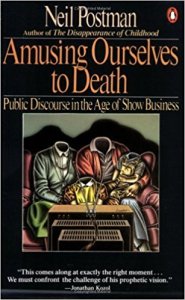 I just pulled my 1985 copy of Neil Postman’s Amusing Ourselves to Death off my shelf and read there words:
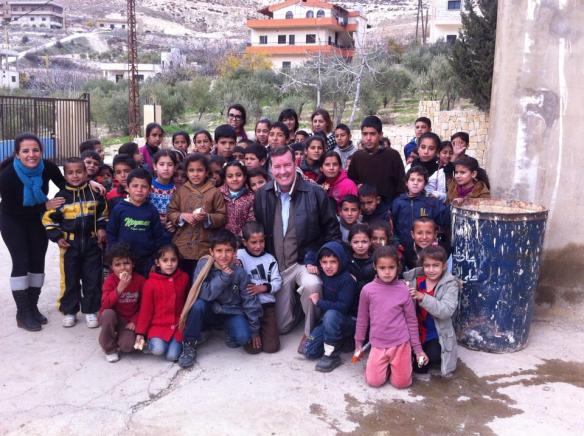 It’s been more than a year since I posted about the remarkable work of the Cradle Fund. For those of you who are new to this blog – and thank you for being here – the Cradle Fund is a non-profit, Christian-run Middle East initiative led by the Institute for Global Engagement (IGE), which “helps rescue, restore and return Middle Eastern Christians and other religious and ethnic groups to a home where they can live and practice their faith free from fear.”
 The Cradle Fund is the only non-profit initiative that this blog supports. I have been friends with Chris Seiple, its founder and president emeritus of IGE, for many years. Whether you have supported the Cradle Fund in the past or have yet to help, I urge you to think about supporting this remarkable initiative.
 A long time ago through the prophet Jeremiah, God gave a word to the people of Jerusalem about the condition of their social life. Even though that word was the result of a divine finding, it didn’t sit well for a people who had concluded that their social life was pretty darn good. But in the eyes of Yahweh, according to the prophet, the people’s social life had become generationally organized around deceit, dishonesty, and greed; from the top down they were a shameless, wayward community, a false witness to the law of the Lord:
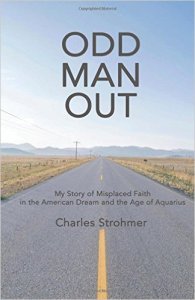 After a year of steady writing and then several unexpected publishing delays, I’m glad to say that Odd Man Out has now been published. You’ll find that its style is a departure from what you are used to reading from me. None of my previous books were autobiographical, nor are most of the articles I write, including what appears on this blog. Instead, Odd Man Out is a short, honest, true story of what was by far the strangest ten-year period of my life.
 I Have a Vision
 h liturgies that are never mechanical, and spontaneity that is never trivial.
 Redeemer’s voice speak with such authority that nothing will do but obedience, nothing matters but God’s love, and others coming in can only wonder, and wish, and ask. . .
![refugee tent city [Klaus Reisinger]](https://wagingwisdom.com/wp-content/uploads/2015/09/refugee-tent-city-klaus-reisinger.jpg?w=584) These are demanding times for Christians who are committed to loving neighbor as they love themselves. It is becoming increasingly easy to slip into less exacting paths. I am glad that our pastor has been addressing this theme in various ways in a number of
These are demanding times for Christians who are committed to loving neighbor as they love themselves. It is becoming increasingly easy to slip into less exacting paths. I am glad that our pastor has been addressing this theme in various ways in a number of  Several inches of snow blanketed the ground and it was still falling as I drove to the Wednesday evening fellowship at Jeannie’s house. The forecast called for 8-10 inches by midnight, and I believed it. But suburban Detroit is virtually bereft of hills and S-turns, and the large fleet of salt trucks with their huge plows were clearing the main roads.
 Waging Wisdom