ISIS & AL QAEDA: THE ROLE OF JIHAD part 2 of 2

Continued from the previous post.

wave curlAccording to Sayyid Qutb, as we saw here, Islam spread widely geographically during its earliest decades because Muslims implemented God’s totality rule over all of life, but when they became idolaters, or impure, Muslims lost God’s favor and were no longer able to implement God’s totality rule. In Milestones, Qutb is quite clear that the solution is first and foremost individual renewal, by which he meant the rise of a new breed of Muslim leadership – purified and  cleansed of idolatry. The “vanguard” (his word) movement would then have God’s favor to fight the flood of idolatry, both in Islam and in the wider world, and implement “the religion of God,” by with he meant “the Islamic way of life,” as he wrote in Islam: The Religion of the Future.

In Milestones, Qutb writes: “It is necessary to revive that Muslim community which is buried under the debris of man-made traditions…, and which is crushed under the weight of those false laws and customs which are not even remotely related to the Islamic teachings.”

For this revival to occur, the vanguard must not simply strap on the ammo and rush into battle. It must be held back to be cleansed by studying the Qur’an, and only the Qur’an, for guidance. Only afterward will it be ready to prevail. Spiritual purity first; the geographic spread of Islam seconds (by war if necessary); social justice third. That was Qutb’s perceived pattern of the original vision of Islam. He insisted that the vanguard follow it.

“Only such a revivalist movement will eventually attain the status of world leadership,” he writes in Milestones. “It is essential for mankind to have new leadership…. Without doubt, we possess this new thing which is perfect to the highest degree, a thing which mankind does not know about and is not capable of ‘producing.’”

A purified vanguard would then first set things right by taking concrete form in a nation: “If Islam is again to play the role of the leader of mankind, then it is necessary that the Muslim community be restored to its original form…. In order to bring this about, we need to initiate the movement of Islamic revival in some Muslim country. Only such a revival will eventually attain to the status of world leadership. How is it possible to start the task of reviving Islam? It is necessary that there should be a vanguard which sets out with this determination and then keeps walking on the path, marching through the vast ocean of [idolatry] which has encompassed the entire world…. I have written ‘Milestones’ for this vanguard.”

Until the Taliban and al Qaeda were driven from power in Afghanistan at the end of 2001, the signs seemed pretty clear that they had been steadily implementing Qutb’s unusual view of Islamic revival in that Muslim country. Apparently the ISIS group in Iraq and Syria, which now claims itself to be an Islamic state, albeit illegitimately, has similar designs.

In Milestones, Qutb frequently reminds his readers of the practical nature of his vision “to wipe out tyranny, and to introduce true freedom to mankind,” and he is quite clear that this may need to occur militarily:

“The method of this religion is very practical…. [It] uses the methods of preaching and persuasion for reforming ideas and beliefs; and it uses physical power and Jihaad for abolishing the organizations and authorities of the Jahili [idolatrous] system which prevents people from reforming their ideas and beliefs but forces them to obey their erroneous ways and make them serve human lords instead of the Almighty Lord…. [It] is a practical movement which progresses stage by stage, and at every stage it provides resources according to the practical needs of the situation and prepares the ground for the next one.”

Also in Milestones, Qutb describes his unusual view of jihad as moving inevitably from individual renewal, to transforming Muslim societies, to surging into nations, to eventually conforming peoples everywhere to Islamic law. Olivier Roy, a scholar of political Islam, writes in Globalized Islam that radicals since Qutb “explicitly consider jihad a permanent and individual duty…. This is probably the best criterion with which to draw a line between conservative neofundamentalists and radical ones…. Among the few writings of Osama bin Laden, the definition of jihad as a permanent and personal duty holds a central place.”

For Qutb, then, it seems that there is no pick-and-choose jihad. Jihad is one; it is a continuum. It begins with the struggle to personal purity, then goes to its next phase, of taking over a Muslim country, whether by persuasion or by war, in order to implement social justice. In the next post we will look at what Qutb meant by social justice.

©2014 by Charles Strohmer

Image by Sunova Surfboard (permission via Creative Commons)

ISIS & AL QAEDA: THE ROLE OF JIHAD part 1 of 2

Back to the future I sometimes joke that only novelists know the future. Apparently some gifted few also know it in the theater of the real as well. I just tracked down a note to myself in the margin of my copy of Greenmantle (1916). In the opening scene, Sir Walter Bullivant, of the Foreign Office, is explaining to Major Richard Hannay about Turkey and the Ottoman side of the Great War and religious power. Some will say, Hannay, that Islam is becoming a back number.

“Yet – I don’t know,” Bullivant continues. “I don’t quite believe that Islam is becoming a back number…. There is a dry wind blowing through the East, and the parched grasses wait the spark…. There is a Jehad preparing. The question is, How?” John Buchan’s great tale of derring-do fictionalizes an answer, as Hannay and his band of merry men face off against the Germans who are trying to use Islam to help them win the war.

Today, as everyone knows, many people are dying in the Middle East from very real jihads plotted and executed by militant organizations such as ISIS and al Qaeda. Hundreds of thousands (Muslims, Christians, Yazidis, and others) have fled Iraq and Syria for safety. But the role of jihad can be puzzling to non-Muslims. Here is my short take on it as non-Muslim.

“Jihad” means “struggle” in Arabic, and there seems to be three types. One is military and is known by Muslims as the “lesser jihad.” It is a call to war by a legitimate Islamic nation against an enemy nation. It can be authorized only by an Islamic state and declared only by the legitimately recognized religious authority of that state. Another type of jihad is practiced by individual Muslims. Known as the “greater jihad,” it is the daily inner struggle against whatever seeks to prevent one from becoming a better Muslim. It is practiced in submission to Allah. It seems to me that the desire is not unlike that of a Christian’s inner struggle against sin in order to become more like Jesus and live the faith as well as possible.

The greater jihad, however, is also practiced as a nonviolent collective struggle against social, political, and economic injustices for the good of a community or nation, to build a better Muslim society (again, in submission to Allah). In What’s Right with Islam, Imam Feisal Abdul Rauf, whose mosque was just blocks from the World Trade Center, calls it a group jihad. It has also been called social jihad. The concept seems similar in principle to nonviolent Christian social and political activism.

Sayyid Qutb, whose radical religious-political views are the subject of this series of posts, developed what we could call a fourth view of jihad. It is based on his view of Islamic history and does not seem to me to fit the criteria of any of the three forms of jihad just noted. Qutb’s idea of jihad certainly hasn’t made jihad a back number. His view is well developed in his book Milestones, and it seems to be the theological backdrop used to justify the militant jihad practiced by ISIS, which has been considered illegitimate by many Muslim scholars.

We’ll pick that up in detail the next post.

©2014 by Charles Strohmer

ISIS & THE RISE AND FALL OF ISLAM part 3 of 3

fall in black & white (ciro@tokyo)In the previous post we looked at the rise of Islam during its beginning years, in Mecca and Medina, especially the difference in Muhammad’s religious-political methodologies in the two cities. In this post we will look at Sayyid Qutb’s curious interpretation of Islam’s history, especially what he seems to have indicated was the fall of Islam. In the next post we will look at Qutb’s radical solution to that fall and how it influences ISIS and al Qaeda.

The Fall of Islam. According to Sayyid Qutb, the arrival of Islam in the Arabian peninsula in the seventh century was God’s solution to “the secular vs. the sacred dichotomy,” (“the hideous schizophrenia”), that had spread throughout the world. Implementing that solution would end the sacred vs. secular dichotomy by making the religion of Islam the rule for all of life, including political life. Qutb wrote in Islam: The Religion of the Future (IRF), that “the secular vs. sacred dichotomy has never been postulated in Islamic history, nor can it ever be.” The problem, however, as Qutb saw it, was that totality of what he often called “true Islam” “true religion,” that is, God’s total rule, was only implemented for a short while before Muslims themselves caught secular vs. sacred virus.

In other words, according to Qutb, after the widespread Muslim conquests during Islam’s first century – in and around the Arabian peninsula across north Africa and into Spain – Islam was able to spread only so far, geographically, because Muslims no longer adhered to the unitary Islamic vision of Muhammad and his companions. Instead, the Muslim community and its leaders, with few historical exceptions, continually fell prey to idolatry. They allowed false gods to rule many aspects their public lives, just as Jews and Christians before them had done, by not complying with what Qutb thought was God’s vision for all of life.

For Qutb, the solution for Muslims was to return to the original unitary vision. And the secret for achieving this lay in following Qutb’s interpretation of the Mecca and Medina period. “For thirteen years after the beginning of his Messengership,” Qutb wrote in Milestones, “[Muhammad] called people to God through preaching, without fighting … and was commanded to restrain himself and to practice patience and forbearance. Then he was commanded to migrate [from Mecca to Medina], and later permission was given to fight.” The is a key tenet to understanding Qutb’s thought as well as that of militant organizations such as al Qaeda and ISIS.

In Muhammad’s journey from religious prophet to political ruler to military conqueror, Qutb saw two essential attitudes or phases. (1) During the Meccan period, Muhammad held his warriors in check under intensive study of the Qur’an only. This was a time when Allah cleansed them inwardly and they received “initial stages of training” from “that one source of guidance” (the Qur’an). (2) Only after having achieved spiritual purity through such cleansing would victory be granted when the warriors went out to conquer and subdue (Milestones, chapter one). Qutb was insistent on this, and it lead him to a third non-negotiable point: Every failure to establish Islam’s totalitarian rule was the result of premature fighting, that is, of military jihad before sanctification.

This interpretation of Islam fit neatly within Qutb’s general view of world history as manifestations of the sacred vs. the secular dichotomy. According to Qutb, Muslim history, for the most part, had picked up the bug, for which the only solution was an injection of Muhammad’s (lost) original vision for implementing God’s totality rule over all of life. And the only way to get that injection was through a return to the purity of what Qutb believed was Islam’s original vision.

But Qutb did not stop with theory. As we saw here, he recognized the connection between theory and practice, ideas and actions, belief and behavior. So he challenged the Muslims of his generation to get with it. Writing voluminously from his prison cell in Egypt during the 1950s and 60s, Qutb called for a new breed of Muslim leadership – a purified, cleansed vanguard that would fight the flood of idolatry and implement “the religion of God,” by which he meant “the Islamic way of life” (IRF). “Only then with the hideous schizophrenia come to an end” (IRF). “The religion of Islam is the Savior” (IRF).

In the next post we will look at the role that “jihad” plays in Qutb’s vanguard movement.   Osama bin Laden, who, like Qutb, had no formal religious training from any Islamic seminary, is the most infamous jihadist pioneer to date. Bin Laden’s revolutionary al Qaeda movement is the most battle-hardened, and ISIS is an offshoot.

©2014 by Charles Strohmer

Image by ciro@toyko (permission via Creative Commons)

ISIS & THE RISE AND FALL OF ISLAM part 2 of 3

Bedouin campIslam arose in the Arabian peninsula in the seventh century, during a time when there was a lot of fragmentation of kingdoms, rise of new kingdoms, and reshuffling of borders taking place in Europe, the Middle East, and North Africa. Sayyid Qutb believed that Muslims followed Islam in its totality early on; that is, they fully implemented God’s sovereign rule over all of life, what he sometimes called God’s unitary message.

But the totality of God’s rule was only in place for several decades, according to Qutb. Muslims, like the earliest ancient Jews, “having seized the leadership of mankind, lost its grip on Islamic principles, and went into decline,” as essayist and critic Paul Berman put it in Terror and Liberalism, commenting on Qutb’s view. So what happened, specifically?

Muhammad, the founder of Islam, was a committed monotheist, and his biggest religious gripe about the countless small bedouin tribes that populated the Arabian peninsula in his day was that they were polytheists. He preached monotheism with some success among them for more than a decade in and around Mecca. Although he was resisted and at times persecuted for it, he nevertheless united some of the tribes under his banner “There is no God by Allah.”

Then in the year 622, with a small band of close followers, he traveled 280 miles north to Medina, a city with an uneasy balance of power between well-established Jewish settlers and more polytheistic Arabs. It had no stable government and was apparently pretty wild and unruly. Muhammad had accepted the city fathers’ invitation to become the go-to arbiter of Medina’s social and political disputes.

Like many politicians and business people throughout history who have little interest in religion except to manipulate it for their own interests, that was apparently the case in Medina. Islam was merely useful to the city fathers, writes Middle East scholar Bernard Lewis in The Arabs in History (TAH), “not so much as a new religion, but as a system that could give them security and discipline (and) satisfied their political and social needs.” “The full religious conversion of the Medinese did not take effect until much later.”

Lewis believes that it was in Medina, not in Mecca, that the fledgling religion of Islam became politicized, marking a turning point for Muhammad and his closest followers, whom Muslim history calls his “companions.” In TAH, Lewis writes:

“In Mecca, Muhammad was a private citizen, in Medina the chief magistrate of a community. In Mecca he had had to limit himself to more or less passive opposition to the existing order, in Medina he governed. In Mecca he preached Islam, in Medina he was able to practise. The change necessarily affected the character, activities and doctrines of Muhammad and of Islam itself.”

During the several years that Muhammad ruled Medina, a series of bloody skirmishes and deceitful dealings between the Meccans and the Medinese culminated in Muhammad’s victorious return to Mecca. The rudimentary political Islam that ruled Medina now extended to Mecca as well, and here and there in the nearby region. This increased the geography of Muhammad’s religious-political rule, as more and more bedouin tribes and city dwellers came under submission to the new religion of “Islam” – which means “submission” in Arabic.

It was during this period that the growing Muslim “tribe” was first referred to as the umma – the community bound together by the religion of Islam. And in TAH, Lewis writes of key changes in the collective thinking of those so united. Importantly, the Islamic “faith replaced blood as the social bond,” and that “change in effect meant suppression … of the blood feud,” which in turn allowed for greater unity within the umma through arbitration. Also, and significantly, there arose a new conception of authority:

“The Sheikh of the Umma, that is, Muhammad himself, functioned … not by a conditional and consensual authority, grudgingly granted by the tribe [the umma] and always revocable, but by an absolute religious prerogative. The source of authority was transferred from public opinion to God, who conferred it on Muhammad as His chosen Apostle. [The umma, then, was a] political organism, a new kind of tribe with Muhammad as its Sheikh, and with Muslims and others as its members. Yet at the same time it had basically a religious meaning. It was a religious community, a theocracy. Political and religious objectives were never really distinct in Muhammad’s mind or in the minds of his contemporaries.”

After Muhammad’s death in 632, Abu Bakr, Muhammad’s father-in-law and a senior companion, became the leader of the umma and was given the title “Deputy” (of Muhammad) – “Caliph” in English. He held executive power and his functions included being the umma’s military leader. With a year of becoming Caliph, Bakr was engaged in a series of successful battles and conquests in and around the Arabian peninsula. And the rest, as they say, is history.

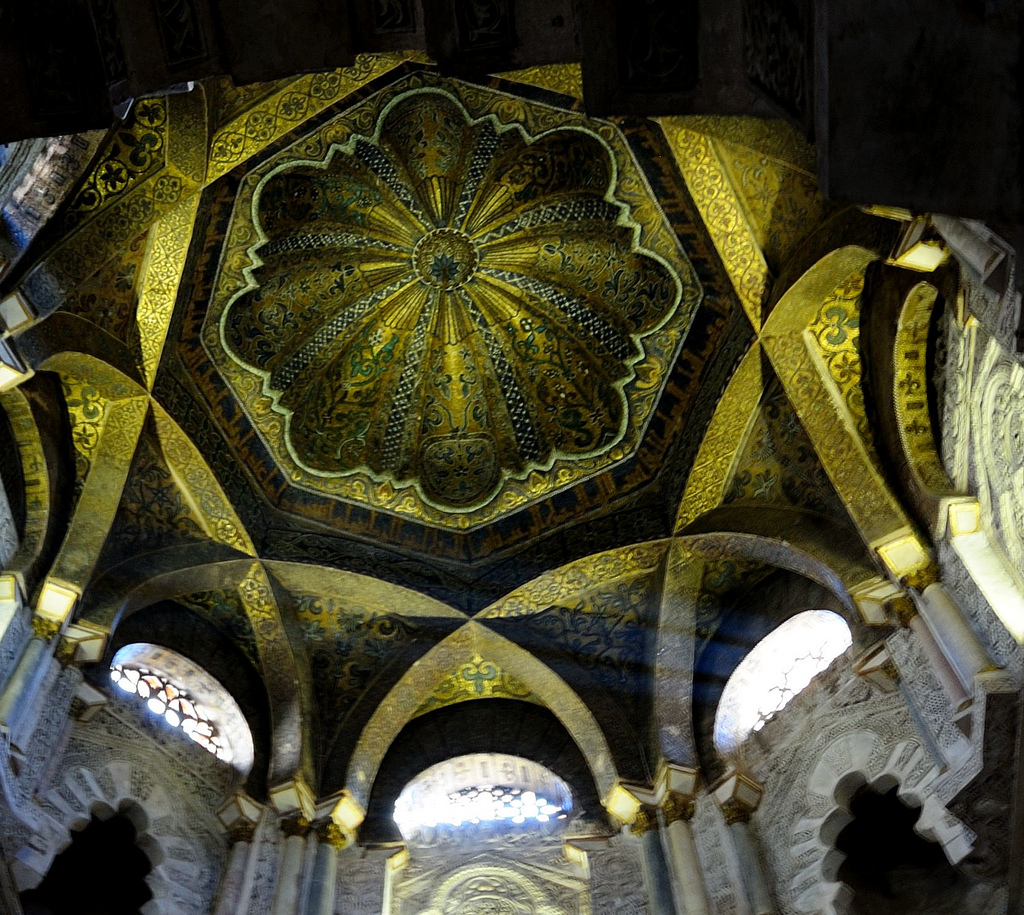
mosque interior domeWithin 100 years, Islamic rule had spread into Southwest Asia, across North Africa, and into Spain. Muslim armies had conquered cities, provinces, lands, and all sorts of Jewish, Christian, Arab, and pagan tribes that were then part of the ruling Byzantine and Persian empires of the Near and Middle East. In the process, the significant question of how to rule such a widespread empire of diverse peoples had been answered by the institution of state rule around the religious caliphate – the central ruling institution of Islam, which had a variety of guises until it was completely abolished in the early twentieth century.

But what concerns us here are those very earlier years and the twist Qutb put on them to account for what we may call the rise and fall of Islam, which we pickup in the next post.

©2014 by Charles Strohmer

Images by jonl1973 & -Reji respectively (permissions via Creative Commons)

ISIS & THE RISE AND FALL OF ISLAM part 1 of 3

electron microscopeMany radicalized Sunni Muslims in the Middle East, such as ISIS and al Qaeda, adhere to a doctrine that can be summed up as “the religion of Islam vs. the world.” The most recognizable such name in our time is that of Osama bin Laden who, with Abdullah Yusuf Azzam (deceased), founded al Qaeda. Another is Abu Musab al-Zarqawi, who became the head of al Qaeda in Iraq (AQI) and waged jihad on U.S. and coalition troops and on Iraq’s Shiites (he was killed in June 2006). Another recognizable is Ayman al-Zawahiri, al Qaeda’s longtime chief ideologue, who was named al Qaeda’s leader after bin Laden’s death (May 2011). He is thought to be holed up somewhere in the mountainous Afghanistan-Pakistan border region.

During the past few years, a murky figure named Abu Bakr al-Baghdadi, the leader of ISIS (or, IS, the Islamic State), has been aiming to surpass the reputations of bin Laden, Zawahiri, and Zarqawi as the most powerful jihadi leader. He took over AQI in 2010 or 2011, and began turning it into a worse child of hell than al Qaeda itself. However, according to Michael Morell, former Deputy Director of the CIA, Baghdadi was booted out of al Qaeda in January 2014 because he would not obey Zawahiri – not because ISIS had become inordinately violent, as is commonly reported.

So what’s up with this “us vs. everyone else” mentality anyway? And why does it drive these Sunni jihadist organizations? We began to see in the previous two posts, that a well-thought, modern-day rationale can be found in the prolific writings of the Sunni political activist Sayyid Qutb (1906-1966). I don’t mean that you would find his books calling for suicide bombings, beheadings, and similar other horrors. But it’s clear that “the religion Islam vs. the world” is an organizing principle of his worldview. It is also clear that jihadist organizations such as ISIS and al Qaeda are deeply indebted to Qutb’s worldview, which can be traced to his radical view of history and of Islam, which we will now look at.

But first a caveat. I can sympathize with the countless numbers of Sunnis who are not violent and who hate it that the above jihadi leaders and their organizations are seen as representing Sunni Islam. In my own tradition, Christianity, countless numbers of us hate it that many people consider violence done by Christians as representing Jesus. Guilt by association is a horrible mark to have to bear, not easily, if ever, removed. Nevertheless, the jihadis mentioned above, as well as Sayyid Qutb, claim to be Sunni, not Shia or Sufi, Muslim.

fallen apples (r-z)Previously, we saw that Qutb argued in Islam: The Religion of the Future (IRF) that the root human problem is a religious one: We habitually choose to let God rule our religious, and perhaps our moral, life, but not public life, and so we have become idolaters (a word Qutb uses frequently). That is, having kept God’s rule out of social, political, and other aspects of life, we created human systems for ruling them ourselves. Qutb is pointedly clear about this, and no one can accuse him of being short of breath about it, either. Perhaps this was because for him it meant the loss of the sovereignty of God over all of life (his doctrine of the sovereignty of God was key to his worldview). Loss of God’s sovereignty expressed itself, for Qutb, in what Qutb called the miserable state of the world, beginning with the ancient Jews and culminating (in his time) with the Marxists, for whom God was completely off-limits.

In (IRF), Qutb shorthanded this root human problem as “the hideous schizophrenia,” or “the sacred vs. the secular dichotomy,” whereby not only world history but also Islam was sliding to its nadir. And the reason? Islam, he believed, was once totally submitted to God’s total rule, but only for a very short time. Mostly, Islam, including its contemporary expression in his day, had a habit of falling prey to idolatrous ways of running public life, so it lost God’s favor, and with that its authority and rulership. This is a view held by al Qaeda and ISIS.

But why was Islam once getting the job done and what had scotched that? Qutb’s answer takes us back to a conclusion that he drew about religious purity and Islam’s original vision, and it is a key for understanding the “us vs. everyone else” religious mentality of ISIS and al Qaeda. To help in understanding Qutb on this crucial point, I want us to look in the next post at Islam’s earliest years.

©2014 by Charles Strohmer

Images by EMSL & r-z respectively (permission via Creative Commons)

WHERE ISIS STANDS: US VS. EVERYONE ELSE part 2 of 2

old typewriter and booksHaving identified when, where, and how the world went wrong (in ancient Jewish history; see the previous post), the Egyptian intellectual and widely-read Islamist activist Sayyid Qutb believed he had found the religious and historical starting point for what he considered history’s God-less trajectory. The life and times of Jesus in ancient Palestine was the next stop is his radical view of history.

Qutb believed that the ancient Jews had reduced God’s rule over all of life to the religious and moral aspects, and that Jesus, like Moses and the Jewish prophets, was a true messenger of God sent to restore Jewish life and practice back under God’s total rule. In Islam: The Religion of the Future (IRF), Qutb wrote that “Jesus (peace be upon him) … was sent by God as a prophet to the Jews, confirming and corroborating the Law of Moses.” But the Jews “reacted unfavourably to the message of Jesus” and in the end “resisted Jesus and his message” and “induced Pontius Pilate … to attempt the murder of Jesus by crucifixion.” (Of Christ’s death itself, Qutb was ambiguous because, as he said in IRF, “there is no definite injunction in our Qur’an or Traditions regarding” Jesus’ death. The Qur’an, not the Bible, was his ultimate authority.)

Judaism, per Qutb, had rejected Christ’s restoration message, but Christianity did not fair any better. Due to the persecution and scattering of Jesus’ disciples, Christianity, at least not in any systematic sense, never recovered the original unitary vision of the Mosiac Law concerning God’s rule over all aspects of human life.

And then came another historical disaster: the official conversion of the Roman Empire to Christianity in the fourth century. Noting that many people of the era called it “the triumph of Christianity,” Qutb called its Christianity’s “greatest calamity” (IRF). In the books of his that I have read, Qutb ranges through the domestic life, social policies, and foreign relations of the Holy Roman Empire, lambasting much of it, including Church councils. Along the way, he interprets hundreds of passages in the Qur’an as supporting his conclusions. The Christianity of the Holy Roman Empire, like Judaism before it, became hopelessly lost to other gods. In IRF he writes:

“The Christian community …could not crush or eradicate idolatry. Christianity’s principles became muddled and transmuted as a result of a new synthetic religion displaying conspicuously  equal elements of both Christianity and paganism. In this respect, Islam differs from Christianity. It completely exterminated its rival (idolatry) and propagated its principles pure and without opacity.”

Yet at times Qutb shows sympathy for those faithful Christians who were horrified by Roman immorality, imperialist debaucheries, and pagan influences but who could do little about them. He had no patience, however, for the monasticism that arose to counter those tendencies or for the Roman Catholic church’s priestly monopoly on biblical interpretation.

To conclude his march through history through another series of critical moves (which I omit discussing here), Qutb arrives at twentieth century Marxism, which gets his severest attack. E.g.: Marxism “cannot survive without its abominable police machinery, its bloodbaths, its liquidation purges and its concentration camps.” “Marxist doctrine is nothing more than incomprehensible ‘scientific’ fallacy.” “Marxism is completely ignorant of the human soul” (IFR). What Qutb called “the hideous schizophrenia” – the segregation of religious life from practical life in the world – which “the whole modern world” suffered from – made its appearance in Marxism as the world’s worst social disease to date.

But there was fix. Constantly relying on his doctrine of the sovereignty of God over all of life and history, Qutb believed that the solution to the hideous schizophrenia – to what he at times called the sacred vs. secular dichotomy – was “the religion of God.” And he was absolutely clear that by this he meant “the Islamic way of life” (IRF). That was where Qutb stood. It is where ISIS and al Qaeda stand: us vs. everyone else.

We will pick up the story to consider “Why Islam?” in the next post.

©2014 by Charles Strohmer

WHERE ISIS STANDS: US VS. EVERYONE ELSE part 1 of 2

night blizzardEveryone stands somewhere. And that stand is ultimately a religious one. We are currently in the midst of several posts (begun here) to discover where terror organizations such as ISIS and al Qaeda stand religiously. It is an “us vs. everyone else” mentality that gained popularity in the Middle East in the core, religious-political views of the Egyptian intellectual Sayyid Qutb, an Islamist activist who books spread widely after his death by execution in Egypt in 1966.

To pick up from where we left off last time, from where Sayyid Qutb stood, he saw an unbearable crisis in the world. Whether he looked East or West or at the Soviet bloc or even at the contemporary Muslim world, everything was sliding away from the “Islamic way of life,” which Qutb believed was “the basic system ordained by God for dynamic human life,” as he wrote in Islam: The Religion of the Future (IRF). Contrary to the core message of the Christian Bible, Qutb believed that Islam was the “universal” and “everlasting” way, and “human beings draw pain and destruction upon themselves whenever they overlook it or contradict it” (IRF).

In the books of his that I have read, Qutb employs evocative images of human disintegration and the miserable state of the world that remind me of a line from Leonard Cohen’s haunting song The Future, about a time when “the blizzard of the world has crossed the threshold and it has overturned the order of the soul,” therefore things will “slide in all directions.”

History’s fatal flaw. To account for what he perceived as the sorry state of the twentieth century, Qutb swept back through time to try to identify when and where the world went wrong. He located it in ancient Israel’s history, in what he said was Judaism’s reduction of God’s reign over all of life to God’s rule over ceremonial and individual moral concerns only. Qutb put it this way: the Torah “included a set of beliefs and divine laws” (the law of Moses) that the “Jews were commanded to apply … to all aspects of their lives,” but they failed to do that. Instead, they made “their Torah a basis for purely oratorial preaching” and “a basis for rituals to be slavishly performed by rote in their temples” (IRF).

According to Qutb, Judaism, now with its reductionist Torah, had lost its founding vision of God’s rule over the totality of life. In the place of God, over time, “gods” (a word Qutb uses frequently) from pagan nations had wheedled in to ancient Israel’s worldview to become organizing principles for many aspects of Jewish life. The Jews had become idolatrous (another word Qutb uses). They embraced polytheism while claiming to be monotheists.

According to Qutb, when the Jews dropped the ball on God’s total rule it set in motion in history what he called “the sacred vs. the secular dichotomy,” and that became the organizing principle of history’s God-less trajectory. This is a main theme running through IRF and Qutb often shorthands it, and its ramifications, as “the hideous schizophrenia.”

The hideous schizophrenia, to summarize his metaphor, is the fatal flaw of history, worked out in varying degrees of idolatry in every culture, including many Muslim cultures. It is the critical problem of civilization detached from God and God’s arrangement for all of life. It is the root of “the social orders, the schools of thought and the secular doctrines which have not issued from the original Divine unitary source” (IRF). And it pitted Qutb and his followers against the entire world. That part of the story we pick up with the next post.

©2014 by Charles Strohmer

Image by StormPetrel 1 (permission via Creative Commons)

THE RELIGIOUS ROOTS OF AL QAEDA AND ISIS part 4 of 4

pond studyRecently at lunch a friend mentioned ISIS and immediately shook his head to express his great shock at the unconscionable violence of these fanatics. He also said he was mystified by what makes them tick. At the time, I happened to be writing up the material about their core religious beliefs for these posts, and at the end of long conversation he and I had about those beliefs, he said: I didn’t know any of that, and it’s helpful to know that these guys don’t come out of thin air.

I hope that these posts equally help you to understand core religious reasons why ISIS is responsible for so much death and despair. These shockingly brutal hellhounds include religion among the justifications for their rampage across Iraq and Syria, their beheadings, apparently even of children, their persecution of Christians, and their stated goal of establishing a regional caliphate (Islamic state). Its leader, a terrorist called Abu Bakr al-Baghdadi, known as the “Invisible Sheik,” recently changed the organization’s name from ISIS to IS, the Islamic State, and named himself as caliph (religious and political head of the state).

All of this has taken place even though ISIS probably numbers only about 25,000 (currently) and despite the fact that early this year “al Qaeda central” (so-called) finally disowned ISIS, which was a large branch of al Qaeda. For interested readers, Bobby Ghosh, previously Time magazine’s Baghdad bureau chief, has a short article on the history of ISIS.

Over the years, I have found the clearest, most concise, and most comprehensive framework for understanding al Qaeda and ISIS in the persuasively argued writings of the Egyptian intellectual turned political racial, Sayyid Qutb (1906-1966), whose influence in the Middle East remains strong. So far in these posts, beginning here, AL QAEDA AND ISIS part 1 of 3 we have been looking at Qutb’s curious bio and the general religious-politic picture of Egypt during his adult life. Beginning with this post we are moving from those general topics to his specific religious beliefs, which helps in understanding what drives jihadist organizations such as ISIS and al Qaeda.

I want to cover Qutb’s religious views in some depth in these posts because few Americans know that the jihadis have a well-thought-out religious rationale, and fewer still know what that rationale is. Although I will be offering a reader’s digest version of it, I believe it is nevertheless a fair assessment that speaks for itself. Christians, in particular, I think, will want to turn a sharp ear to it because some of Qutb’s religious descriptions of what is at the heart the world’s problems may, surprisingly, remind them of ways in which their own preachers and teachers have identified these problems. And, personally, I found it interesting that Qutb brought a combined philosophical and theological intelligence to his criticisms of and prescriptions for whatever aspect of life was in his sights that was not unlike how some Christian philosophers and theologians I have read discuss root problems.

But I want to be clear about three things. One, Qutb’s religious views add up to being highly socially and politically activist, but the books of his that I have read, do not call for beheadings and similar other horrors, as far as I can determine. The syntax of at least one of his popular books, however, Milestones, which we will look at later, is very militant-sounding, and fanatics, of course, will bring and apply their gross spiritual disorder and misuse of the imagination to anything. (Barry Cooper’s excellent book, New Political Religions, discusses this disorder at length.)

gobsmackedTwo, in my view some Muslim scholars, such as Muqtedar Khan (the University of Delaware and the Brookings Institution), who is a self-described liberal Muslim with whom I have had dialogue, seem “soft” on Qutb even when discussing Milestones. See, for instance, this article by Khan. Three, I am not suggesting that Qutb’s religious views hold the truth about life. My purpose here is simply to try to present his views accurately, for they are serious stuff with serious social and political ramification, whether they are acted on peacefully and incrementally or in a revolutionary manner by jihadist organizations.

Having closely read a number of Sayyid Qutb’s English-translated books, I agree with the comment of essayist and critic Paul Berman that “Qutb is not shallow. Qutb is deep” (New York Times Magazine). Greek philosophy, Judaism, Christian theology, church history, church councils, Constantinianism (the formal alliance of church and state first employed by the Roman emperor Constantine), the Renaissance and Reformation periods, and the salient ideas of many Western thinkers, politicians, and Christian figures of his day – Qutb was conversant with and critical of them all. Although he appreciated the benefits of science and technology, he criticized as lamentable the intellectual climate and institutionalism of modern Western Europe, and he mounted significant criticisms of American life, liberal democracy, Communism, socialism, Marxism, fascism, Nazism, and capitalism.

Qutb’s knowledge of Islam and the Qur’an, of course, was extensive. After reading three English volumes of Qutb’s In the Shade of the Qur’an, Berman, in his book Terror and Liberalism, concluded that for Qutb, “a proper understanding of the Koran can be achieved only in an atmosphere of serious struggle, and only by someone who is engaged in a ferocious campaign for Islam, not by someone at ease in his chair. The Koran, he observes, does not merely offer a body of knowledge, to be plucked at will, as if from a tree. The Koran offers a way to live.” (The direct bearing of ideas upon actions, of theory on practice, was huge in Qutb’s worldview, as we will see in a future post when we look at his book Social Justice in Islam.)

Despite being an intellectual, Qutb wrote in a simple, straightforward style that appealed to Muslim youth. Gilles Kepel, a foremost Western scholar on Qutb, notes that Qutb’s style was very different from the complex rhetoric of the Islamic scholars. In his book Jihad: The Trail of Political Islam, Kepel writes: “Qutb spoke directly to his readers, using the modern idiom to get simple points across.”

Qutb’s doctrine of “the sovereignty of God” over all of life and history is crucial to his worldview and seems to be the theological starting point for his analysis of the world’s root problem, of what I call Qutb’s view of history’s fatal flaw, and his solutions to it. Some knowledge of this will help us understand ISIS. A short account follows in the next post.

©2014 by Charles Strohmer

Images by Patrick Dohney & Magdalena Roeseler respectively  (permissions via Creative Commons)