Identity and Relevance

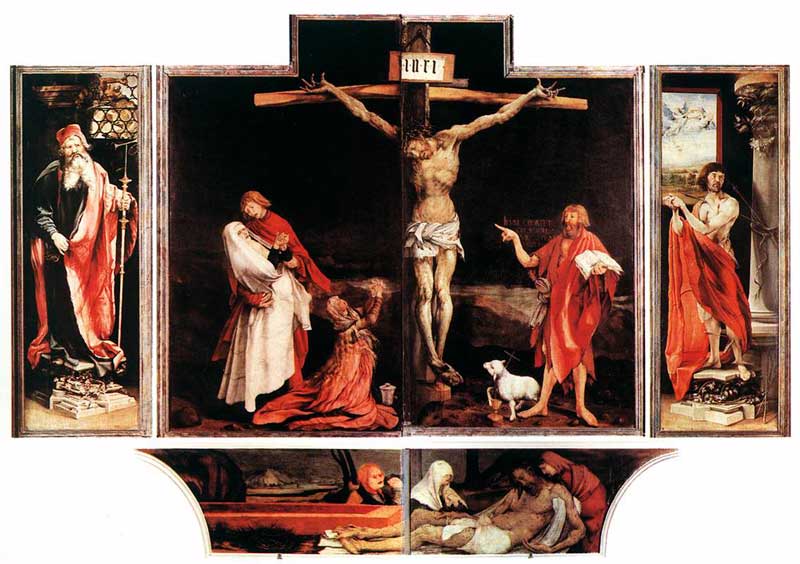
Gruenwald's Isenheim AltarpieceThinking lately about God’s solidarity in Christ with the suffering, the poor, and the marginalized, I ran across these words from Jürgen Moltmann, which I had made margin notes alongside, until today long-forgotten, in my copy of his book The Crucified God. While considering his words again today I realized why I so infrequently walk this path.

The Christian life of theologians, churches and human beings is faced more than ever today with a double crisis: the crisis of relevance and the crisis of identity. These two crises are complementary. The more theology and the church attempt to become relevant to the problems of the present day, the more deeply they are drawn into the crisis of their own identity. The more they attempt to assert their identity in traditional dogmas, rights and moral notions, the more irrelevant and unbelievable they become…

[In] these specific experiences of a double crisis, reflection on the cross leads to the clarification of what can be called Christian identity and what can be called Christian relevance, in critical solidarity with our contemporaries…

As far as I am concerned, the Christian church and Christian theology become relevant to the problems of the modern world only when they reveal the “hard core” on their identity in the crucified Christ and through it are called into question, together with the society they live in.

Faith, the church and theology must demonstrate what they really believe and hope about the man from Nazareth who was crucified under Pontius Pilate, and what practical consequence they wish to draw from this. But what kind of theology of the cross does him justice, and is necessary today?

To return to the theology of the cross means avoiding one-sided presentations of it in tradition, and comprehending the crucified Christ in the light and context of his resurrection, and therefore of freedom and hope.

To take up the theology of the cross today is to go beyond the limits of the doctrine of salvation to inquire into the revolution needed in the concept of God. Who is God in the cross of Christ who is abandoned by God?

To take up the theology of the cross further at the present day means to go beyond a concern for personal salvation, and to inquire about the liberation of man and his new relationship to the demonic crisis in his society. Who is the true man in sight of the Son of Man who was rejected and rose again in the freedom of God?…

[To] realize the cross at the present day is [to move] beyond a criticism of the church into a criticism of society. What does it mean to recall the God who was crucified in a society whose official creed is optimism, and which is knee-deep in blood?…

Jesus dies crying out to God, “My God, why hast thou forsaken me?’ All Christian theology and all Christian life is basically an answer to the question Jesus asked as he died… The issue is not that of an abstract theology of the cross and suffering, but of a theology of the crucified Christ.

(Jürgen Moltmann, beginning his book to disillusioned visionaries, The Crucified God, his emphases.)

©2015 by Charles Strohmer

Painting: Grunewald’s Isenheim Altarpiece

Our Children’s Wisdom: Some Questions for Parents

joys of homeworkThe search for wisdom is so highly valued in the Bible that Christians, others too, often ask, “How do we get wisdom?” It’s a perennial question and a particularly urgent one in the context of raising and educating children (see, e.g., the book of Proverbs). It occupied the minds of baby boomer parents (maybe not as many as it should have!) and it is now pressing in on millennials with kids.

Of course we know two answers right away, that we can get wisdom from the Bible and through prayer. But not everyone prays or reflects on Scripture. And even if the do, there is also an overlooked way in which everyone gets wisdom, even those who don’t pray and read the Bible. Here is some food for thought on this, which may help parents prime the pump.

We get wisdom from childhood, through a process as simple as it is profound. That is, for the most part early on, our wisdom simply grows up with us and in us. We don’t manufacture it or study it as a school subject, and we don’t spend much time thinking about it. We absorb it throughout childhood. It develops in us, and we in it, as a singular part of its development in the history of the family, community, and culture in which we live.

Perhaps the best analogy for the way we “get wisdom”(Proverbs 4:7) in this sense is found in the way we come to speak our mother tongue. We simply “pick it up” as we go along, by hearing, by imitating, by others correcting us. Long before we go to school to “learn English” from textbooks we are already using it with considerable fluency. By the time we begin to study it from books it is such a second nature to us that the way it comes across as a subject to be learned makes it seem strange, like algebra.

We develop in our wisdom in the same way. We pick it up, we absorb it, as we go along. Yet the analogy goes further. When we come across products of other wisdoms – Indian music, African medicine, Chinese architecture – our initial response is commonly like hearing a foreign language for the first time. We say, “How peculiar!” We take it for granted that our products are the normal ones and that the others are odd or even abnormal. This feeling can persist long after we know that the other people naturally regard their products as normal and ours as peculiar or abnormal.

So in the normal course of our formative years, we do not formally learn our wisdom; we absorb it, more or less uncritically, as we go along. It develops in us largely within our homes and through various significant others and authority figures with whom we interact: fathers, mothers, aunts, uncles, grandparents, older siblings, baby sitters, and perhaps Sesame Street and other sources. It’s not long before we are absorbing it from friends and neighbors, our teachers, rivals and enemies, sports and religion, radio, television, film, the Web, social media, the blogosphere, and much more.

chinese architecture (Nidhi M)But there are two things I want to point out about this process. One is that, although these sources have their own spokespersons and expositors, we are not absorbing each source’s wisdom in its entirety. Nothing even close to that. Instead, it’s done piecemeal. Each of us, from childhood, takes whatever we do take and we give it a particular imprint from our own individual circumstances and personalities, just as we all have our own handwriting. Slowly, what we have absorbed becomes a part of us – from here, there, and elsewhere.

The eyes of our minds are continually and imperceptibly gathering additional tints to their lenses, so our own wisdom – our own a way of seeing life and living in it effectively – is developing in us. Eventually, this absorption process gives us highly developed instincts for responding selectively to the world around us, such as in determining what is important or unimportant. It is our wisdom.

And we notice its distinction from that of others. For instance, by the time we are confronted with the way of seeing and living (the wisdom) of a different culture, much of it may seem so alien that we cannot imagine how any reasonable person would think and act like that. Some of it just gets explained away as being archaic or special or aberrant, or it is ignored or overlooked because there is no place in our minds to put it.

The second thing is this. And it’s as crucial and it is vital. The process of absorbing wisdom from childhood is not just about being taught and relying on obvious facts (don’t touch a hot stove; don’t play in the traffic) or overt moral values (don’t lie; say you’re sorry; be honest). The process is also subconscious. In fact, it is the absorbed, subtle influences and attitudes, the non-taught ones, that can be the most powerfully influential in the long run, and thus the most difficult to identify and change if they are wrong, for they come to us in childhood like the Gibeonite embassy, as if from far away, in disguise, unnoticed until it is too late.

An illuminating illustration, and one with far-reaching ramifications across the spectrum of everyday life, is how children get wisdom from parents subconsciously; that is, the parents don’t realize what hidden values, ideas, and attitudes they are imparting and the children don’t recognize they are picking them up.

Are the children, for instance, raised in a home where they get to see their parents arguing, or do the parents hide their fights from the children? If the former, do the children get to see the parents make up afterward? If so, how that is done will also influence the children. Or are the children left hurting and further bewildered because the parents kissed and made up privately, so the children don’t know that a reconciliation took place or how that was accomplished? And if the parents hid their fights, what has that said to the children as they get older and their own arguments arise?

We are not talking about one-off incidents but patterns of various kinds of parental behavior that betray hidden values, ideas, and attitudes that are rubbing off on the kids. So, to continue. Is an atmosphere of honest questioning fostered in the home, or do the children see in the parents an unapproachableness here? Or if a child pushes it questioning too far, in hopes of a satisfying answer, is he or she then impatiently fobbed off: “Just do what I say!” Or: “That’s just the way it is.” Or: “You’ll understand when you grow up.”

human eyeWhat topics are discussed at the dinner table? What topics are taboo? Does the family ever eat together? What do the children see their parents regularly spending money on, and how much money do they see them spending on these things? What kind of entertainment do the children see the parents enjoying on a regular basis? Is there any pattern of activity in which a child gets involved with a parent in helping the poor, the needy, the aged? Do mom and dad ever admit their mistakes to the children? What is the parental attitude toward religion, politics, the children’s friends, school teachers? How are people of different races treated?

I remembered growing up working alongside my dad in his auto repair business. He was known as “the car doctor,” and you won’t believe me when I say that he began to teach me about cars and car repair starting when I was nine or ten years old. But it’s true. And by the time I was sixteen I was glad of it, for I was earning lot of money as a mechanic! But that’s not what I want to call attention to here. I just needed to say that to get to this.

Year after year of working with my dad in a very public and busy auto repair shop in Detroit, I was able to watch how he interacted with people of different races. I put a lot of hours in at that shop, many days a week, especially during school breaks and the summer months, and I can’t recall ever seeing even a hint of racism in my dad. What I absorbed was his respectful manner of talking to and getting along with all sorts of people. He ended up with regular customers of different races, and in Detroit. Although I can recall my mom saying, “We try to get along with everyone,” neither of my parents ever sat me down to talk about “race issues.” I simply absorbed his peaceable values and attitudes about race throughout my teenage years. What if he had been a racist?

Again, absorbing wisdom is not just about what children are taught. The questions posed above are just several of many that parents need to struggle with for their children’s sakes. Subtle influences are loaded with powerful implications for the shaping of a child’s wisdom. Parents whose children are not home-schooled may not have as much influence over what goes on inside the classroom as they might like, but they do have control over what the children absorb in the home.

(Part of the above was adapted from Uncommon Sense: God’s Wisdom for Our Complex and Changing World, by John Peck and Charles Strohmer, chapter six.)

©2015 by Charles Strohmer

Images by Cayusa, Nidhi M, and Cesar, respectively (permissions from Creative Commons)

Think About It

thinking sculptureNot long ago I was nervously seated near the front of a church listening to myself being introduced as the guest preacher for that Sunday morning. Even though I’ve been there, done that many times in many churches, and arrive over-prepared for my talks, I’m never at ease in that introductory moment.

But that Sunday my nerves intensified when the host added that I was an “intellectual.” Nooooo. What do I do with that? I groaned. Sure, he’d said it amiably and as a compliment, which I appreciated, but intellectual? How do I undo that? I don’t see myself as one, and this wasn’t a university classroom. Mind you, the millennials in that space were probably jazzed to hear it. But what about the others? I’ve been around. I could almost hear the congregation, friendly as they were, suddenly wondering if there wasn’t a better way they could be spending their time that morning.

In hopes of trying to get the audience back, I opened with an impromptu joke. “I’m glad to be here this morning as an intellectual with all of you intellectuals. After all, who among us doesn’t use our brains?” Okay. Okay. I knew it was a naff as it was coming out. I’m not your man for spontaneous jokes. But I had to say something!

Flash forward to today. Perusing a stack of files in my office, I ran across a transcript of a short radio talk given some years ago in Detroit by my dear friend, the British pastor and writer John Peck. I read it and immediately wished it had been on my lips that Sunday morning. With a slight wave of the editorial hand and John’s permission, I’m able to share it with you here. I hope it inspires you as much as it does me.

“Jesus in Mark 12 told one man that he was not far from the kingdom of God because he spoke, as the original Greek word indicates, ‘thoughtfully.’

“Thinking is hard going. Some people give it a bad name by using it as a substitute for action, which is a pity because we can’t do without it. Odd thing is, we take it for granted in areas like business or science, but when it comes to faith we often switch off the mind, and when we do, substitutes for thinking take over, such as emotion.

“A favorite substitute is rhetoric. We are inspired by a powerful preacher who has the art of getting us excited about the gospel. He makes us feel it’s true. And in the midst of a world that is constantly pouring cold water on our faith, we need that. But that’s not teaching. It doesn’t have anything to do with the way we think. In fact, the rhetoric may even use the world’s techniques of persuasion – some preaching sounds like an extended TV commercial, in spite of Paul’s words in 1 Corinthians 2:4.

puzzled“Christian teaching is about understanding the meaning of the gospel. And don’t confuse inspiration with teaching. Inspiration is God motivating us, and it is aroused by emotive words and vivid images. Teaching is God’s way of working us through the problems that arise in applying the gospel consistently in everyday life. It is about changing our thinking to something more like the mind of Christ.

“Paul says to the Philippians, ‘Let love be with discrimination.’ By this he does not mean bigoted sterotyping or naive innocence. He wants love to exercise wisdom in deciding what is the best thing to do, rather in the way C. S. Lewis said, ‘It is not a question of “be good, sweet maid, and let who will be clever, [but] be good … and be as clever as you can.”’ Writing to the Ephesians, Paul says that mature Christians don’t get blown about by every wind of doctrine.

“Thinking, therefore, is not just about going to college. It’s about growing up. Some people are called to heavy theoretical intellectualizing; most of us aren’t. But either way, we are all called to use judgment, discernment. If we don’t, our laziness will keep us immature.

“We need to think at least as hard about our faith as we do about business or our hobbies. Some say this ruins spontaneity: thinking makes you inhibited, calculating, unemotional. Unfortunately, it often does. There are special reasons for this, to do with the influences at work in our Western culture. But it doesn’t have to. Paul was an intensely passionate person. But he was also a profound thinker. He spoke in tongues more than anyone in the Corinthian church; yet he treasured one word spoken “with understanding” more than all that.

“How could he let himself go like that? Because he had thought through the issues beforehand, so he could trust his instincts. Understanding brings safety. And he taught this to everyone: don’t just listen to me, he told the Corinthians, judge for yourselves. Don’t just swallow even the greatest preacher’s message whole. Listen to the arguments, keep asking questions. Think.

©2015 by Charles Strohmer and John Peck

Images by Davide Restivo and Daniel, respectively (permissions via Creative Commons)

Going Steady

on road to EmmausSome years ago a man told me that he had never read the Bible cover-to-cover. Normally that wouldn’t have struck me as odd, but this guy had been a church-going Christian for twenty years. Puzzled, I asked for an explanation. I don’t recall his exact words, but what came through was well, like, you know, I’ve read enough of the Bible to know what’s in it.

It was around this time when another Christian asked me if I would pray for her to have enough discipline to stick with a “through-the-Bible-in-a-year” reading schedule she had begun. “I’ve never done this before,” she said, “and I’ve been a Christian twenty years.” There it was again. I commended her for her decision to go steady with the Bible for a year; but doing that for the first time in twenty years? I just didn’t get it. And I couldn’t help but wonder where this gal and guy were at, after twenty years, in their “walk with the Lord,” as we used to call it.

Maybe it’s just me, but their comments seemed odd because during the first few years after becoming Christian I found myself devouring the Bible from cover to cover many times. I use “devouring” deliberately, because in my before-Christ history I had the exact opposite experience. A nonChristian spiritual teacher whom I had been following told me that I “owed it to myself” to read the whole Bible because it had a lot of wisdom. I took his advice and read it. I think it took me several months. But the Book was as dry as shoe leather. Yet as a new Christian, I feasted on the Bible continually, as naturally as if I were enjoying my favorite prime rib dinner.

I can’t prove this, but I suspect that if you haven’t embarked on a relationship with the Author of the Book, you’ll be chewing on some very tough shoe leather. I don’t blame anyone who doesn’t have an appetite for that, for the problems arising from that diet will of course be fatal. But problems also exist for those who have been given a personal relationship with the Author but who also have a now-and-then, here-and-there diet with His Book.

stack of BiblesGoing steady with Scripture means more than doing intermittent inductive, topical, or word studies; more than learning doctrine; more than playing Bible roulette to land on a verse to direct your path. It means more than discovering nine-foot giants with hands studded with six fingers, or finding “pagans” serving the Lord, or having hopes of becoming God’s end-times prophet.

It means more than treating the Bible like one might read the newspaper on the train to work or play around in the evening on the Web. It means more than engaging in a critical scholarship that reduces the story of Esther to a farce, the life of David to a fictional character, and the resurrection of Jesus to a myth. Even more than using the text to lead people to Christ.

Going steady with Scripture engages us in more than what meets the eye. It means spending regular time with the Author of the Book in His Book. It means a recurring opening of the Book with an unrushed, prayerful, and reflective attitude in hopes of dwelling in the secret place of the Most High. And you never know what will occur when the Presence meets you in that secret place of the Life behind the text, there in an encounter with the living, true, and merciful God. Or how you will be afterward: at peace or afraid, healed or hurt, elated or in tears, confirmed or challenged, with answers or with puzzles, with insight or with questions, with forgiveness or with guilt, in hope or despair, in joy or sorrow. We don’t know what we need. But the Author of the Book does.

Going steady with Scripture means settling in over the course of one’s life with God’s Book open humbly in our laps. There, God’s Spirit graces us to participate in a deepening personal relationship with the Author, in the ongoing rebuilding of our lives, in increasing of love for others, and in absorbing a godly wisdom for our ministry or our work in the world. Who doubts the ongoing, Christlike fruit that this steady process of transformation will produce?

I’m not nearly as steady as I want to be, as I know I should be. I fluff off. I make excuses. I think  I know it all. And I fear some rude awakenings in that day when God opens the books of our individual lives before Him, mine too, and points out how much more like Jesus our “walk with the Lord” could have been if we had gone steady with His Book. And I wonder if God might be easier on those who had no Bible than on those of us with a stack of translations we rarely open.

I’m done preaching here, except to report these words from the New Testament of two persons who knew where shoe leather belonged, under foot, as they walked with the Author of the Book: “Were not our hearts burning within us while he talked with us on the road and opened the Scripture to us?” Any takers?

©2015 by Charles Strohmer

Art from wikimedia commons and photo by J. Mark Bertrand.

The Wisdom of Old Books & Original Sources

old books“There is a strange idea abroad that in every subject the ancient books should be read only by the professionals, and that the amateur should content himself with the modern books.” That’s C. S. Lewis, from his Introduction to a classic text, St. Athanasius on the Incarnation. Lewis wrote that Introduction seventy years ago, and it’s well worth hearing the rest of his admonition today.

He continues: “Thus I have found as a tutor in English Literature that if the average student wants to find out something about Platonism, the very last thing he thinks of doing is to take a translation of Plato off the library shelf and read the Symposium. He would rather read some dreary book ten times as long, all about ‘isms’ and influences and only once in twelve pages telling him what Plato actually said.

“The error is rather an amiable one, for it springs from humility. The student is half afraid to meet the great philosophers face to face. He feels himself inadequate and thinks he will not understand him. But if he only knew, the great man, just because of his greatness, is much more intelligible than his commentator. The simplest student will be able to understand, if not all, yet a very great deal of what Plato said; but hardly anyone can understand some modern books on Platonism. It has always therefore been one of my main endeavors as a teacher to persuade the young that first-hand knowledge is not only more worth acquiring than second-hand knowledge, but is usually much easier and more delightful to understand.

ancient library (Duke edu.)“This mistaken preference for the modern books and this shyness of the old ones is nowhere more rampant than in theology…. Now this seems to me topsy-turvy. Naturally, since I am a writer, I do not wish the ordinary reader to read no modern books. But if he must read only the new or the old, I would advise him to read the old. And I would give him this advice precisely because he is an amateur and therefore much less protected than the expert from the dangers of an exclusive contemporary diet. A new book is still on its trial and the amateur is not in a position to judge it. It has to be tested against the great body of Christian thought down the ages, and all the hidden implications (often unsuspected by the author himself) have to be brought to light…. It is a good rule, therefore, after reading a new book, never to allow yourself another new one until you have read an old one in between. If that is too much for you, you should at least read one old one to every three new ones.

“Every age has its own outlook. It is specially good at seeing certain truths and specially liable to make certain mistakes. We all, therefore, need the books that will correct characteristic mistakes of our own period. And that means the old books.”

I have been thinking about Lewis’s admonition in the context of presidential speeches – the original sources where we hear the actual words of a President and make up our own minds – one-to-one, in an unmediated way – about what a President has actually said, rather than relying on a second- or third- or fourth-hand interpretation. As Lewis might have said, we have a mistaken preference for listening to how our political analysts interpret a President rather than listening ourselves the President.

It is a good rule, therefore, never to allow yourself to listen to an analyst, or a political challenger, or a pundit on talk radio until you have first heard the President describe a problem and explain a solution to end the problem. I began doing this myself much more often since the 1990s, beginning with President Bill Clinton, and it has been very surprising to me to see how distorted a view analysts, challengers, and others, with their rigid ideological agendas, can have of a President’s actual words and meanings.

Let us remember Lewis’s admonition as we here in the States now head into a year-and-a-half of political campaigning for the November 2016 elections. Heeding Lewis will make us not only wiser citizens and voters but greater respecters of truth.

©2015 by Charles Strohmer

THE GOD OF THE UNITED STATES

ancient templeEvery nation has it god or gods. That is how the Old Testament person would have answered a question if asked about the ultimate commitment of a nation. If you happened to run into a prophet and pressed him on this, he would name any number of national gods. The Baals of Caanan; Dagon of the Philistines; Ra, Nut, or Ma’at of the Egyptians; Marduk of the Babylonians; Ashur of the Assyrians; Yahweh of Israel. The list goes on.

But don’t stop with the names. Press the prophet. Ask him, So what? What does it matter? And he would explain to you that each god has its own distinctive features, which in turn gives a nation not only its religious life but also its social, economic, and political contours as well. Those ancient peoples would certainly have been able to understand what the prophet was on about. And the prophet would be the first to know that to dis a nation’s gods and question their rule is to be deemed a heretic, and that is to invite trouble of the worst kind from the powers that be.

Don’t worry, this isn’t a post to unpack all of that. A decent Bible commentary will help you there. We moderns, of course, don’t think and talk in that language. But maybe we should. Maybe we should learn to understand and discuss our nation’s ultimate commitment in terms of its god(s) and the direct influences it/they wield over our social, economic, and political contours. The ancients got it. Maybe we shouldn’t turn our noses up at them, as if they were ignorant. Maybe we are just blind to a basic truth about life, one that should be obvious to us but today has been made to seem foolish due to the secularism that courses our bloodstream.

God and AdamIn the United States – a perfect example – we only go so far as to talk about America as “Christian nation.” But we stop there. We don’t take the next logical step to the ultimate, the question of the god(s) of the United States. The last few decades alone have seen a universe of pro and con books, articles, and lectures created from Christians and secularists alike on “America as a Christian nation,” not to mention all the Sunday sermons that have been preached on it. It’s a topic that I have researched for decades and written about many times over the years, but I can’t recall any book or article that entered into the question about the god(s) of the nation. Apparently, Christians assume that it must be the biblical God. Probably secularists assume no god at all.

Perhaps we Christians don’t consider this truth about our nation’s god(s) because we go to church, where we hear about the God of the Bible and take it for granted that it is this God that gives our social, economic, and political life its contours. I mean, isn’t that what it means, theoretically, to conclude that America is a Christian nation? Or perhaps we don’t get it because the gods have for a long time been invisible, hidden, among us. In lands where the gospel has made considerable historical headway, like America, the old gods have been driven underground. After all, we don’t have shrines in our homes or state capitals to Baal or Dagon; well, I hope not! Instead, ideologies, big complex ideas, are the gods, the invisible ultimate allegiances, of modern nations.

It is a lot less work to get your mind round a visible god of wood or stone than it is an abstract image such as freedom or equality. I’m not saying that by nature freedom and equality are gods. We make them gods. And because they are invisible, it is easy to assign them whatever meanings we wish. Which is why we Americans are all over the map if asked to define, say, freedom and equality. Not to mention pulling apart. And some gods we make much more significant than others, especially those that become our ultimate allegiances.

The God of the United States is “America,” a trinity of “life,” “liberty,” and “the pursuit of happiness.” Around this trinity we have organized our nation’s social, economic, and political contours. Living it is second nature to us. To question it is heresy. Most ultimately, of course, the one, true, and living God is the God of the United States and of every other nation. My question is, Where are our heretics today?

©2015 by Charles Strohmer

Top image by Steven Zucker, lower image by Waiting for the Word (permissions via Creative Commons)

The One-explanation Syndrome

wisdom traditionIt’s easy and comfortable to live with the “one-explanation syndrome.” Here are some simple illustrations. A broken marriage is explained with the statement: “That happened because the wife had an affair.” A teenager’s jail sentence is explained by: “That happened because the kid got in with the wrong crowd.” A church splits and someone says, “When that church’s pastor resigned, it was all over for that church.”

Such comments are typical, and their language implies that one reason explains what is really a complex event. The marriage failed because of an affair. The church split because the pastor left. The United States went to war in Iraq in 2003 because of Iraq’s weapons of mass destruction. The great recession of 2007-2008 occurred because of the widespread failures in financial regulation.

Of course we now know that there were many reasons for the great recession and the war about Iraq. And if asked around, you would discover that was true for the church split, the teen’s jail sentence, and the broken marriage. But we like things to be kept simple. We seem to have a natural preference for one explanation. Events, however, are complex. Any one explanation can seem plausible enough, at least for a time, but the wise understand that it takes more than one ingredient to bake a cake or to go to war.

Here, I am trying to get at what we could call “multiple parallel reasons” for an event that are all true. This is a normal way the Bible itself looks at events. So let’s conduct a little thought experiment.

“Why did it take so long for the Israelites to occupy all of the Promised Land?” If you asked that question to most Christians who know the Old Testament, it is quite likely that you would get one, possibly two, scriptural reasons for an answer. Yet the Bible provides no less than five. Four are in Judges; the other in Deuteronomy. Fascinating for their sheer variety, one does wonder how they can all be true at once.

The first reason (Judges 1:19): they did not have sufficient armament. This explanation is very straightforward: although the Lord was with the men of Judah, and although they took possession of the hill country, they were unable to drive the people from the plains because they had iron chariots. This is a technological reason concerning the military and the armament. In the plains, the iron chariots would be free to attack en masse and to maneuver adequately. Israelite infantry might be able to evade them, but it could never keep rank in the face of a chariot attack or mount an effective counterattack afterward.

The chariots were made of iron rather than of wood, which made them formidable armament. The Israelites were late on the scene with iron technology. They had not mastered it even in Samuel’s time, which was one reason why the Philistines were so much trouble to them. Even as late as the time of Elisha, the loss of an ax head was a serious matter. So, although there may have been occasions when God intervened in battle, in terms of military technology alone the Israelites had no chance of competing with the Canaanites. Scripture recognizes this.

The second reason (Judges 1:28–2:3): Israelite treaty arrangements with their enemies. In the remainder of Judges chapter 1, it is clear that the peoples whom Israel did defeat were taken into their social order, albeit as slaves. As a consequence, treaty arrangements were taboo at this time of Israel’s history. Israel had been warned that if it entered into treaties even with its defeated enemies, the gods of those enemies would be a snare to Israel. This is the backdrop to the second reason, which today we might call a sociological one. History is full of examples of how a subject people have eventually radically modified the lifestyle and values of their conquerors, from the Greeks of the Roman Empire to the black slaves in North America.

choicesLike technology, the societal aspect of life is taken seriously by Scripture. The book of Proverbs, for example, concerns itself extensively with societal life. In the New Testament, the same concerns are recognized. “Don’t be misled,” says Paul, “bad company corrupts good character” (1 Corinthians 15:33; see also 2 Corinthians 6:14-18). First Peter, which seems to be a sort of follow-up letter for new converts, has some fascinating insights into the societal interaction between the Christian and the world outside (2:11-12; 3:3-4; 4:2-11). So in Judges, the judgment pronounced by the Angel of the Lord was not against Israel’s disobedience to some arbitrary divine ruling. It was explicitly stated to be based upon Israel’s failures to follow principles of social interaction that had been set down for it.

The third reason (Judges 2:22–3:5): to teach battle experience. This reason is peculiar on the face of it. It argues that the Israelites failed to drive out the Canaanite nations, so the Lord did not drive them out either in order that the Israelites would learn how to fight them. But if the Lord had driven them out, they would not have needed to learn! Of course there is more to it than that. This reason belongs to what we might call educational psychology.

Apparently, Israel’s morale was degenerating into that of the loser, perhaps because the Israelites’ compromises with the indigenous peoples affected their social and religious life, with their will to fight being undermined in the process. The determined attitude needed for struggle and resistance was being lost and had to be relearned. If at that point God had given them the whole land by a succession of miracles, they would not have appreciated it enough to make good use of the resultant peace. Further, for the next three centuries the land was under threat from invasion, and Israel, in a continued state of loss of morale, would have been thoroughly defeated. They could not have survived in such a state except by a succession of miracles, which in the nature of the case would have to be unending. In other words, a serious motivational problem had to be addressed.

This is not an isolated biblical example of this reason. The Israelites wandered for forty years in the desert, not only as a punishment but also to learn obedience through testing, to toughen them up for the rigors of invading Palestine. In the same way, the Exile, centuries later, had an educative significance. In the New Testament, the educative ideas of training and learning become dominant notions in the word “discipleship.” Learning, of whatever kind, has its own principles of operation. One such principle is the necessity of controlled experience: testing. People learn by being exposed to situations in which they may discover the limitations of their skill without the results being too irrevocably disastrous.

The fourth reason (Judges 3:7): the failure of faith. That “the Israelites did not trust the Lord” is of course the most frequently cited explanation Christians give for the Israelites failure to occupy all the Promise Land immediately (see also: Judges 10:10, 13). But it was not a failure of faith in the miraculous. After all, immediately after the Israelites in the desert had accepted the discouraging report of the ten spies, but then realized that they were losing their chance of conquest, they went ahead and attacked the Amalekites and Canaanites anyway. Clearly they were expecting divine help. The unbelief, the lack of faith, went deeper than that. This is a religious reason.

wisdomThere was a shift of religious loyalties, a hankering after other gods. This occurred frequently throughout the history of ancient Israel, and the insidious thing about it was that it was often disguised as a worship of the Lord while having the kind of devotion that was only appropriate for a heathen god. One God for the Temple or synagogue, another for daily life. That shift of religious loyalties resulted in a shift of commitment to a different kind of law, for different gods have different laws.

The Persians, for example, reckoned that their only hope of bringing down Daniel was concerning the law of his God (Daniel 6:5). Other gods, they knew, had other laws. Queen Jezebel also knew this. Her politics, based on the “fear of Baal,” entailed different kinds of property laws than those of Israel, which were based on “the far of the Lord.” This is why Jezebel cannot understand why her husband, the Israelite’s King Ahab, doesn’t just take Naboth’s vineyard for himself after Naboth refuses to sell it to the king (1 Kings 21). Religous loyalties  and their consequences are taken seriously by Scripture.

The fifth reason (Deuteronomy 7:22): to preserve the balance of nature. The overall picture so far is of an initial military failure through lack of heavy armament alongside treaty  arrangements that resulted in integration and intermarriage with consequent loss or weakening of religious loyalty to the Lord and a community at times characterized by a lack of fighting morale.

All of those reason, then, can be more or less harmonized as a pattern of causes and effects in which the operation of some may bring others into play. But this fifth reason (see also: Exodus 23:29–30) is a quite different animal. It is an ecological reason. As such, and this may be its most distinctive feature, it is not concerned just with the specific needs of the Israelites.

If the conquest were too rapidly decisive – if, in fact, the Israelites had been fully obedient to the Lord! – then there would have been more territory under their control than they had manpower to deal with, and the ecological balance of man, plant, and beast would have been upset to the detriment of all the inhabitants. (This is a typical concern of Deuteronomy.)

The writer does not envisage any miracles coming to deal with it. On the face of it, this explanation does not seem to fit in with the others. The chain of causes and effects that the others are working with does not seem to apply here. In fact, this one seems contradictory to them. Nevertheless, it fits with the others within a biblical way of seeing life and interpreting events.

So, why did the Israelites not occupy all the Promised Land immediately? How can all five explanations be true? This is a way in which the Bible thinks about life. It is part of its wisdom. As we get to grips with it, we will gain more wisdom about how the world works and what is behind the events that we so often want to simplify.

©2015 by Charles Strohmer

(An extended treatment of “multiple parallel explanations” can be found in chapters 11-13 of Uncommon Sense: God’s Wisdom for Our Complex and Changing World, by John Peck and Charles Strohmer.)

Center image by Lauren MacDonald (permission via Creative Commons)

Learning Wisdom from Outside

wisdom of pulling togetherI once came down with what everyone thought was a bad chest cold, but when rough coughing set in Doc supplied some meds. Ten days later I was sicker and Doc prescribed different drugs. These also missed the mark and my health deteriorated. Doc then said it might be walking pneumonia, so rest, Charles, and, here, take these other drugs. I worsened and was now waking myself up in the middle of the night coughing violently.

Two months had now passed. I was getting scared and my work suffered. I was on a writing deadline for a new book but only able write for a couple hours each day (the publisher gave me an extension). I had also been preparing teaching material for a long overseas trip, where I would be traveling from city to city and speaking nearly everyday, and on some days more than once. I had tickets to board the plane in a month and I wondered if the trip, nearly a year in planning, would have to be postponed. I had visions of audiences asking why this very sick foreigner was among us behind a microphone popping pills and coughing his lungs out.

During this period, my wife and I continued hosting a weekly, evening Bible study in our home. One night after we had all closed our Bibles and opened the snacks, Anna, a nurse who had been attending and was concerned about my health, suddenly asked a strange question, “Have you breathed-in any mold dust lately?” “What in the world is that?” I asked. “It’s like dust,” she said. “Kind of blue-gray in color.”

You could have knocked me over with a feather. I flashed-back to the day I had strewn several bales of straw over a large area of freshly sown grass seed on our front yard, to protect the seed and new grass from getting too much sun. (It’s the done thing here in the hot South.) Having moved here from a big city in the north, I knew little about rural life. I hadn’t thought anything about the strange blue-gray “dust” that I had been inhaling, which floated up in front of my face every time I broke open a bale and scattered the straw.

“I’ll bet that’s your problem,” Anna said. “I think you’ve been misdiagnosed. You probably inhaled a lot of mold dust and it’s made you very sick. Take a sputum sample to your doctor and get tested for that.” Long story short, Anna’s was a word of wisdom. The correct meds were prescribed and I boarded the plane, still coughing, but now recovering.

This story has always symbolized to me what we could call transcendent points of reference for evaluating problems and making decisions to resolve them. None of the usual cast of medical characters, bless them, had the wisdom needed to resolve my particular, and terribly worsening, problem. Instead, it was from a source outside my doctor’s circle that I gained the needed wisdom for the proper diagnosis and solution.

Whenever we encounter problems we typically seek wisdom to resolve them through the usual cast of characters, such as by turning to a family member or to a trusted friend or leader. We live in a time, however, in which many of the problems we face – socially, economically, politically, and so on – cannot be resolved from within our normal realm of relationships, because the problems did not have their sole origin in those relationships. A universe of ideas, values, and ways of doing things that seem “alien” to us encroach upon our lives each and every day, even if we don’t like it and don’t want them to. In our increasingly shrinking world with its growing cosmopolitanism, “outside influences” are by default implicated in everyone’s problems.

So it’s not just that we, within our normal relationships, are facing this predicament. The reverse is equally true. We are implicated in the problems that others face who are outside of our cast of characters and who look at us as “alien.”

Public dipomacyCollective problems such as this are not going to be resolved by staying solely within our own group. If we depend solely on the wisdom our usual sources, we might be entirely unable even to pinpoint the problem. We need to develop a habit of listening to “alien” voices to find a resolution, especially when a diagnosis keeps missing the mark.

The most obvious and crucial example today, I believe, is for Christians to listen to Muslim voices of moderation (and vice-versa). Far too often, the only sources of understanding that we Christians have about Muslims comes from what other Christians have said about Muslims. And in the bigger picture, it is, for instance, common that the only view Christians have about Palestinians has come from Israelis.

If we want to know what’s really going on with Muslims, however, or what’s really going on in the Middle East between the Israelis and the Palestinians, what I am suggesting is to learn about Muslims from Muslims and about Palestinians from Palestinians. This is to have a fundamental respect for the truth. When both “aliens” are doing this in the right spirit, it adds wisdom to all the parties understanding of a collective problem to help us work together resolve it. This kind of learning wisdom from others is vital in our time.

Timothy Keller, founding pastor of Redeemer Presbyterian Church in Manhattan – a city wildly diverse in its religious and cultural ethos – knows a thing or two about the importance of fostering learning wisdom amid human diversity. In answer to a question I put to him about learning wisdom from the other, Keller located it in the Bible’s teaching of common grace.

Simply put, all human beings, “whether they are Jewish, Muslim, or Christian, or whether they believe in God or not, share gifts of wisdom, insight, creativity, and beauty because these gifts come to everyone. Christians call this common grace, because they consider these as gifts that come from God. If that’s the case,” he concluded, “then I could expect that my neighbor who does not believe anything like I believe might still have wisdom from God that I have to listen to.”

Wisdom is waiting for us in the neighborhood if we pull together there.

©2015 by Charles Strohmer