
A dictator ruins a nation and leaves its people devastated

INTRODUCTION TO AN INTERVIEW
When we see a country that has been devastated and its people living in dire straits, it’s often the result of war. In March, 1995, I saw the results of a different agency of deterioration. I was stunned to see how a nation’s institutions could be ruined and its people plundered – not by war – by a dictator. I was in Romania for the first time, five years after the dramatic revolution that had overthrown Nicolai Ceausescu, the nation’s dictator President (1965-1989). After twenty-five years of repressive domestic policies by the Ceausescu government, I could still see unmistakable evidence of a society impoverished, an agrarian countryside ravaged, and a people living amid dire straits.

By 1995, Romania had received tremendous amounts of aid from the West, but widespread privation and institutional decay remained. My first sight of this was at the international airport in Bucharest, a grim-looking cinder block structure with poor lighting, ill-equipped toilet facilities, and antiquated x-ray booths that – I had been warned – might ruin my camera’s film.

On the ride into the city, the driver dodged countless deep potholes in the roads as if he were ducking bullets. Dilapidated cars and trucks rattled along, blue smoke pouring from tail pipes. Dirt and grime seemed to coat everything like a layer of paint. We passed neighborhoods in which the wood fences between houses were leaning over, collapsing in wide v-shapes. Gusts of wind stirred up dust along the curbs and sidewalks.

In Bucharest, the capitol, entire city blocks of high-rise Soviet-style apartment buildings stood partially completed. Their construction having been abandoned, their bare steel girders, rising no farther skyward, had been left to rust in the open air, the long booms of their derelict cranes swaying gently eight, ten, twelve stories high. It looked as if someone had fled during an emergency and had not come back. Well, someone had.

It was the absence of beauty. But that was not the fault of the people. The Ceausescu administration’s severe political repression and disastrous economic policies were responsible. Many of Ceausescu’s policies, however, were a continuation of Romania’s first communist president, Gheorghe Gheorghiu-Dej (1947-1965), who had implemented Stalinist policies of crushing the opposition. I learned how this worked and how it affected the people during the Ceausescu years from my translator Alexandru Nādāban and his wife, Daniela. We spent endless hours together talking in their home in Oradea each evening after my classes were finished for the day at the Bible Institute where I was teaching for a week.

I learned about the decrees, the endless stream of decrees issued by the regime. Electricity was often rationed. No room in a house could have more than one 40-watt light bulb. This decree was enforced. Informers walking the streets at night would report to the Securitate (the brutal secret police) about any rooms that looked too bright. Television broadcasts were limited to two hours a day, much of it being news about the Leader. Occasionally the power would be cut off without warning. You would be reading a book, mending a shirt, sitting in the cinema, or working at the office or factory when the lights would go out. Hospitals were not exempt. Patients died on operating tables and babies in incubators.

In the cities, the hot water – for homes, offices, factories – originated from huge water-producing facilities that conveyed the hot water through a vast network of very large pipes that snaked the streets above ground. I saw these ugly large pipe-snakes everywhere. Some that I saw were as large as 2.5 feet in diameter. During the winters, the government could cut off a city’s hot water supply if it got “out of favor.” Toward the end of Ceausescu’s regime hot water was limited to two hours a day, then two hours a week, then to once a week in most cities.

If the regime wanted houses or lands, they took them. Farmers and their families throughout the country were “relocated” to cities, where they were forced to work for the regime’s interests. Decrees were at times issued by the government even on how much people should eat. It was nearly impossible to organize dissent because the state made it difficult or impossible to disseminate information to friends or allies. Photocopiers were prohibited and typewriters were registered with the police. If you complained, the Securitate questioned you, or worse. Informers abounded. Fear was used to control many people.

I could go on telling you what I saw and learned about how horribly the Romanian people had suffered under the dictator. But instead, I want you to hear Alexandru’s voice. The professional relationship that began between us in 1995 immediately grew into one of those rare deep and lasting friendships. Alexandru was lecturing those years on theology and church history, and it was his students that I taught for the week – students who were as delightful as they were intellectually hungry for biblical wisdom.

Alexandru (Alex) and his wife, Daniela, pulled me through a depressed state of mind that frequently overtook me the more I felt plight of the people. They took me into their heart and home – which they had made in a Soviet-style apartment building. They looked after me. We broke bread together. I learned more about Christ’s love and Christian commitment and perseverance from them. I still do.

And I learned something else, too. It is one thing to watch your country being brought to ruin right before your eyes year after year by a corrupt, ruthless, and authoritarian President and his government. It is quite another thing to decide how you will live day by day amid the insistent darkness. So I invite you to hear Alexandru’s voice in the following interview, which I conducted with him in 1998. It took place in London, where he was conducting research for his Ph.D. It was originally published in Openings #2, January-March, 1999, and was slightly edited, here, for clarity.

INTERVIEW
Charles Strohmer: What was your general attitude toward the Ceausescu regime?

Alexandru Nādāban: It was like that of many others. Most of us had an official attitude and a private one. We had to use the official one in public in order to keep our jobs and stay out of trouble with the government. The private one was against the regime. For instance, privately, people would tell jokes about the regime, and this helped us to deal with the conditions.

Charles: What was your life like under Ceausescu?

Alex: I lived in Arad, in western Romania, near Timisoara, where the “revolution” began – we often now call it “the uprising.” When I was in high school, whenever Ceausescu visited Arad we were called to be out on the streets, along with many other people, to praise the dictator as he went by in his limousine. This happened all the time, everywhere in Romania. Ceausescu would visit the cities and parade by in his convoy and we would be all cheering. It was like Jesus entering Jerusalem. Flowers and carpets and songs and banners and bands. Military guard.

Charles: How did you take to this?

Alex: To me this was nothing. Just something to do. One time I was standing along the street waiting for several hours with everybody else. When Ceausescu’s convoy finally got close to us, two big policeman (they were driving a brand new BMW owned by the police) drove by telling us in a whispering voice, “Clap you hands. Clap you hands.” It was like in a movie, totally orchestrated. Television would show this quite often. I also remember after high school being in the army in 1975, when the economy had its first crisis [and] there was no sugar and work was becoming scarce because the country was running out of raw materials.

Charles: How did you get around the regime’s clamp down on getting information from the West?

Alex: At the beginning of Ceausescu’s regime things were more liberal. But after awhile not too much. I occasionally was able to listen to the Radio Free Europe station for Eastern Europe out of Munich and to Voice of America out of Thessaloniki, Greece. But it was forbidden to listen to them. People could report you to the Securitate for that. And then you would get a visit. I also listened to radio Belgrade for the music. We did not get this much, but occasionally we could pick it up. They played Jimi Hendrix, Janis Joplin, Gary Glitter, the Jackson 5, Led Zeppelin, the Beatles . . . I wasn’t crazy about this music like some of my friends were. I was interested in airplanes, cars, and weapons, so I occasionally read science magazines (one from France was especially interesting). The western diversity was a clear sign that in the East we were far behind.

Charles: Could you get anything from the TV about the West?

Alex: We got “Columbo!” And “the Saint.” And westerns. Programs like that, about the good guys and the bad guys but not about politics. During the recession in the 1980s, the state reduced TV to two hours a day. News at the beginning for twenty minutes. News at the end for ten minutes. Both about Ceausescu’s presidential activities. Then many times Ceausescu would also take up the other hour and a half. This was the Communist Party. We had a joke about this: Ceausescu was fighting to unite the two news programs!

Charles: What about public criticism of Ceausescu’s policies?

Alex: No. There was none because the state, one party, owned and controlled everything – the army, the borders, the companies, media, the newspapers, the trade unions, everything. Ceausescu was the president of everything – except the church, because he was a communist. I do not have any knowledge about any Romanian Orthodox Church protests against communism or in defense of the people. And the four Baptist colleagues I knew did not have any message for the situation either. Everyone’s private policy was to keep quite and not disturb the authorities.

Charles: I want to come back to your life under the dictator in a minute, but first, what was your religious background? How did you come to faith in Christ?

Alex: I was raised in the Orthodox Church but our family was very secular. As I think back to those days, I do not think that I was a Christian. I went to church at Easter but not Christmas (it was too cold!). If I went any other time it was only to see my granddad, who attended there. I never understood what was happening during an Orthodox service. So for me the church was meaningless. I became a Christian at age 28, in autumn 1982. I was in a personal crisis and couldn’t do anything about it. It was like I was paralyzed. I couldn’t make decisions. I couldn’t make my will work. I was reading the New Testament and . . .

Charles: Why were you reading the New testament?

Alex: Well first my sister got converted in a Pentecostal church and then my mom was converted in a Baptist church. She gave me a Bible, so I was reading it. But I couldn’t understand a thing. Six months later I was still in this big crisis and also very sick by then. It was summer, and I had a day or two off from my job. I had a terrible pain in my stomach. I decided to pray about this. I don’t know why. I just said, “God, if you exist, this pain is nothing for you, if you exist. So you could stop it. If you stop it, I’m going to be baptized this year.” (I knew that to be baptized was to connect with God in some way, so I had this association.) And the pain stopped.

Charles: That day?

Alex: That very moment! So I realized that God exists. Some days later I got in touch with someone who knew more about this. Oddly, I also made plans to leave the country by hiding in the back of a big truck going to the West. In the autumn I talked to a Baptist guy about God. He explained about the Bible and salvation and baptism, and finally I reached a point where I had to make a clear decision. So I prayed with this guy to give my life to the Lord. Afterward I was so happy that for three or four weeks I thought I could fly, and I was talking to everyone about Jesus. So then I was baptized. When I went to the church, a Baptist one, it was so different from an Orthodox one. A man was preaching and explaining the Bible and it made sense! And I was devouring the Bible on my own, too. I could not stop reading it. Also, my past began to make sense and I saw why my crisis had happened. God helped me to get out of it and become normal again.

Charles: You teach theology and church history. What motivated you in that direction?

Alex: I was involved in numerous Bible study groups, teaching, and people said to me, “You have teaching skills.” So after the revolution, London Bible College started teaching a course in Romania and I enrolled. Then LBC received some funds from Sainsburys to bring three students to London for three years, and I was one of those. So I did a BA course there, with a M.Phil. toward a Ph.D. in historical theology.

Charles: After becoming a Christian, did you think differently about your nation? Did it change how you were treated politically?

Alex: The first thing that happened was that the truck driver never came to pick me up to smuggle me out of the country. In fact, he had completely disappeared. From this I realized: I’m a Romanian, I’ve become a Christian, my place is in Romania, and as a Christian I should be a good citizen. But in terms of politics, I realized that I now had to show the authorities that there is another kind of righteousness. So I did this whenever I could.

For instance, a couple years after I was a Christian, I was “invited” to come before a committee of the Communist Party in the company where I worked (remember it was communist owned and controlled) to be questioned about my “new opinions.” You could not resist this or you would be out of a job and then nobody would employ you for fear of recriminations. I answered all their questions, but it was not what they wanted to hear. Immediately afterward the secretary of the Communist Party in the company said to me that I would be “treated accordingly.” This meant that, among other things, I was refused promotions and looked on with suspicion. Also, I needed to find another apartment and they prevented me from getting one.

Charles: How could they prevent you from moving?

Alex: Because the state owned all the housing (blocks of flats). The exception was if you had a lot of cash to buy a place, or if you inherited. So you were on a list and the state gave you your housing. You could build a house with a state-owned company, or try to buy an apartment, but that took at least five years. Anyway, this was a way of protesting – just by telling them my opinions as a Christian. Another way I protested was to stop going to many of the communist political meetings in the company. You were expected to attend. But not going was a way to protest. Anyway, I did not want to hear all the propaganda anymore.

Another time, the communists began another political arm called, believe it or not, the Democratic Front (something like that). When I was in my early 30s, I was “asked” to join by a communist leader in my company. (The major pressures always came through the company where you worked.) The Democratic Front was a new invention for people who were not in the Communist Party. Even the churches had to belong. But I refused to enroll in it. They pressured me several times, but I finally said, “I’m not going to do it and that’s it.” Some time after that, interestingly, I was walking to my job one day and I saw the guy who had been trying to recruit me. He did not have anything against me personally. We started talking and he said, “Be yourself. Keep to your way. And be smart. Things might change.” So here were the two attitudes. An official one and a private one. I think this guy wished he could take a stand like mine.

Charles: Sounds like being a Christian gave you the wisdom and courage to make public stands politically and socially even though they were personally costly.

Alex: Yes, because by reading the Scripture and having fellowship with God, I now knew the truth. No one forced me to have this new attitude; it was natural, like breathing, like finding my identity finally. I remember I would ride around on the tram or walk among the people in the city and see them downcast and dissatisfied and all the time complaining. And I wasn’t. I didn’t have a good apartment or very many things or much money. And the communists were in power. But so what? Life was nice because I was in fellowship with God.

Charles: Did you get involved in the “revolution?”

Alex: Yes, a little. But I was ready for a lot. No one knew what was going to happen. First I heard a few vague things on Radio Free Europe – “something was happening.” And then some relatives of people in my company got killed in Timisoara. I got sick and could not eat, knowing that people were getting killed. Then little by little some of us who had been in the army organized now as a small group to fight against the communists if they tried to do the same thing in Arad.

By the fifth or sixth day of fighting in Timosara, a bunch of my colleagues and I left work one morning and met with 500 hundred others in the main square in Arad. By late afternoon there were about 20,000 people gathered there. Soldiers were shooting bullets into the air occasionally. But not at the people. I went up to an army officer and looked him straight in the eye and asked, “Do you have war ammunition?” And he said yes. So I asked, “Did you receive an order to shoot?” He said no. Then he lit up a cigarette and we talked for another minute and he said to me privately, “Even I don’t like what is happening here.” And from that minute I knew we were going to win.

Charles: Really? What gave you that idea?

Alex: A month before this, during the Communist Congress, we thought Ceausescu might step down because that was a time when communist leaders everywhere in Europe were resigning. The Berlin Wall had come down, Czechoslovakia had become Democratic, and so on. I was deeply let down, along with everyone else, when Ceausescu did not resign but was reelected by the Communist Party as president. That very night, when Ceausescu was reelected, the most famous classic choir of Romania, called Madrigal, dressed in exquisite seventeenth-century clothing and sang: “Glory, Ceausescu, glory.” And I remember saying to myself, “That’s it. He’s now a god. Until now, everything was tolerated, but this is too much for God.” And I told a friends, “This is the end. Ceausescu will be replaced soon. God can be offended. He’s going to take action now.” I thought, “This is God’s hand,” because it would have been impossible to overturn this dictatorship without God, because they were so well organized. So I was willing to get involved because I realized that it was a judgment from God. I also realized that if I died I knew where, as a Christian, I was going!

Charles: Looking back, it all seems to have happened so quickly, in just a week.

Alex: Everyone was pretty nervous. The day that Ceausescu fled Bucharest, my church in Arad had its usual church meeting and I went. But they didn’t say anything about what was going on. So at the end I raised my hand and said, “I have one request. Would you like for us to sing a song?” I’m sorry, I cannot remember the name of this song, but the lyrics are powerful and they were very relevant. They talk about giving honor to the Resurrected One because he scattered the night of death and awakened the world from its tomb and gave it life and power. The chorus goes like this: “Jesus is alive. Jesus is alive. Praise and honor to him.” [After the army sided with the people] and Ceausescu fled, the present minister of culture, Ion Caramitru, came on TV saying, “Ceausescu fled from the capital. Jesus Christ is born in Romania today.” This was only two days before Christmas eve.

Charles: All kinds of significant aid poured into Romania after the revolution, from both Christian organizations and secular sources and from governments. What do you see as the effect on the people?

Alex: A lot of it was needed. The country was on the verge of starvation. I could not think what would have happened without the revolution. Maybe we would have become the European version of North Korea. It was crazy. There was a rumor that Ceausescu intended to put his son Nicu in his place. We would have become the first communist dynasty! But western materialism conquered Romania without warning. If under Ceausescu’s regime you could find thousands of Romanians who were ready to become missionaries for Jesus’ sake, you cannot find them any more, and they haven’t gone on the mission field! Now Christians are more used to receiving aid and benefitting from this.

A wrong mentality has developed. For example, one of our radio stations recently broadcast a short drama based on Jesus’ comments about the poor widow who put two very small coins in the temple offering. Through the words of one of the characters in the drama, the Christian playwright gave this interpretation: in order to help the poor, he (the character) will convince the rich Christians to give him some money. Then he will give his money to the poor. But this is the exact opposite of why Jesus told that story, but it is what a lot of Christians are doing now in Romania. They do not want to give up their material achievements to help others. Does this look familiar to you?

Charles: So the influx of western materialism has even changed Christian attitudes?

Alex: Yes. During the uprising, everybody was shouting “God exits” and praying and kneeling in public squares and things like this. Nobody did this before. A communist country recognized that God exists because of the miracle of the revolution. But after that – it did not take long – people did not seem to be interested in God but in getting something because many ministries and organizations from the West were coming with a lot of clothes, food, and medicine. So Christians were thinking: “We should be like the West.” Instead of being something, having something. Of course there was a lot of good taking place, in terms of schools, clinics, and orphanages, and so on. But many Christians became too caught up in getting dollars for the buildings and for all the latest technology instead of for the church – the people. Part of the reason is because millions of dollars came pouring in from overseas only to build new big buildings.

Charles: This reminds me of the prophet Amos, whom God called to denounce ancient Israel, in part, because material prosperity had influenced them to lose sight of their covenant responsibilities with one another.

Alex: As I said, there was a lot of good. But the emphasis is now too much on things. Before it was on people and Christians had a message. Now we don’t look any different from the nonChristians. Our message has become watered down. We don’t have the influence we had before.

Charles: During one of my trips to your country, a Christian confessed to me that he did not trust in God like he used to before the revolution.

Alex: This is not uncommon. People are reinterpreting Scripture in order to fit the materialism. Before, there were times when you couldn’t get even the basic things you needed. You had to pray. You had to trust God. People were more involved with people then. Now you just go to the market and you buy it – if you’ve got the money. Now you need God only when things go wrong. Before, everything was wrong, so your faith had to be everyday faith. Also, a lot of Christians “don’t have time” now for helping others.

Charles: It’s now ten years after the uprising. A lot of economic and political reform is still needed. Do you see the government as able to accomplish this?

Alex: Things are moving quite slow. According to the Romanian newspapers, politicians are more interested to get a raise for their salaries than to govern the country. True changes will only be brought in by honest hard working people who are willing to confront the corruption and bribery, as well as the poverty. But what Romanians must understand, and I refer here to the common people on the street, is that corruption and dishonesty does not refer only to politicians, financial sharks, and the selfish rich in high positions. It refers to all Romanians. We have to be honest. Everyone of us.

Charles: Under communism it was not possible to mention the Bible as a source for instruction about economics, politics, business, and so on. Are Romanian Christians thinking about this and trying to apply biblical wisdom is such areas?

Alex: Some Christian leaders are trying to do this. But it is a slow process, and not many Christians have studied the Bible to know what ideas it might have for these areas. For instance, the Bible gave people an alternative for the communist wisdom of the past, and now we even have a Christian Democratic Party. But people in Romania cannot say that this party has the answer or the solution for the country just because it as a Christian Party. On the contrary, because they are Christians (most are Romanian Orthodox), they are blamed for not having very much in common with the Bible!

Another big problem is that after the revolution, almost all the communists politicians became “Christian.” This was how they denied their past. But saying they are Christians is not enough, and it is one of the reasons why Romanian society still does not work. The Bible is a book for all of life. If all the Christians really believed that and began to study the Bible that way, it would make a big difference. Romania is in a transition period. We lack good laws and a decent economy. But God through the Bible can provide us with help in these areas.

Charles: What do you see happening in the future?

Alex: I think the nation will be more and more inheriting the problems of the West. And in the churches we’ll have more and more full time professional Christian workers, and we’ll have the congregations. Leaders will be those who know how to manipulate the congregations to be responsive to their message. It will be more and more difficult to find someone who is dedicated to God and not to capitalism.

I also think that people will get more dissatisfied with the churches, both the Orthodox and the Protestant, and that there will be many liberals and that the society will become more secular. I think that this Constantine style of keeping the country united by religion will fade away because Romania is not menaced by a foreign power. Maybe it will take all of this to happen before the true Christians can show the people what the real church is all about.

(This interview was first published in Openings #2, January – March, 1999. It has been slightly edited for clarity here.)
The Church at Philippi and Christian Political Allegiance

The gospel of Christ enters Christians into a life-long process of discipleship in which everything, but everything, sooner or later, including our politics, must get squared with the gospel. This is what dawned on the church at Philippi one sunny morning concerning their Roman political identity and allegiance. As a result, that early church issues us a challenge concerning our political loyalties as American Christians. It begins with a little history and ends with the Cross.

During the time of Christ, the city of Philippi, Macedonia, had been a strategic military outpost of the Roman Empire for nearly 200 years. There were Greeks and Jews in the city, but a large percentage of the population were Roman citizens, people who treasured that citizenship for the special civic and political privileges it gave them. Roman citizenship was for them essential to their national identity and it afforded them many benefits, included having their rights protected by the government. It would have been second nature for the Roman citizenry of Philippi to rely on the laws of Rome to protect their rights and to demand those protections should the need arise. Citizenship was a big deal. Even the children of the Roman citizens were taught to get that.

About twenty or thirty years after Christ’s death and resurrection, a church was founded at Philippi by the apostle Paul (along with Silas and some of his other companions) during one of his missionaries journeys. Given the large percentage of Roman citizens among the local population, it’s reasonable to conclude that a good portion of the church established by the apostle at Philippi was comprised of Roman citizens. It’s also reasonable to say that the Roman Christians in the church had a pronounced pride in their Roman citizenship, not unlike we American Christians take pride in American citizenship.

Some months after establishing the church, Paul left Philippi to continue his missionary journey; then some years later, while imprisoned in Rome, he sniffed out a serious problem in the church. Paul learned (probably from Epaphroditus’s visit to him in prison) that a number of believers in the Philippian ekklēsia were holding on much too tightly to their Roman citizenship as their fundamental political identity and allegiance. Paul then wrote a letter to the church, which appears to have been a vibrant and well-organized community. The Epistle to the Philippians shows the apostle’s deep affection for the church and a considerable amount of praise for them.

But here’s the thing. The apostle to the Gentiles admonishes the church for going overboard with their political loyalties to Rome. This is significant. Religion’s scholar Richard A. Spencer has written that only in Philippians does the apostle use language that speaks specifically of political identity, when he admonishes the church to live in a way that is worthy of the gospel of Christ. That political admonition is found in 1:27 and 3:20. Yet there’s been bit of mischief in the English translations of 1:27, which in turn conceals the takeaway in 3:20. Here’s how.

What is overt in the Greek – Paul’s admonition about the church’s politics – is hidden to us in the English translations. A key New Testament Greek phrase in 1:27 is commonly translated: “Whatever happens, conduct yourselves in a manner worthy of the gospel of Christ.” Almost identical is another common English translation: “… let your conduct be worthy of the gospel of Christ.” The trouble, here, is that the translations focus our thoughts on moral behavior in general. Yet in 1:27, the key verb construction in Greek, politeúesthe, refers not to moral behavior in general but to political conduct. Of course political life disciplined by the gospel of Christ cannot be disassociated from general moral conduct, but who thinks of that when reading about general moral conduct? In the Greek, the language has a clear meaning about political loyalty: i.e., let your political behavior be worthy of the gospel of Christ.

A little further on in the short letter (3:20), Paul reinforces the political point of his earlier statement (1:27) with the word politeuma, a commonly used noun of the day to denote Roman “citizenship.” Everyone would have understood politeuma that way, and by implication the rights and privileges of a Roman citizen. Even those who were not Roman would have understood the word that way, perhaps somewhat enviously. And the word is translated as “citizenship” in English Bibles in 3:20. But notice that Paul deliberately draws attention to a unique type of citizenship: in heaven: “Our citizenship is in heaven.” Notice, too, that the word politeuma closely correspondences to politeúesthe. The clear similarity would have set the Philippians to thinking.

By the time of the Epistle the church in Philippi had become well-established. It was filled with serious believers and practitioners of the gospel. It had its own deacons and elders. The letter reveals an ekklēsia that, all-in-all, was doing quite well, even when enduring periods of persecution. Throughout the Epistle it is obvious that the apostle to the Gentiles loves these believers dearly. Yet he loves them enough to include a clear exhortation to examine their political loyalties. Even a vibrant body with able leadership can overlook having its long-held political allegiances disciplined by the Cross. For the Philippian Christians who were Roman citizens, their civic and political loyalties to Rome needed rethinking. So Paul, whom we know is no slouch when it comes to argument, seeks to turn the tables on those loyalties.

He sets them up for that by first by using the verb construction politeuomai (1:27): “let your political behavior be worthy of the gospel of Christ”; then he draws their attention to their politeuma, “citizenship” (3:20). When coming to the word politeuma, perhaps they thought, oh, Roman of course; we’re Romans after all! But while they are congratulating themselves on being Roman citizens, Paul immediately upends their glory with: “your citizenship is in heaven” (3:20; emphasis added). With the words “in heaven,” he suddenly “forces” the church to face what he was really on about in 1:27: rethink the state of your political identity and allegiance. Paul was not patting them on the back about being Roman. You have a fundamentally different identity: as citizens of heaven. Too bad, I say, that the apostle’s warning about political conduct has been hidden from us.

I can almost hear Paul saying to his friend Epaphroditus as they are talking in Paul’s prison quarters in Rome: “They are such a great assembly. I love them to death, but I hate to think that their Roman citizenship holds such a powerful grip on their public witness for Christ. Their citizenship in heaven must be reflected in their political behavior. Let’s pray for them. Maybe the Lord will give me an idea about how to address this issue and I can include it in the letter I’m writing to them. They need a shift of mind-set, from Caesar and Rome to Christ and heaven.”

Whether any such conversation occurred between the two friends, the fact remains that the political admonition of 1:27 and the takeaway meant in 3:20 is hidden from us by the English translations. The crucial question “where is your ultimate civic or political identity and allegiance?” is never asked of us. I think Paul would have “Amen’d” what Charles A. Wanamaker said in his commentary on Philippians. The apostle Paul, he wrote, is exhorting them, and us, to live as citizens of heaven, “in a manner commensurate with the values and norms of the good news of Christ.”

The Philippian challenge to American Christian political loyalty remains. The believer’s citizenship in heaven is not about waiting for a life to come in the sweet by-and-by, so that in this life you just get to go ahead and think and act politically according to the basic principles of this world. Our political lives do not get a free pass on being disciplined by the gospel of Christ. Although Paul has much to say about the resurrected life elsewhere (1 Cor. 15), in Philippians he leaves no doubt that citizenship in heaven entails a basic identity with Jesus that instructs our way of life on earth, including our political life.

“Brothers and sisters,” I hear the apostle’s voice echoing down the corridor of history to us. “You are following Jesus in many areas; follow him in your political life also. Sure, that may be tough. Believe me, I get it. I’ve been hounded, persecuted, beaten, arrested, and now I’m in prison! Still, don’t let your American political loyalties get the better of you. Don’t let anything trump your political witness for the gospel. Jesus suffered politically by decree of the government. Follow his lead.”

But back to the Epistle. In the same breath in which Paul challenges believers to live their political lives in a manner worthy of the gospel of Christ, he adds,“[t]hen, whether I come and see you or am absent, I will hear about you . . . standing firm in one spirit, with one mind, working side by side for the faith that comes from the gospel” (1:27).

That there will be no misunderstanding of what he means by the gospel, in between 1:27 and 3:20, Paul reminds the Philippian church, and us, of their responsibility to imitate Christ’s humility in all things. He does this by quoting the extraordinary Christological hymn, sung by the early church, about our Lord’s unmatched humility:

“Let this mind be in you which was also in Christ Jesus: Who, being in very nature God, did not consider equality with God something to be used to his own advantage; rather, he made himself nothing by taking the very nature of a servant, being made in human likeness. And being found in appearance as a man, he humbled himself by becoming obedient to death – even death on a cross! . . .

“Therefore, my dear friends . . . continue to work out your salvation with fear and trembling, for it is God who works in you to will and to act in order to fulfill his good purpose” (2:6-13). Your citizenship is in heaven. Live politically, as well as in every other way, in a manner worthy of the gospel of Christ.

©Charles Strohmer, 2025

What’s going on in America?

An old pal of my in England recently emailed me, saying that it’s almost impossible to find someone to say something pleasant about Trump on this side of the Atlantic, especially after the way he treated Zelensky in their White House meeting (Feb, 28, 2025). He also mentioned that his daughters can’t understand how a convicted felon, racist, someone who falsifies his tax and incited an attack on the Capital is even allowed to be elected, let alone President, adding that Prime Minister Boris Johnson was kicked out for way less. Paul concluded his note to me with, “What’s going on in America?” He is too perceptive a thinker for me to fall back on the lazy way of clichés, sound bites, or memes. We have had many long serious conversions over the decades. Here is my reply, sent on March 13, 2025.

Hi Paul,

Always good to hear from you. I can well understand why you and your daughters ask, “What’s going on in America?” I have often said that I write to know what I think. Your question has “forced” me to put into writing a task I’ve put off: to see what I myself think about what’s going on. Here’s some summary thoughts that came to mind. I have always appreciated the fact that you try to understand the behavior of others, even those you find offensive. I hope the following thoughts, although briefly stated, provide you and your daughters with some understanding.

I see several significant social and political shifts that have contributed to what’s going on in America today: the rise of the imperial presidency; government run increasingly as a business; the steadily escalating division between the conservative-minded and the liberal/progressive minded; Trump’s working principles; Trump’s pivot to Putin.

1) The rise of the imperial presidency. Trump is the current Oval Office heir to what’s been called “the rise of the imperial presidency.” In the modern era this was given a boost when the U. S. Congress, which alone has the sole constitutional power to declare war, did not declare war on Vietnam but instead authorized Presidents Kennedy and then Johnson to use “military force.” After Johnson, President Nixon held a vast view of executive power, which, in my view, grew considerably as a result of what he saw he could get away with (e.g., illegal wire taps, withholding information from Congress, circumventing judicial processes) until he got busted through what became know as the Watergate scandal, which broke in the news (1972-1973). Eventually, with his near-impeachment at hand, Nixon resigned the presidency (Aug., 1974). Afterward, some attempts were made by the U. S. Congress to try to curtail presidential power to shore up constitutional restraints. Yet neither the political liberals nor conservatives gave up wanting a president to be the guy who dreams big dreams for the nation and promises to make them a reality (one hears this bs implied or directly stated all the time in presidential campaign speeches).

Then came a tipping point: 9/11 and U.S. responses. Besides Congressional authorization of George W. Bush to conduct military actions (but called wars) against Al-Queda, the Taliban, and Iraq, Congressional acquiescence played an important role in allowing Bush, and President Obama after him, but especially Bush, to exercise presidential power domestically that was virtually unchecked by meaningful legal limits (e.g., Guantanamo Bay, spying on US citizens, Obama’s military strikes against Libya and ISIS exceeded constitutional limits).

It seems to me that constitutional brake pads meant to stop the movement of increasingly abusive executive authority have worn thin over the decades. Apparently Congress has not been able or is willing to slow down, never mind stop, what has become the ever-evolving executive authority a president gets away by using presidentially appointed teams of clever constitutional lawyers. It doesn’t matter which political party sits being the so-called Resolute desk in the Oval Office. Each president, in his own way, has a field day (for 4 or 8 years) bypassing constitutional restraints on presidential power, each in their own (partisan) ways, getting much of what it and his party wants, while Congress does little or nothing about it, or even endorses it, as the majority party in Congress will usually do – currently the Republicans. Large segments of the population of the party in follow in step.

The raft of Executive Orders adds to the problem. EOs are created and signed by presidents because EOs do not need Congressional approval. They can at times be good for the country, but they can also be vehicles whereby a president gets around federal laws. EOs are often reversed or cancelled by the next president if that person is from the other party. Congress and federal courts can strike down bad or unnecessary EOs, but that takes time, and all the while the limits of executive authority continue to be tested if not crossed. Although we are currently only weeks into Trump’s second term, many of the EOs that his administration are carrying out are having the effect of a guillotine upon agencies and institutions rather than being actual reforms (no one disagrees that actual reforms of various agencies and institutions are necessary).

The imperial presidency (the cult of the presidency, as some now call it) seems to be reaching what the Old Testament person would call idolatrous proportions in more recent years. All sorts of social and political unrest here has emerged and contributed to this, including a number of Supreme Court rulings that have reified the social and political divisions of an already split country. Into the volatile mix, add Trump’s first term, the rise of MAGA, his absolute refusal to admit he lost the 2020 election, the January 6, 2021 violent riot at the Capital, the Biden administration (4yrs), and now Trump’s second term, which seems to be taking of monarchial dimensions, fueled by strong support from Republicans in Congress and some strange brew of MAGA people and many Evangelicals. Trump is having his own field day. The imperial presidency seems to have been unleashed. My question to myself has been: is it unlikely that Trump will try, with Congressional support or not, to make an end-run around the constitution and go for a third term, or worse?

2) Government run as a business. About 20 yrs ago I began collecting occasional pieces of analysis which argued that a subtle and at-times not so subtle shift was occurring in which our federal government was being steadily transformed into a business enterprise. I don’t have access at this time to my notes on this development, but the thesis seems to have been prescient. Our “government” has slowly been moving outside of functioning within the laws, norms, and principles respective of a constitutional republic to be increasingly run, “governed,” as a business enterprise. Jim Skillen has done extensive research into this. He recently summed it up this way: “the federal constitutional order of the United States republic is increasingly being governed – as well as interpreted by the Supreme Court – as a marketplace.” Trump moved this shift along during his first term (2016-2020), with various political moves that directed more government benefits and power to big corporations and the wealthy. He is strengthening, if not solidifying, the shift of the U.S. to become increasingly identified as marketplace. As Skillen muses, “the outcome might look more like a privately owned company whose chief investors and directors constitute a corporate oligarchy under his autocratic authority. In either case,” he concludes, “Congress and the Supreme Court my find themselves shrunken to toddlers tagging along for the ride.”

Trump is a businessman and, as you say in your email, he seems to think international politics is like real estate deals, which seems to be dragging us into a dangerous and darker future. He seems to know no other way that being a businessman. That’s how he’s running the presidency. As he’s found of saying: “I’m a deal maker. I do deals.” Interestingly, he never adds, “and I’ve been bankrupt many times.” I mention that little omission since he’s now running a country, and it makes me wonder what he is running it into.

3) The slow revolt of the conservative-minded against the liberal/progressive-minded. Or, to put it this way: the steady movement of social liberals/progressives away from religious conservatives. This movement now seems to have spanned into unbridgeable gap, playing itself out politically in the near-absolute division today between the Republican Party and the Democratic Party. Its social-political roots can be traced to the rise of the moral majority (late 1970s). The movement gained a lot of traction during Reagan’s 8-year tenure (1980s), with the division at times becoming more defined during the 16-year period that gave us the Bill Clinton and George W Bush presidencies, respectively(1992-2008).

After presenting himself as a kind of left-of-center Democratic candidate, when elected President Obama (2008-2016) slowly influenced the Democratic Party leftward, particularly when he publicly came out in support of gay marriage, which seems to have been a subtle factor in setting in motion enough social momentum across the country for the Supreme Court’s landmark decision in 2015 to legalize gay marriages. Further contributing to the liberal/conservative division in our country was the Court’s decision in 2022 to end the 49-year old law that guaranteed a constitutional right to an abortion. The decision was seen as a huge victory for conservatives (it put the ball back with the states, and it so far has not slowed down the rate of abortions, and it has resulted in previously unheard of complicated lawsuits). Since then all sorts of trans-related issues are making the (so-called) left-right division here even more absolute. Further, Trump’s first, and now his second term, are solidifying the country’s social, political, and religious divisions.

4) Trump’s working principles. In brief: deny, deny, deny; obfuscate, obfuscate, obfuscate; sue, sue, sue. To understand these, one needs to look into the life of Roy Cohn, the lawyer who was key in Trump’s rise to power in real estate; the two men had a close business relationship. I researched this around 2016-17. That research explained a lot about Trump, which is in evidence even more consistently to this today. Cohn (d. 1986) was known as the person who mentored Trump in many and varied ways to exploit power and instill fear; Cohn’s formula: attack, counterattack, never apologize. Cohn was also expert at media manipulation. Apparently the 2024 biographical film, “The Apprentice,” (I’ve not seen it) is partly about this relationship.

5) Trump’s pivot to Putin. There’s no need for me to say anything about this because it’s been so much on Trump’s own lips and in some of his actions, beginning in his first term, but now quite often; it’s become self-evident. In my opinion, Trump is edging his way into ruling the U. S. like Putin and Xi Jinping rule their nations.

It’s over to you now, mon ami. These significant five shifts in American life (there would be others) seem pretty clearly implicated as motivating social and political factors. Thanks for the opportunity to know what I think! Which, as always, seeks further understanding. I hope these five begin to help us build up a comprehensive picture re what’s going on here today. I look forward to your further thoughts on this.

Continued grace, strength, and wisdom.
Charles

Your dance with technology: who leads? – “Everyday Sabbath” book review by Charles Strohmer

In 1954, Jacques Ellul published La Technique, the French Protestant intellectual’s groundbreaking work on the emerging technological world, a world he perceived as monolithic and inevitably totalistic. A decade later, the English translation appeared as The Technological Society. The book’s troubling and prescient takeaway is that technology is out of our control; in fact, it controls us. Resistance is futile. Having been enlightened to the problem of technological control, readers are left with a sense of powerlessness before the cold mercy of Technique, a dehumanizing idol that grows ever stronger and steadily coerces us toward its own ends, about which we are in the dark. Ellul doesn’t offer solutions to his disturbing conclusion – perhaps in part because he doesn’t discuss the distinguishing human quality of responsibility.

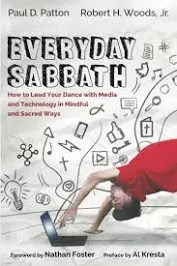
Thankfully, human responsibility toward technology is front and center in Everyday Sabbath: How to Lead Your Dance with the Media and Technology in Mindful and Sacred Ways. Paul Patton and Robert Woods have co-authored an exceptional book that provides answers to the problem Ellul diagnoses. Using the metaphor of dance, they offer a biblically grounded musical score for learning how to lead when dancing with technology, social media, and pop culture.

Patton and Woods are all about developing our God-given, albeit often neglected, responsibilities toward digital technologies. We have these useful technologies at our fingertips all day long. The authors see them as gifts from God. Yet they can easily gain control – not just occasionally but habitually. And when they do, our relationships with God, family, church, friends, school, and work, and even play take a beating.

The authors contend that “the biblical notion of Sabbath is under a unique kind of assault in our digital culture,” from a “24/7 flood of distractions” that “can drown out our capacity to rest in God’s presence.” The way ahead is to find sabbath rest amid the busyness of our digital culture by cultivating “holy habits” through what the authors call the Three Sacreds: “sacred intentionality, or a purposefulness toward God’s ultimate calling; sacred interiority, or an immediately accessible inner thought life and memory serving redemptive purposes; and sacred identity, or an understanding of who we are and who we are to become as people made in the image of God.”

The book’s nine chapters bring the Three Sacreds on stage to offer a wonderfully inviting panorama of insights and practical disciplines for creating – and maintaining – regular times of sabbath. To cultivate the Three Sacreds and “disentangle us from the dominance of spectator passivity,” each chapter includes fresh biblical exegesis relevant to life in our digital world. Conversation with sources from the past two millennia – Ignatius, Rumi, Calvin, Emily Dickinson, J. R. R. Tolkien, Abraham Joshua Heschel, Richard Rohr, and many others – also fills the pages. In addition, the book contains thoughtful breakout boxes, practical tips, and discussion questions designed to provoke readers with new ideas and exercises for moving the dance with technology into more comfortable rhythms.

A feature I find particularly appealing is the authors’ clarity on the Jewish practice of Shema. Using the biblical Shema – “Hear, O Israel: The Lord our God is one, the Lord is one” (Deut. 6:4) – as an illustration, Patton and Woods encourage readers to adopt their own brief confessional prayer as a further means to develop godly rhythms for leading the dance. One’s prayer may be short or long. It includes scripture relevant to one’s dance (examples are offered), but it can also include truths from other relevant sources. It is memorized over time and “asserted explicitly everyday” as a central confession.

Patton and Woods know their stuff. From assignments and discussions with students in their university classrooms over many years, these two scholars of communication and media discovered that most of the students were in varying degrees addicted to their phones and social media. Not a few even experienced withdrawal symptoms when they were given simple assignments that included going without those technologies for a mere twenty-four hours.

Concerned, the teachers began creating curriculum that both affirmed technology as a gift from God and teaches students how to identify problems and change their responses toward pop culture and social media to form wiser habits of engagement. Everyday Sabbath is the fruit of that labor in book form.

The book’s interior has been laid out for easy use in classrooms for courses in pop culture, media and technology, and spiritual formation, but the book is not only for students. The authors write “for the ‘thinking Christian’ who wants to develop a biblically based, holistic way to respond to our digital culture’s worldview and grow Christ-like habits of the high-tech heart.”

Winsomely written, amply illustrated, and potentially life-changing, Everyday Sabbath is the kind of book you can’t go wrong with. Its insights, conversations, and practical exercises serve the authors’ purpose of helping move readers from being mere recipients of the book’s wisdom to becoming daily participants in leading a dance with the digital world for the glory of God.

It’s a dance, but it is also a battle, as Ellul identified all those years ago. We have a responsibility to became wiser stewards of our time so as not to allow Technique rule our daily activities. “In a technological age,” the authors write, “Christians are called to be ‘resistance fighters’ who take part in a worldview guerilla warfare and practice what apologist and author C. S. Lewis describes as ‘resistance thinking’ in our daily involvement with media and technology.” In other words, resistance is not futile under God in Christ.

©2023 by Charles Strohmer

This review was originally published in the January 2023 issue of The Christian Century under the title “In the dance with technology, who leads?” Subtitle: “Jacques Ellul diagnosed the problem. Paul Patton and Robert Woods offer some solutions.

Easter?

Dear Friends,

Okay, you’re right. I’ve never before written a letter to you my faithful readers here on my blog, but I wanted this post to be a bit more personal. So here goes.

We live during such a fast-paced and unusually dramatic and demanding period that the day we take to stop in grateful memory of the most significant event in history can by now seem like an event in the distant past. Old news. No longer on our minds. Even though it was only a few weeks ago. We’ve moved on. Today’s events are the thing.

But is the greatest event in history, what we call Easter, behind the times? Behind your times? I ask you.

Thanks to one of the more constructive benefits of the Internet, I listened online to two Sunday morning messages by Pastor Mike Osminiski in the quiet of my study on the afternoon each one was preached, Palm Sunday and Easter. Each teaching was an hour long and I found myself taking a lot of notes, but it was not time spent but time deeply blessed. I was so totally blessed receiving fresh and relevant insight and understanding about the last week of our Lord’s life and the resurrection that I’m linking both messages here on my blog for you.

Opening up Psalm 118 and Psalm 22 in the context of Mark 11, Pastor Mike took me into the story of Jesus as Jesus personally entered the story of God for the closing days of his life on earth, moving from the triumphal entry into Jerusalem to the Passover meal and then through the betrayal to Jesus’ trial, death, and resurrection. Although this was theologically solid stuff, it wasn’t abstract theological teaching. It was rich immersion into Scripture corresponding to what Jesus faced then and there, during a week that at times even for him seemed unimaginable.

We are often told that Jesus fulfilled the Scripture. And that is true. Yet Jesus’ life was also embedded in the Scripture. The two Sunday messages brought out to me that Jesus had a very real personal understanding of having entered the narratives of Psalm 118 and Psalm 22. Jesus saw in them timely words from Father to Son (from hundreds of years earlier!) that gave him courage to face the way ahead, to keep going, so that his own mind, will, and emotions did not dominate his decisions that terrible week, when unthinkable grief and suffering were to be placed on his shoulders (that he might fulfill the Scripture). Also, and importantly, the two Psalms gave Jesus vision and hope of the joy he will experience after his resurrection from the dead.

And there was this too. Both messages gave me fresh insight that helped me understand more clearly as to why seeking the Lord to locate ourselves in scriptural narratives, particularly during dramatic and demanding days such as ours, is a vital part of following Jesus.

Mike did not use the word “Easter” to talk about this. He talked about Resurrection Day.

Resurrection life, not bunny rabbits, is what we ought to be gratefully remembering on the day everyone calls Easter. That indestructible life is God’s gift to us. It’s not passe. It’s for our life today. Hey, here’s a thought. Perhaps we should start a movement to replace the name “Easter” with “Resurrection Day”?

As we understand more about Jesus’ life that week, its unprecedented personal challenges, and where he took inspiration from, perhaps we may be able to see and be inspired to keep going by seeing at times where to enter the story for God in Scripture for our own lives, humbly and obediently, to receive more of that resurrection life of Jesus to get us through whatever kind of trial or suffering we face. Please don’t read that as offering a “there, there now” brother or sister, “all will be fine.” This is not that. Who knows what lays ahead for us during the ongoing, demanding, time-foreshortened moment that we still find ourselves in as followers Jesus. We live in seriously shifting times. Let us not take the world-historical event of Resurrection Day as a thing of the past.

I ask you, what other than the everlasting power of the life that defeated death will do for you today?

I don’t know how Pastor Mike’s teachings will personally bless you. But this I pray. If you’re longing for a fuller lifting of the veil in order to better see Jesus today, and to receive insight into the power and authority of Christ’s suffering, death, and resurrection as essential graces for your faith and life today, in whatever you face, or that faces you, no matter how demanding, I pray that you will find all of that and more in these two messages.

‘Nuff said. It’s over to you now. Here’s the two links. Oh, I should add that Mike opens the start of each Sunday service, but you may then want to scroll ahead to where he starts each message, as preceding each one is a 20+ minute word on Communion from someone else – not to say those are not worth your time! Also, you’ll see two different ways to listen. I suggest listening by clicking the little white arrow at the bottom of the church scene, rather than the one below it, which is audio only.

Pastor Mike starts the Palm Sunday message around the 20min, 30sec mark:
https://www.lhcfwarren.com/sermons/palm-sunday-and-psalm-118/

He starts the Resurrection Day message around the 38.00 min mark:
https://www.lhcfwarren.com/sermons/psalm-22-good-friday-and-resurrection-sunday/

If you have any difficulty accessing a talk, let me know.

Yours truly, in His life,
Charles

©2022 by Charles Strohmer

Image courtesy of Creative Commons, Samantha Simmons

Our Citizenship (on earth as it is) in Heaven

In 2020 and 2021, I guest-preached two messages at Evergreen Church in which I tired as best I could to offer biblical responses to the difficult historical moment in which the American church finds itself. There are, of course, many and varied aspects to this unusually challenging period in American history, and by no means do I understand it all, or fully understand what I think I know! But two significant aspects kept pressing on me in 2018 and 2019. One is the centrality of the human heart and the refining fire of God upon it. The other is our citizenship as American Christians (lived on earth as it is) in heaven. Below here is a YouTube link to “Our Citizenship (on earth as it is) in Heaven.” (If you prefer an mp3 vocal-only of the talk, send me an email and I’ll send the link.)

A brief word about the talk. As I understand unusually challenging historical moments, they must be met with moments of deeper learning on our part than what we are accustomed to, which though prayers, grace, wisdom, and the mercy of God lead to greater redemptive responses to the crisis on our part than what we may otherwise typically rely on. Although the word “heaven” turns our thoughts to the next life, the talk focuses on our citizenship lived on earth as it is in heaven – to adapt a phrase from how our Lord taught us to pray. So in this message I introduce what I think is a much needed conversation we need to have as American Christians: the difference between the duties Jesus calls us to fulfill in the Sermon on the Mount v. rallying around demanding our rights.

(See this link for the other talk, “The Refiner’s Fire in a Time of Crisis,” go to: https://wagingwisdom.com/2020/08/27/the-refiners-fire-in-a-time-of-crisis/)

I want to thank Pastor Wes White for the invitation to speak and worship leader Brennon Carpenter for making the talks available online. Your comments, questions, or feedback is very much welcomed. (We are all in this as learners, that is to say as disciples.)

Here is the talk about our citizenship priority. This talk starts immediately after clicking the arrow, so if you miss the opening words, I’m just saying that Philippians is one of the apostle Paul’s prison letters.

Charles Strohmer is a Christian minister and writer. He blogs at http://www.wagingwisdom.com.

©2021 by Charles Strohmer

The folly of listening to conspiracy theories

glass chess piecesIn a 1952 essay on the return, or Second Coming, of Christ, C. S. Lewis wrote that our “ears should be closed to any future William Miller in advance. The folly of listening to him at all is almost equal to the folly of believing him.” It’s a warning not to fall prey to the heedless disregard some people have for Christ’s own words about his return. To typify this, Lewis looked back to William Miller, a nineteenth century American farmer who also served in the War of 1812. But Miller was also a religious enthusiast. During the 1830s, he preached and published pamphlets of lectures proclaiming the world would end in 1843, with the bodily return of Jesus Christ.

Miller justified his belief from Bible passages he had strung together and put his own spin on. He preached with such passion that many who at first just listened ended up believing that he had actually decoded from Scripture the unknown; that he actually knew. Tens of thousands of people, called the Millerites, amassed around his view, convinced that he knew. Of Miller’s folly, Lewis, relying on the words of Jesus – “of that day and hour knoweth no man” – writes that Miller “couldn’t know what he pretended, or thinks, he knows” (Lewis’s emphasis). But Lewis goes further. In the essay he shows the folly not only of claiming to know when “the world’s last night” (the title of the essay) would arrive but even of listening to the claim.

While reading the essay it hit me that we today would do well to listen to Lewis’s warning about listening. But not about dating systems for Christ’s return. Every generation of Christians since Miller’s has learned its lesson about that. Today we need to learn it about conspiracy theories. And if we say, “well, we don’t really believe them,” with how much honesty can we say that we aren’t listening?

I learned my lesson the hard way. In the late 1970s, a newish believer, I listened to Christians who spoke in hushed tones about secret organizations that had strange names such as the Illuminati, the Bilderbergs, and the Trilateral Commission. Most people don’t know anything about them, I was told, but they have a lot of money and power, and they control world leaders, and through the European Union they’re going to usher in the anti-Christ and set up a new world order. It’s all in the Bible, they said, the signs are everywhere if you look for them.

I came to regret my naivety, but what did I know? I was a young believer. Aren’t we supposed to listen to older believers? But I wasn’t going to take anyone’s word on conspiracy theories. Not even a Christian’s. The stakes were too high. During my years in the occult, before becoming a follower of Jesus, I listened to, and then believed in, and then taught what I later found out were the most unbiblical ideas and views. Christ had delivered me from those subtle yet powerful beliefs and I wasn’t going to let myself get fooled again. So after earnest prayer for guidance and my spiritual antenna tuned up, I plunged down the rabbit hole.

During that labyrinthine journey I saw how even well-meaning people might spin into dark webs of intrigue any number of conspiracy theories from twentieth century old bookshuman history. But after awhile I also saw that all such listening-journeys were a waste of precious time. A distraction from following Jesus and listening to him.

Trying to pin down the truth about conspiracy theories is like trying to trap a wet watermelon seed between the tabletop and your fingertip: just when you think you have it, it darts of at the last second. Time and time again. That personal experience was supported by a sense of the occult that I discerned on occasion drifting around the dark corners and cul de sacs of conspiratorial thinking.

Besides, I thought, if I were a member of a cabal that really could take over the world but did not want the public to know what our plans were, the first thing we would do would be to concoct a conspiracy theory that had nothing whatsoever to do with our plans; but to a naive public it would seem credible enough to be listened to, if not also believed. Once we had devised that, we would then cleverly use our vast resources to start leaking it out to the public. Its purpose would be to create an on-going distraction in the minds of a gullible public from our real plans. Surely, I thought, any cabal with the money and influence to take over the world would certainly have brains enough to include that kind of misdirection in its plans.

I should add that my decision to have nothing whatsoever to do with conspiracy theories anymore was not an easy decision to make. For the pull into listening is fascinatingly hypnotic, the spell hard to break once you’re lured. But it was such a relief to break free. Knowing the trap even of listening, I refuse to waste time looking into even the popular whisperings available to our ears today. I have done a little look-see into recent offerings, but only briefly, to know what all the fuss is about.

The bottom line is that listening to conspiracies reveals a childish ignorance of God’s sovereign rule over history and opens the door for replacing the fear of the Lord with one of the worst kinds of fear: “the fear of man, which brings a snare” (Proverb 29:25). It ought to be second nature to Christians to know that time and time again the Bible records various interventions of God to stop the wayward plans of rulers and their nations while simultaneously admonishing God’s people to “fear not” the plotting of cabals but instead to “fear the Lord.”

Yet through belief in a conspiracy theory the people of God become ensnared by fear. That is partly the topic of Isaiah 8:10-17, where the prophet announces God’s rebuke to the people for their belief in a conspiracy:

“Do not call conspiracy everything this people calls a conspiracy; do not fear what they fear, and do not dread it. The Lord Almighty is the one you are to regard as holy, he is the one you are to fear, he is the one you are to dread” (v. 12).

The prophet brings lack of trust in God’s sovereignty and both kinds of fear into sharp focus during a time of international intrigue, secret alliances, and public confusion. The message is clear. A faith-based confession in God’s sovereign rule had been replaced by a fear-driven belief in the sovereignty of man. Like severe arthritis can cripple the use of one’s hand or knee, the fear of man had stopped the ability of God’s people to think rightly as God’s people.

Isaiah is in effect disclosing a tragic irony. Bad times are indeed looming for the people of God, but its source is not going to result from the conspiracy being fulfilled but from God’s judgment (vv. 14-15).

But there is another significant part to the text, one that is often missed: even a prophet of God can be about to step into the trap. Using his own words, not the Lord’s, Isaiah includes an explanatory note to his audience that God had warned him not to follow the way of the people. The prophet was in jeopardy of being caught in the same snare, of not thinking rightly.

“The Lord spoke to me with his strong hand upon me, warning me not to follow the way of this people…” (v. 11).

This personalized warning to the prophet needs to be heard and internalized by God’s people today. Pervasive fear in many Christian circles, particularly in American Evangelical communities, is greatly harming the church’s witness and damaging the nation. So it is encouraging to hear David French, for one, a notable writer in the conservative Christian world, speaking to this. As a pastor and friend of mine said, it’s admirable that one of the things to be admired about what French is doing is that he is writing not only as a member of conservative Christianity but as one who makes sense and appears to put Scripture above party platform.

French has been offering not only incisive analysis of why the fear is rampant but why it is rampant now, during a time in America when political and legal movements of the last forty years, at both federal and state levels, have favored conservative Christians, colleges, and businesses more the ever. And yet excessive fear reigns. Here is a recent piece of insightful analysis by French to get you going: “How American Christendom Weakens American Christianity.”

In his essay on the return of Christ, Lewis writes that believing in dating systems for the end of the world has “led Christians into very great follies… To write a history of all these exploded predictions would need a book, and a sad, sordid, tragi-comical book it would be.” We would do well to hear that today about our own folly.

We Christians have made ourselves into a sad, sordid, and tragi-comical lot in the eyes of the world, deservedly so. By listening to conspiracy theories, whispering to our friends about them, blurbing about them on social media, we are not thinking rightly. Enough is enough. “God has not given us the spirit of fear but of power, and of love, and of a sound mind” (2 Timothy 1:7).

Best we repent and seek God for mercy and grace to close our ears to conspiracy thinking and to instead live in the fear of the Lord. And then, following Isaiah’s lead, let us publicly confess to our Christian friends and on social media how the Lord got our attention and warned us. Whether we are prophets or not. It would be a good start.

Charles Strohmer is a Christian minister and writer. He blogs at www.wagingwisdom.com

©2021 by Charles Strohmer

Images courtesy of Creative Commons.

Why the Experts Need the Intelligent Amateurs

“For the task [of] developing an authentic biblical wisdom among the people of God in this generation, we need in particular two kinds of Christians in our churches. One kind will be what rather hesitantly we might call the experts, those called to work in a particular area of life. It may be what they do for a livelihood, and often it is. But in this rather odd fallen world it may be a spare time activity. These people develop expertise by a certain degree of concentration and specialization. They are likely to be experts in only one field, and so in other respects they will be no better off than the rest of us. They tend either to become leaders and spokespersons in particular aspects of life or to provide resources for leaders and spokespersons.

“Besides the experts, we need the intelligent amateurs. These people are ordinary, average Christians who pursue their own callings but who also seek to understand the world around them as far as God grants them resources, abilities, and opportunities. They won’t be experts, but then they won’t speak like that, either. Most of the time they won’t be on platforms or in pulpits or writing authoritative books. This does not mean that they will be silently submissive or inert.

“They will do all sorts of study as their interests lead them, and they will be able to talk clearly, to listen intelligently, to make worthwhile contributions in discussions, and to have opinions worth accepting or disputing. Any of which may lead to discoveries. When they see a call to action, they soberly commit themselves to it. Above all, they know how to ask good questions. Such people are indispensable for creating a climate in which wise leadership can flourish. They may volunteer for community projects, or join education committees, or become precinct delegates, or even deacons and elders.

“The experts need the intelligent amateurs. This above all the expert needs. The worst possible thing is for the experts to go unchallenged. We suffer at present far too much from the tyranny of the expert. Not only does the expert tend to have an inadequately challenged authority in his own area of competence, but he also gets to be listened to with reverence in areas in which he is not competent. So rock stars are interviewed to pronounce on social ethics, physicists pontificate on the meaning of history, and politicians seem expert about everything! The only people who are expected not to address the world (though within the church the situation is different) outside their competence are religious leaders. (We wonder why?)

“Further, constant work within one’s own discipline easily leads the expert to become unaware of significant questions from outside that are vital for that work. Any teacher worth her salt knows, possibly more than she cares to admit, that her thinking and understanding has developed best in response to intelligent questioning, especially the sort that rocks her on her heels and makes her rethink some position.

“The intelligent amateur has a special power of discrimination. This is invaluable. Paul prays for those engagingly loving Christians at Philippi that their love would abound in thorough knowledge and insight, so as to discriminate the best from the rest (Philippians 1:9–10). Experts, curiously enough, are not the best endowed with this ability – maybe they are too busy studying the trees to appreciate the forest and the surrounding countryside.

“None of us can fulfill our callings as well as we might without a supporting community, and the experts are no exception. Other things being equal, a community like the church is going to have teachers and leaders whose quality is chiefly determined by the acumen of its general membership. If the members are suckers, they will be led by fools or rogues and hardly suspect it.

“If we hope to witness Christianly to this age in the Name of the Lord and in the interests of a more obedient culture, it is essential that as a Christian community we do good work in this area. A doctor will tell you that half her task is about good diagnosis, and half of that is about good observation and analysis. Careless work or arrogantly superficial efforts are going to be disastrous on the part of people who think that they are automatically experts because they know the Bible text or have a degree in sociology.

“It would be easy to give up. We may not be experts, and we may not have the time or the talents to embark on taxing programs of study. We may not be used to such demands being required of our intellectual life to become intelligent amateurs. And maybe our background has taught us to believe that our answers must always be simple, so that “he who runs may read” the message.

“Certainly there is a simplicity in the Gospel. To meet Jesus and trust him is the most natural thing in the world for a child. But living faithfully as an adult in a complex world is not simple. We are not expected to think like geniuses (unless we are one), but each of us is expected to think as hard as we can and to make what contributions we can to the ministry of the whole body of Christ in its witness, teaching, preaching, healing, and persuading. We must all do our part in this, as service to God in the world according to our particular gifts and callings. And we may need to be prepared to double up for others who have stopped functioning.” (Uncommon Sense: God’s Wisdom for Our Complex and Changing World, S.P.C.K, 2000; cpt 15.)

©2021 by Charles Strohmer